Topology · existing Mathlib declaration
Tietze Extension Theorem — Bounded Real-Valued Form
A bounded continuous real-valued function on a closed embedded copy of a space can be continued across the whole normal ambient space without changing its values there or its norm.
- Tietze extension theorem
- normal topological spaces
- closed embeddings
- bounded continuous functions
- norm-preserving extension
- Urysohn lemma
- geometric approximation
The theorem at a glance
Tietze Extension Theorem — bounded real-valued form
A source-bound editorial overview of the exact Mathlib formulation. The image is explanatory; the statement map, formal type, and pinned source remain authoritative.
Tietze Extension Theorem — bounded real-valued form
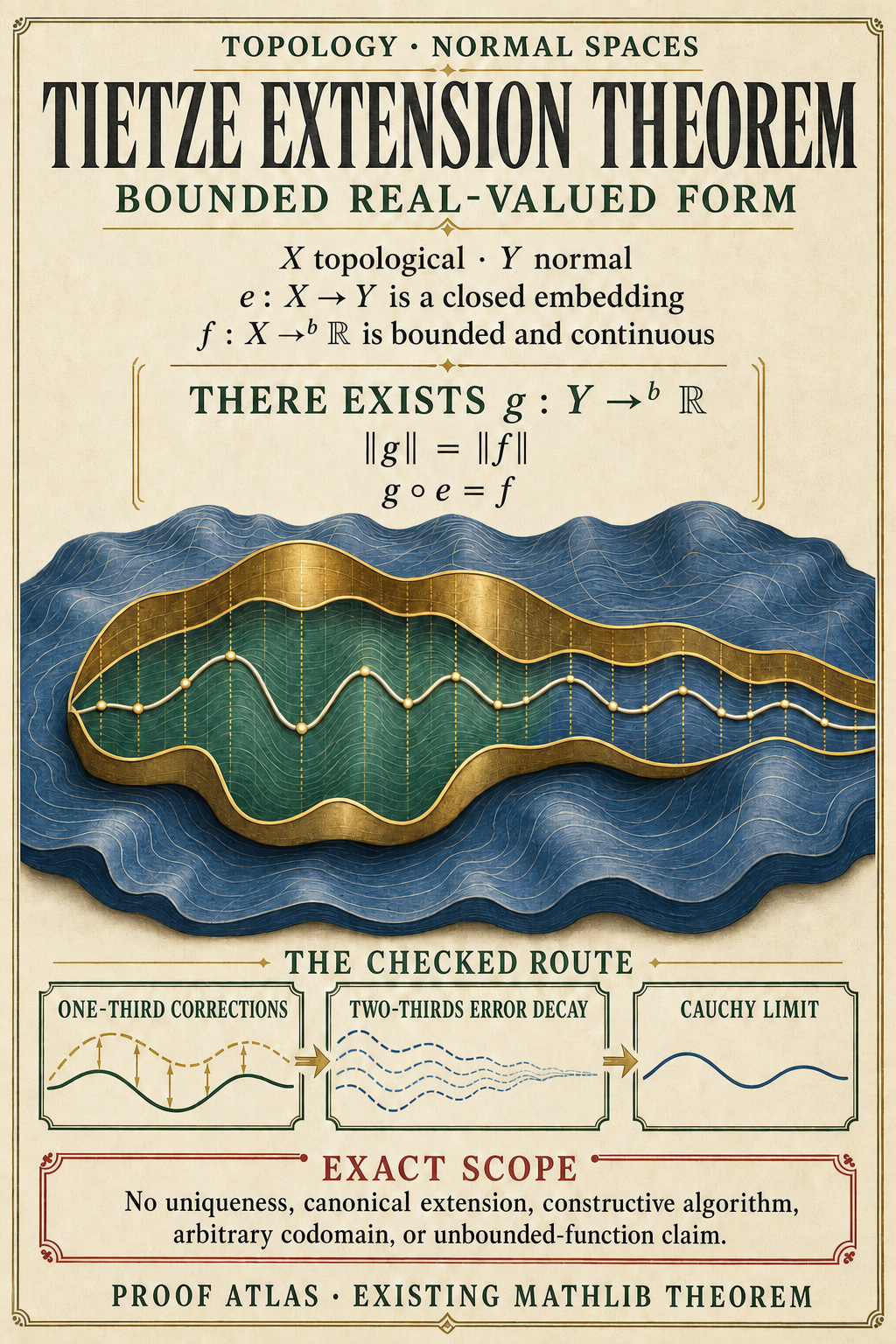
Detailed visual description
The theorem block retains the exact composition and norm-equality conclusion. A sealed embedded region shares one profile and one gold norm envelope with the surrounding normal space, while the source-visible proof route is summarized by one-third corrections, two-thirds error decay, and a Cauchy limit.
Formal orientation
Statement map
This deterministic map orients the reader from the mathematical summary to the pinned declaration and exact checked form. The HTML statement below is authoritative.
Tietze Extension Theorem — Bounded Real-Valued Form — scientific diagram
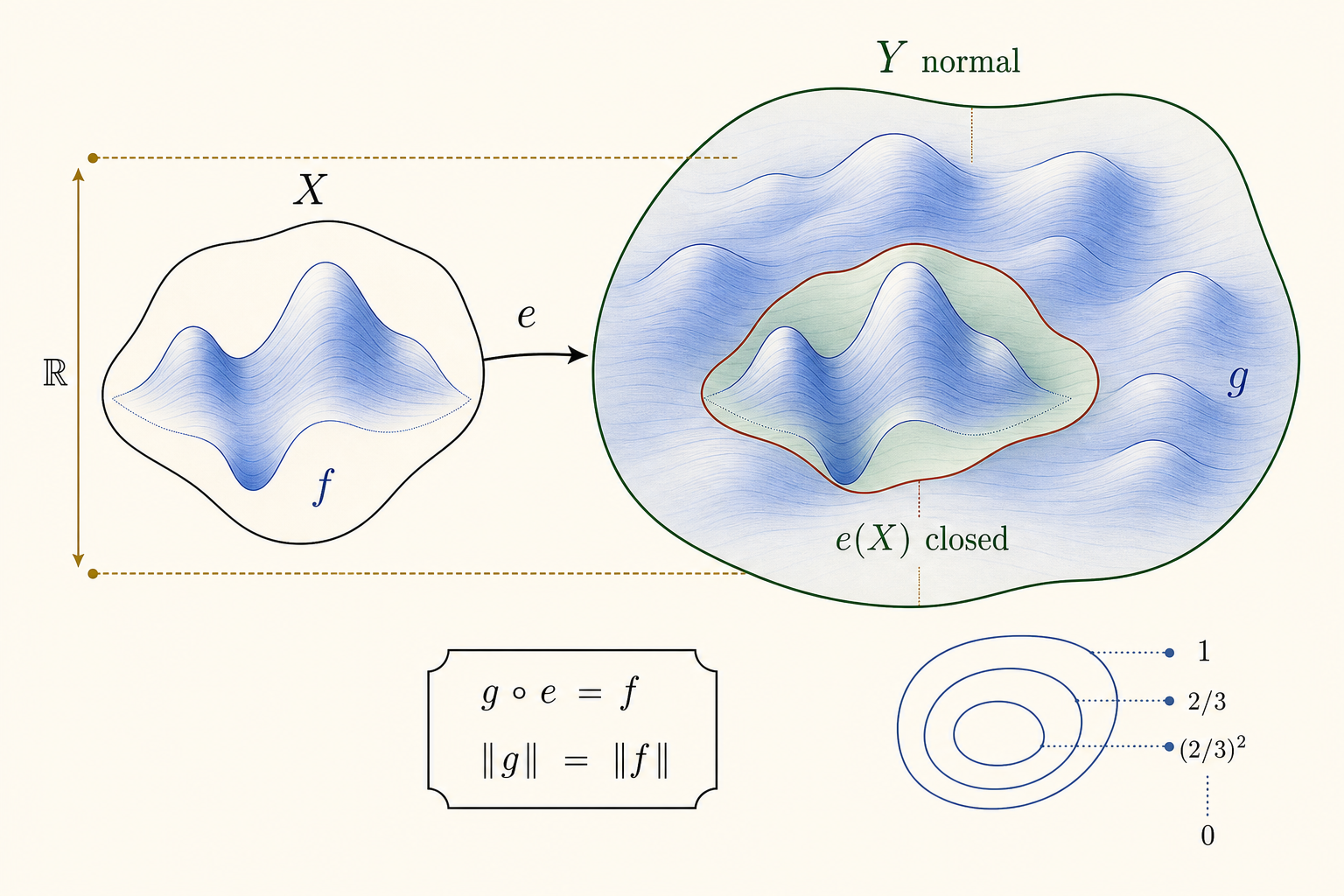
Detailed visual description
This target indexes Mathlib's bounded real-valued Tietze extension theorem in closed-embedding form. For topological spaces X and Y with Y normal, a bounded continuous f : X →ᵇ ℝ and a closed embedding e : X → Y admit a bounded continuous g : Y →ᵇ ℝ with ‖g‖ = ‖f‖ and g ∘ e = f. It is not the unbounded-function theorem, an arbitrary-codomain theorem, a uniqueness statement, or a canonical or constructive extension algorithm.
Complementary intuition
A mathematical landmark
Tietze extension is a central theorem of general topology: normality lets real-valued continuous data on a closed part continue across the ambient space. Mathlib's selected bounded form makes the quantitative strength explicit by preserving the supremum norm exactly.
The low-text schematic gives the theorem a visual identity; it does not replace the source-bound poster or exact statement.
Authoritative formal type
Exact Mathlib statement
theorem BoundedContinuousFunction.exists_extension_norm_eq_of_isClosedEmbedding {X Y : Type*} [TopologicalSpace X] [TopologicalSpace Y] [NormalSpace Y] (f : X →ᵇ ℝ) {e : X → Y} (he : IsClosedEmbedding e) : ∃ g : Y →ᵇ ℝ, ‖g‖ = ‖f‖ ∧ g ∘ e = fSelected evidence declaration text
theorem BoundedContinuousFunction.exists_extension_norm_eq_of_isClosedEmbedding {X Y : Type*} [TopologicalSpace X] [TopologicalSpace Y] [NormalSpace Y] (f : X →ᵇ ℝ) {e : X → Y} (he : IsClosedEmbedding e) : ∃ g : Y →ᵇ ℝ, ‖g‖ = ‖f‖ ∧ g ∘ e = fProofAtlas record
What has been checked
These states distinguish upstream identity, local reproduction, review, and Atlas acceptance. This page is part of the public, read-only Mathlib landmark collection.
Claim boundary
No new theorem is claimed
This target indexes Mathlib's bounded real-valued Tietze extension theorem in closed-embedding form. For topological spaces X and Y with Y normal, a bounded continuous f : X →ᵇ ℝ and a closed embedding e : X → Y admit a bounded continuous g : Y →ᵇ ℝ with ‖g‖ = ‖f‖ and g ∘ e = f. It is not the unbounded-function theorem, an arbitrary-codomain theorem, a uniqueness statement, or a canonical or constructive extension algorithm.
- The selected declaration concerns bounded continuous functions with codomain ℝ.
- Its domain enters the normal ambient space through a closed embedding.
- It proves existence with exact norm equality and exact bundled composition, not uniqueness or canonicity.
- It does not provide a constructive numerical extension algorithm.
- It is not the file's separate unbounded-function or arbitrary TietzeExtension-codomain formulation.
- ProofAtlas is indexing an existing Mathlib theorem, not claiming new mathematics.
Provenance
Origin and evidence stay separate
- Existing declaration
BoundedContinuousFunction.exists_extension_norm_eq_of_isClosedEmbeddingin mathlib- Relationship
- The checked artifact is the upstream declaration itself
- Preferred checked artifact
artifact.library.mathlib.tietze-extension-theorem.v001- Source handling
- Verified upstream reference; no mirrored source package