Geometry · existing Mathlib declaration
Thales’ Theorem
Fix a sphere and two points already known to be endpoints of one of its diameters. For any point p₂, the angle from the first endpoint through p₂ to the other endpoint is a right angle if and only if p₂ lies on the sphere.
- spheres
- diameters
- right angles
- affine inner-product spaces
- sphere membership
The theorem at a glance
Thales’ Theorem at a glance
A source-bound editorial overview of the exact Mathlib formulation. The image is explanatory; the statement map, formal type, and pinned source remain authoritative.
Thales’ Theorem at a glance
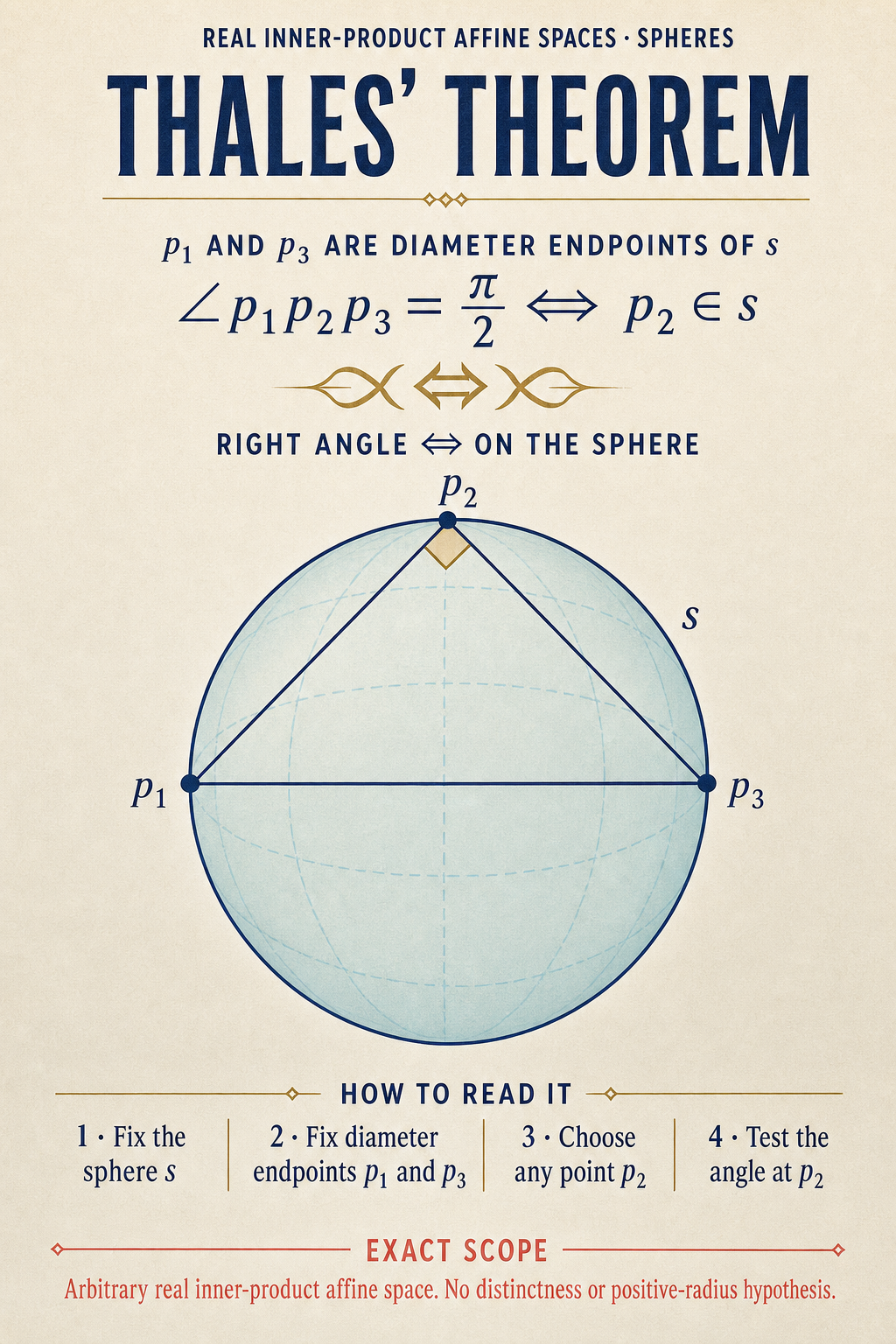
Detailed visual description
The poster pairs the exact equivalence with a single spherical boundary: p₁ and p₃ are antipodal endpoints of a centered diameter, p₂ lies on the same boundary, and its two chords meet at a right-angle marker. The footer preserves the arbitrary real inner-product affine-space scope and the absence of distinctness or positive-radius hypotheses.
Formal orientation
Statement map
This deterministic map orients the reader from the mathematical summary to the pinned declaration and exact checked form. The HTML statement below is authoritative.
Thales’ Theorem — scientific diagram
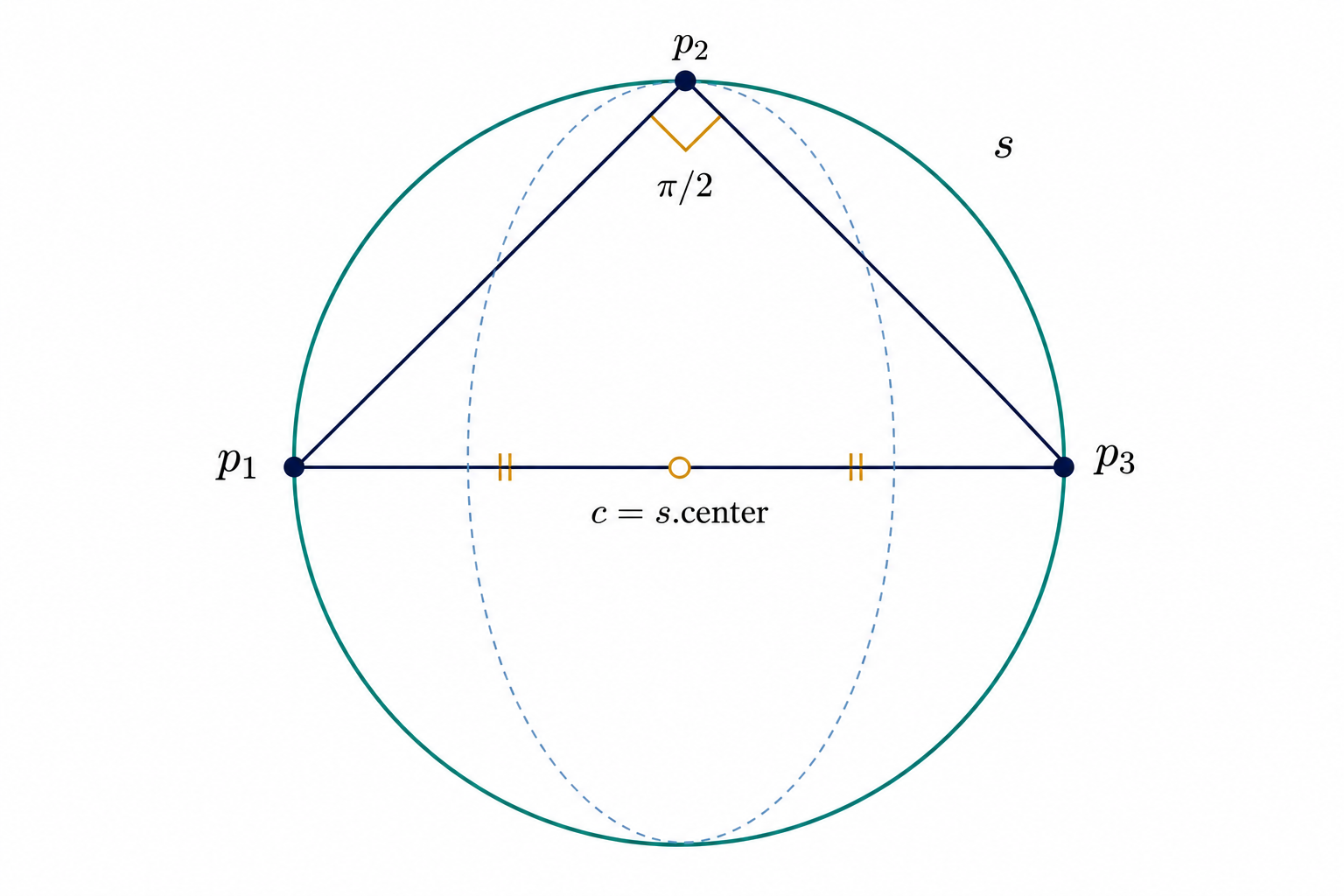
Detailed visual description
This page indexes Mathlib’s theorem for a metric affine space P modeled on a real inner-product space V. Once s.IsDiameter p₁ p₃ is given, the declaration proves ∠p₁p₂p₃ = π/2 if and only if p₂ ∈ s. It has no dimension-two, pairwise-distinctness, or positive-radius hypothesis. A planar great-circle picture is an illustrative cross-section, not the theorem’s full scope. The selected declaration does not prove the nearby two-dimensional result that recovers a diameter from three points already lying on an arbitrary sphere.
Complementary intuition
A mathematical landmark
Thales’ theorem is a foundational bridge between incidence and orthogonality. Mathlib states the result as an exact two-way sphere-membership equivalence in an arbitrary real inner-product affine space, and its proof exposes the inner-product identity behind the familiar great-circle picture.
The low-text schematic gives the theorem a visual identity; it does not replace the source-bound poster or exact statement.
Authoritative formal type
Exact Mathlib statement
theorem EuclideanGeometry.Sphere.angle_eq_pi_div_two_iff_mem_sphere_of_isDiameter {V : Type*} {P : Type*} [NormedAddCommGroup V] [InnerProductSpace ℝ V] [MetricSpace P] [NormedAddTorsor V P] {p₁ p₂ p₃ : P} {s : EuclideanGeometry.Sphere P} (hd : s.IsDiameter p₁ p₃) : ∠ p₁ p₂ p₃ = π / 2 ↔ p₂ ∈ sSelected evidence declaration text
theorem EuclideanGeometry.Sphere.angle_eq_pi_div_two_iff_mem_sphere_of_isDiameter {V : Type*} {P : Type*} [NormedAddCommGroup V] [InnerProductSpace ℝ V] [MetricSpace P] [NormedAddTorsor V P] {p₁ p₂ p₃ : P} {s : EuclideanGeometry.Sphere P} (hd : s.IsDiameter p₁ p₃) : ∠ p₁ p₂ p₃ = π / 2 ↔ p₂ ∈ sProofAtlas record
What has been checked
These states distinguish upstream identity, local reproduction, review, and Atlas acceptance. This page is part of the public, read-only Mathlib landmark collection.
Claim boundary
No new theorem is claimed
This page indexes Mathlib’s theorem for a metric affine space P modeled on a real inner-product space V. Once s.IsDiameter p₁ p₃ is given, the declaration proves ∠p₁p₂p₃ = π/2 if and only if p₂ ∈ s. It has no dimension-two, pairwise-distinctness, or positive-radius hypothesis. A planar great-circle picture is an illustrative cross-section, not the theorem’s full scope. The selected declaration does not prove the nearby two-dimensional result that recovers a diameter from three points already lying on an arbitrary sphere.
- ProofAtlas did not originate Thales’ theorem or Mathlib’s declaration.
- The selected declaration is not restricted to planar circles or finite-dimensional spaces.
- The page does not add pairwise-distinctness or positive-radius hypotheses that are absent from the formal type.
- It does not assert the separate two-dimensional converse that a right angle among three points on an arbitrary sphere forces the first and third points to be diameter endpoints.
- The generated explanation and visuals are not proof evidence.
Provenance
Origin and evidence stay separate
- Existing declaration
EuclideanGeometry.Sphere.angle_eq_pi_div_two_iff_mem_sphere_of_isDiameterin mathlib- Relationship
- The checked artifact is the upstream declaration itself
- Preferred checked artifact
artifact.library.mathlib.thales-theorem.v001- Source handling
- Verified upstream reference; no mirrored source package