Combinatorics · existing Mathlib declaration
Roth’s Theorem
Among the first N natural numbers, a set that avoids every nontrivial three-term arithmetic progression must occupy a proportion that tends to zero as N grows.
- three-term arithmetic progressions
- asymptotic density
- Roth numbers
- corners theorem
- triangle removal
The theorem at a glance
Roth’s Theorem at a glance
A source-bound editorial overview of the exact Mathlib formulation. The image is explanatory; the statement map, formal type, and pinned source remain authoritative.
Roth’s Theorem at a glance
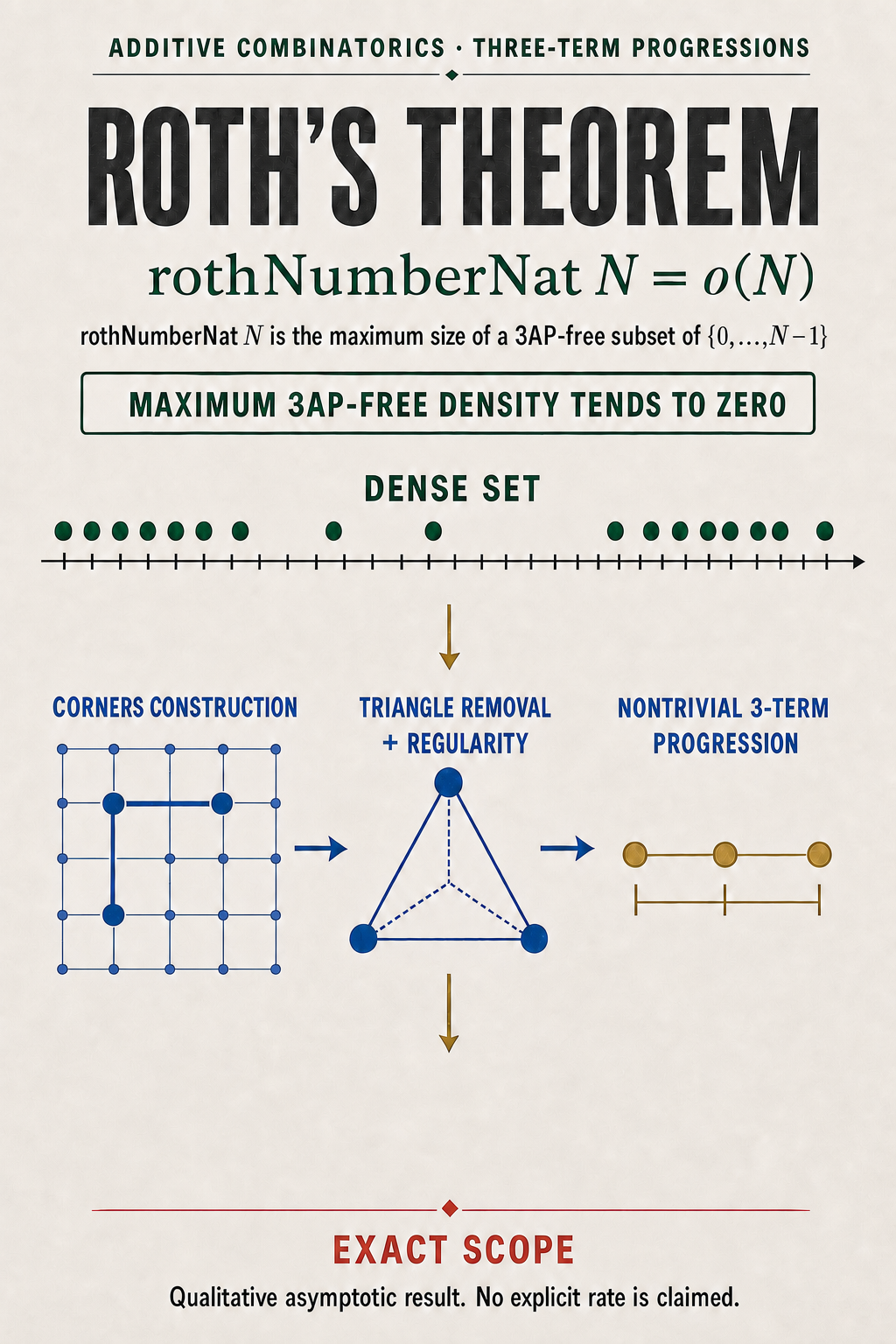
Detailed visual description
The poster defines rothNumberNat, places the qualitative little-o conclusion at the top, and follows the retained source architecture from a dense subset through a grid corner and triangle-removal/regularity motif to three exactly equally spaced points. The exact-scope footer rules out an explicit rate.
Formal orientation
Statement map
This deterministic map orients the reader from the mathematical summary to the pinned declaration and exact checked form. The HTML statement below is authoritative.
Roth’s Theorem — scientific diagram
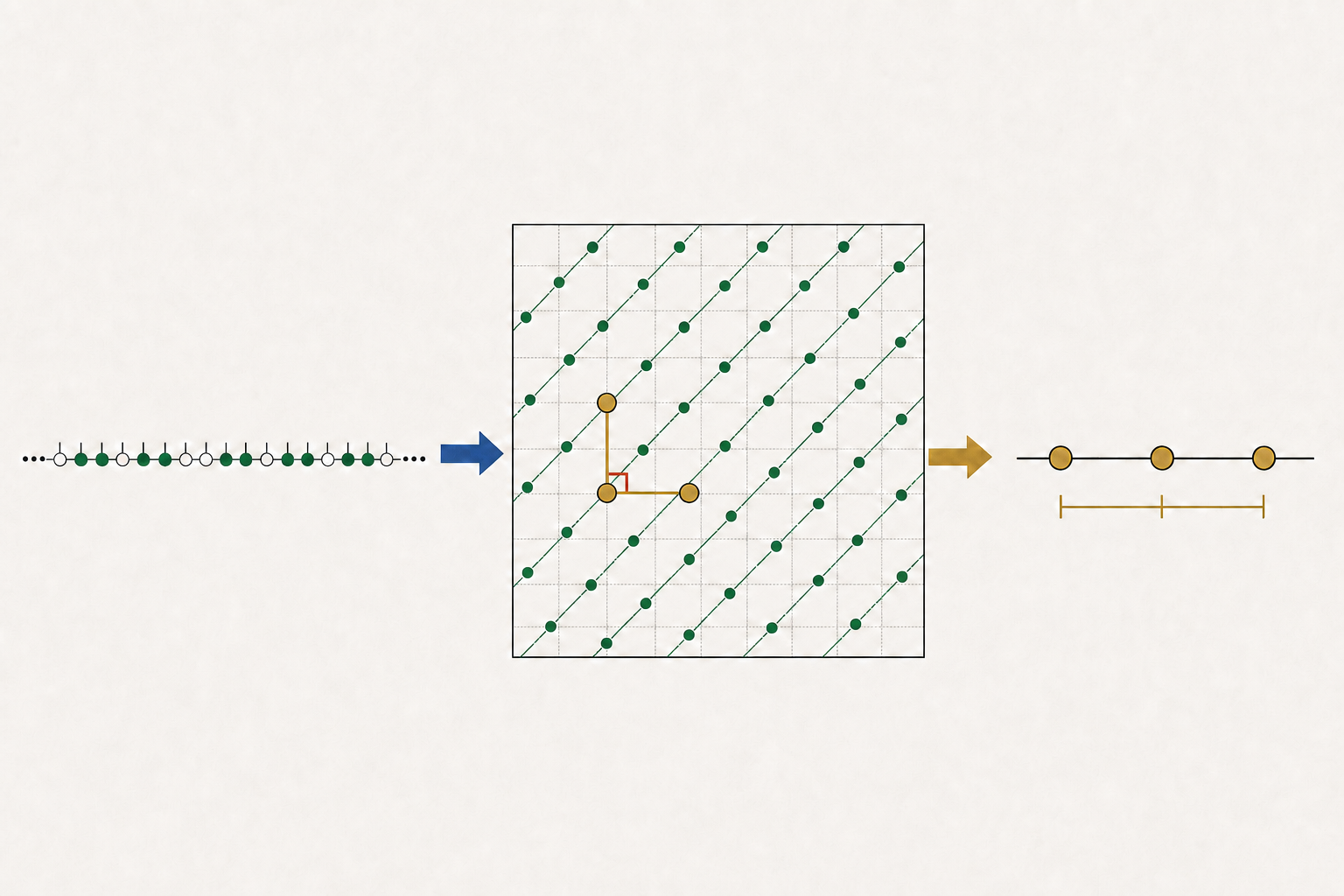
Detailed visual description
This page indexes Mathlib’s qualitative asymptotic declaration for the natural-number Roth function. Here rothNumberNat N is the maximum cardinality of a ThreeAPFree subset of Finset.range N = {0,…,N−1}, and ThreeAPFree excludes nontrivial a,b,c in the set with a+c=b+b. The exact conclusion is an IsLittleO atTop relation after coercion to ℝ. It does not state an explicit decay rate, a finite threshold, a modern quantitative bound, or a theorem about longer progressions.
Complementary intuition
A mathematical landmark
Roth’s theorem is a foundational density result in additive combinatorics. Mathlib’s retained route connects one-dimensional three-term progressions to two-dimensional corners, triangle removal, and Szemerédi regularity.
The low-text schematic gives the theorem a visual identity; it does not replace the source-bound poster or exact statement.
Authoritative formal type
Exact Mathlib statement
theorem rothNumberNat_isLittleO_id : IsLittleO atTop (fun N ↦ (rothNumberNat N : ℝ)) (fun N ↦ (N : ℝ))Selected evidence declaration text
theorem rothNumberNat_isLittleO_id : IsLittleO atTop (fun N ↦ (rothNumberNat N : ℝ)) (fun N ↦ (N : ℝ))ProofAtlas record
What has been checked
These states distinguish upstream identity, local reproduction, review, and Atlas acceptance. This page is part of the public, read-only Mathlib landmark collection.
Claim boundary
No new theorem is claimed
This page indexes Mathlib’s qualitative asymptotic declaration for the natural-number Roth function. Here rothNumberNat N is the maximum cardinality of a ThreeAPFree subset of Finset.range N = {0,…,N−1}, and ThreeAPFree excludes nontrivial a,b,c in the set with a+c=b+b. The exact conclusion is an IsLittleO atTop relation after coercion to ℝ. It does not state an explicit decay rate, a finite threshold, a modern quantitative bound, or a theorem about longer progressions.
- Proof Atlas did not originate Roth’s theorem or Mathlib’s declaration.
- The selected declaration gives no explicit rate or numerical threshold.
- The selected endpoint concerns three-term arithmetic progressions, not arbitrary progression lengths.
- The generated explanation and visuals are not proof evidence.
Provenance
Origin and evidence stay separate
- Existing declaration
rothNumberNat_isLittleO_idin mathlib- Relationship
- The checked artifact is the upstream declaration itself
- Preferred checked artifact
artifact.library.mathlib.roth-theorem.v001- Source handling
- Verified upstream reference; no mirrored source package