Computability and logic · existing Mathlib declaration
Rice's Theorem
Suppose a semantic property of partial functions can be decided computably from program codes. If one partial-recursive function has that property, then every partial-recursive function has it.
- program code
- partial recursive function
- semantic property
- computable predicate
- semantic undecidability
The theorem at a glance
Rice's theorem at a glance
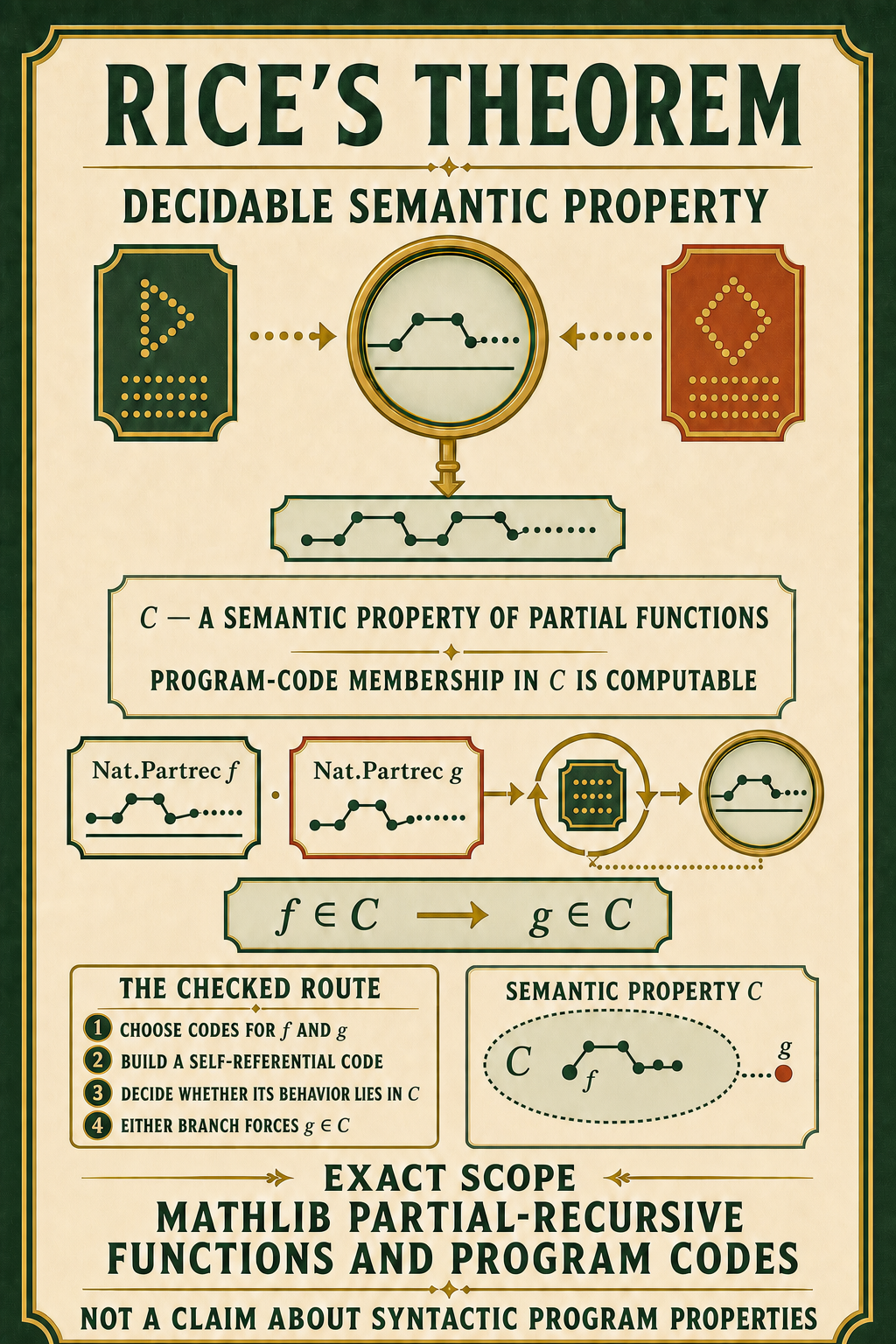
A source-bound editorial overview of the exact Mathlib formulation. The image is explanatory; the statement map, formal type, and pinned source remain authoritative.
Rice's theorem at a glance
Detailed visual description
Program-code plaques feed into behavioral traces. The exact implication is dominant: computable code membership, Nat.Partrec f, Nat.Partrec g, and f ∈ C lead through a self-referential code to g ∈ C. The poster explicitly excludes syntactic program properties.
Formal orientation
Statement map
This deterministic map orients the reader from the mathematical summary to the pinned declaration and exact checked form. The HTML statement below is authoritative.
Rice's Theorem — scientific diagram
Detailed visual description
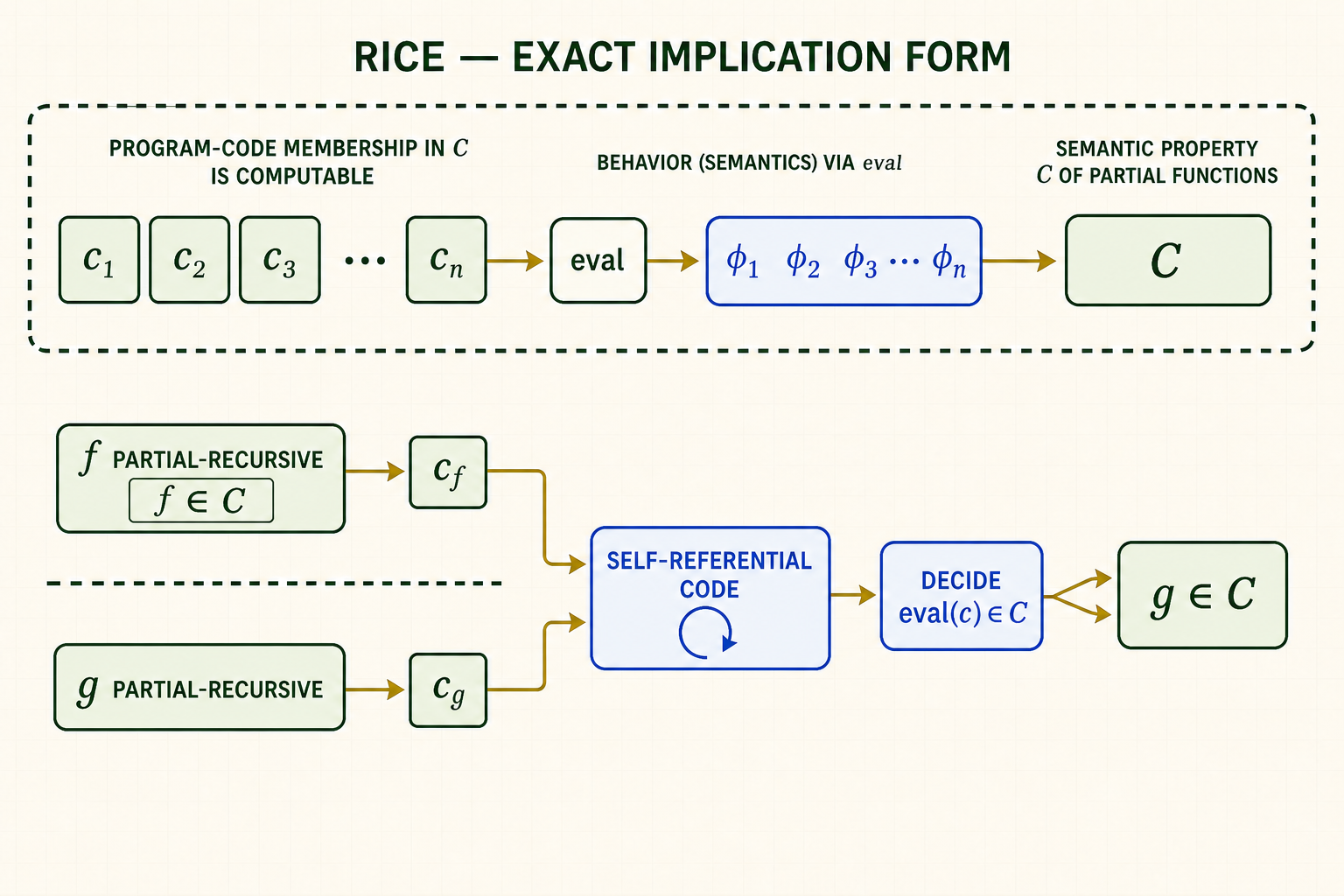
This target indexes Mathlib's implication form of Rice's theorem. For a semantic property C of partial functions, assume program-code membership through eval is computable. If one partial-recursive f belongs to C, then every partial-recursive g belongs to C. It is specific to Mathlib's partial-function and program-code model and does not classify arbitrary syntactic code properties or all noncomputable semantic properties.
Complementary intuition
A mathematical landmark
Rice's theorem draws a foundational boundary around algorithmic reasoning about programs: a computable decision procedure cannot separate partial-recursive functions by a nontrivial semantic property. Mathlib's selected endpoint proves this through a self-referential code in its partial-evaluation model.
The low-text schematic gives the theorem a visual identity; it does not replace the source-bound poster or exact statement.
Authoritative formal type
Exact Mathlib statement
theorem ComputablePred.rice (C : Set (ℕ →. ℕ)) (h : ComputablePred fun c => Nat.Partrec.Code.eval c ∈ C) {f g} (hf : Nat.Partrec f) (hg : Nat.Partrec g) (fC : f ∈ C) : g ∈ CSelected evidence declaration text
theorem ComputablePred.rice (C : Set (ℕ →. ℕ)) (h : ComputablePred fun c => Nat.Partrec.Code.eval c ∈ C) {f g} (hf : Nat.Partrec f) (hg : Nat.Partrec g) (fC : f ∈ C) : g ∈ CProofAtlas record
What has been checked
These states distinguish upstream identity, local reproduction, review, and Atlas acceptance. This page is part of the public, read-only Mathlib landmark collection.
Claim boundary
No new theorem is claimed
This target indexes Mathlib's implication form of Rice's theorem. For a semantic property C of partial functions, assume program-code membership through eval is computable. If one partial-recursive f belongs to C, then every partial-recursive g belongs to C. It is specific to Mathlib's partial-function and program-code model and does not classify arbitrary syntactic code properties or all noncomputable semantic properties.
- Proof Atlas did not originate Rice's theorem or Mathlib's declaration.
- The formal statement is tied to Mathlib's `Nat.Partrec` and `Nat.Partrec.Code` representation, not every machine model simultaneously.
- The hypothesis decides a property of evaluated partial functions from their program codes; the theorem does not classify arbitrary syntactic properties of codes.
- The conclusion ranges over partial-recursive f and g, not all arbitrary partial functions.
- This endpoint is a one-way implication, not the separate rice₂ empty-or-universal equivalence.
- The generated explanation and visuals are not proof evidence.
Provenance
Origin and evidence stay separate
- Existing declaration
ComputablePred.ricein mathlib- Relationship
- The checked artifact is the upstream declaration itself
- Preferred checked artifact
artifact.library.mathlib.rice-theorem.v001- Source handling
- Verified upstream reference; no mirrored source package