Algebra · existing Mathlib declaration
Primitive Element Theorem
If E is a finite-dimensional separable extension of a field F, then one can choose an element α of E such that adjoining α to F produces all of E. The generator exists, but the theorem does not say that it is unique or canonical.
- field extensions
- primitive elements
- finite-dimensional extensions
- separable extensions
- simple extensions
- intermediate fields
The theorem at a glance
Primitive element theorem at a glance
A source-bound editorial overview of the exact Mathlib formulation. The image is explanatory; the statement map, formal type, and pinned source remain authoritative.
Primitive element theorem at a glance
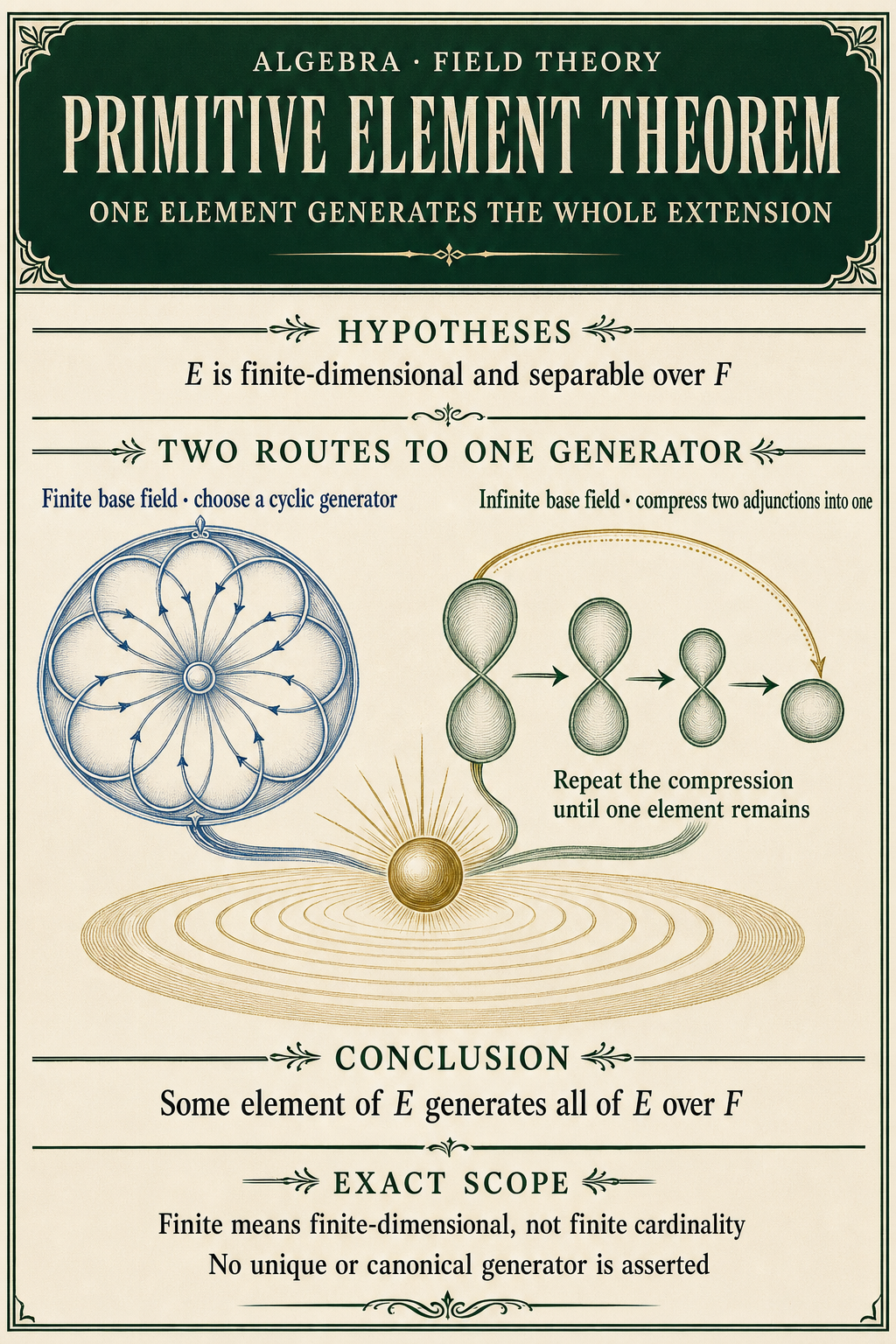
Detailed visual description
The poster states the finite-dimensional separable hypotheses, contrasts the cyclic-generator route for finite base fields with simple-adjoin compression over infinite base fields, brings both routes to one gold generator, and closes with the theorem's exact non-uniqueness and non-cardinality boundary.
Formal orientation
Statement map
This deterministic map orients the reader from the mathematical summary to the pinned declaration and exact checked form. The HTML statement below is authoritative.
Primitive Element Theorem — scientific diagram
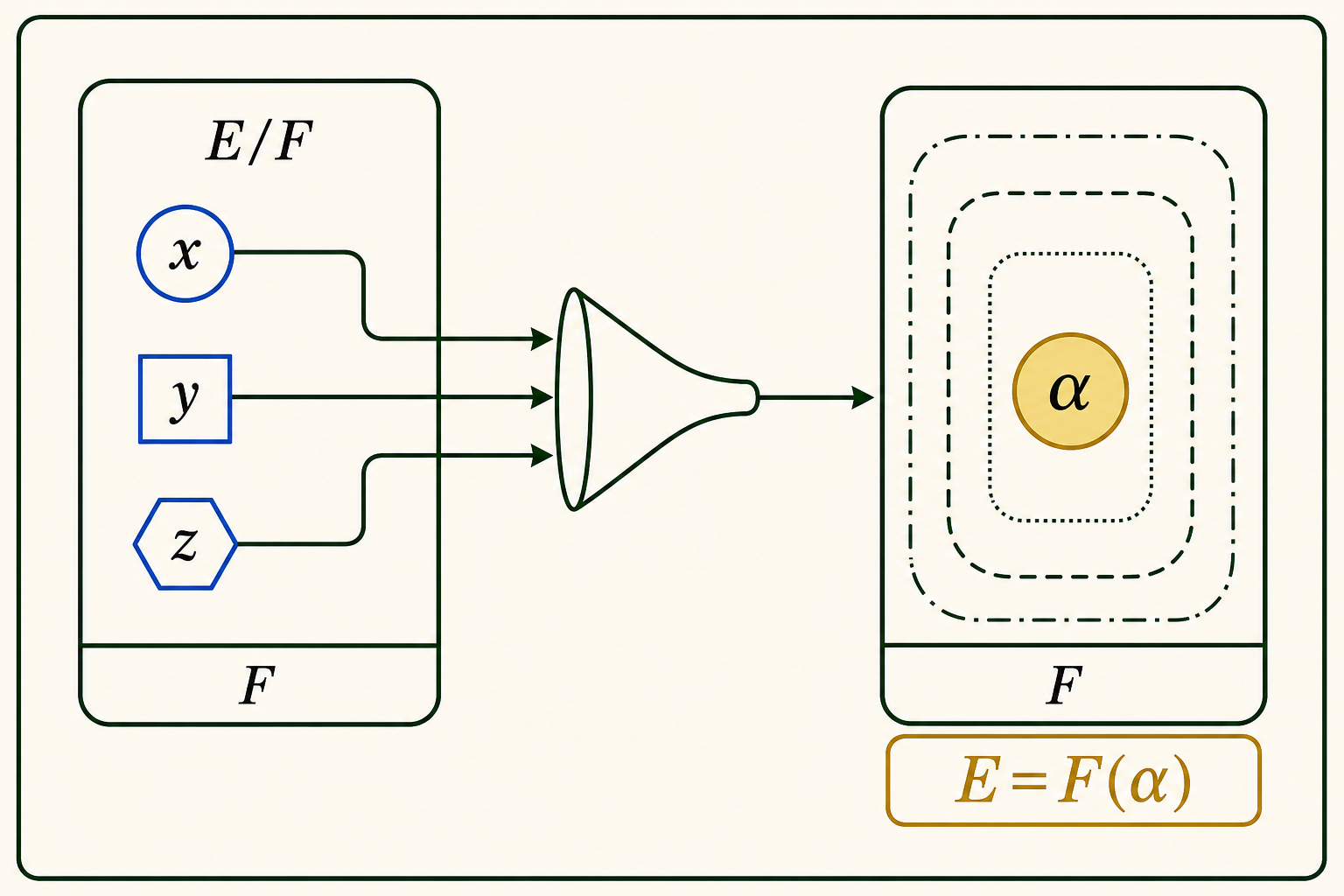
Detailed visual description
This target indexes Mathlib's existence theorem for a primitive element of a finite-dimensional separable field extension E/F: some α : E satisfies F⟮α⟯ = ⊤. Finite means finite-dimensional, not finite cardinality. The result does not assert uniqueness or canonicity of α and does not cover general inseparable extensions.
Complementary intuition
A mathematical landmark
The primitive element theorem compresses a finite-dimensional separable extension from many possible generators to one. It is a foundational bridge between abstract field extensions and the concrete study of a single minimal polynomial.
The low-text schematic gives the theorem a visual identity; it does not replace the source-bound poster or exact statement.
Authoritative formal type
Exact Mathlib statement
theorem Field.exists_primitive_element (F E : Type*) [Field F] [Field E] [Algebra F E] [FiniteDimensional F E] [Algebra.IsSeparable F E] : ∃ α : E, F⟮α⟯ = ⊤Selected evidence declaration text
theorem Field.exists_primitive_element (F E : Type*) [Field F] [Field E] [Algebra F E] [FiniteDimensional F E] [Algebra.IsSeparable F E] : ∃ α : E, F⟮α⟯ = ⊤ProofAtlas record
What has been checked
These states distinguish upstream identity, local reproduction, review, and Atlas acceptance. This page is part of the public, read-only Mathlib landmark collection.
Claim boundary
No new theorem is claimed
This target indexes Mathlib's existence theorem for a primitive element of a finite-dimensional separable field extension E/F: some α : E satisfies F⟮α⟯ = ⊤. Finite means finite-dimensional, not finite cardinality. The result does not assert uniqueness or canonicity of α and does not cover general inseparable extensions.
- Proof Atlas did not originate the primitive element theorem or Mathlib's proof.
- The theorem does not choose a unique, canonical, or computationally preferred generator.
- The generated explanation and visuals are not proof evidence.
Provenance
Origin and evidence stay separate
- Existing declaration
Field.exists_primitive_elementin mathlib- Relationship
- The checked artifact is the upstream declaration itself
- Preferred checked artifact
artifact.library.mathlib.primitive-element-theorem.v001- Source handling
- Verified upstream reference; no mirrored source package