Analysis · existing Mathlib declaration
Poisson Summation Formula
Periodize a continuous complex-valued function by adding all of its integer translates. If those translates are summable uniformly in sup norm on every compact and the Fourier transform is summable at the integers, then the periodized value at x is reconstructed from those Fourier samples with the phase determined by x modulo one.
- Poisson summation
- Fourier transform
- periodization
- integer lattices
- Fourier series
- compact-uniform summability
The theorem at a glance
Poisson Summation Formula at a glance
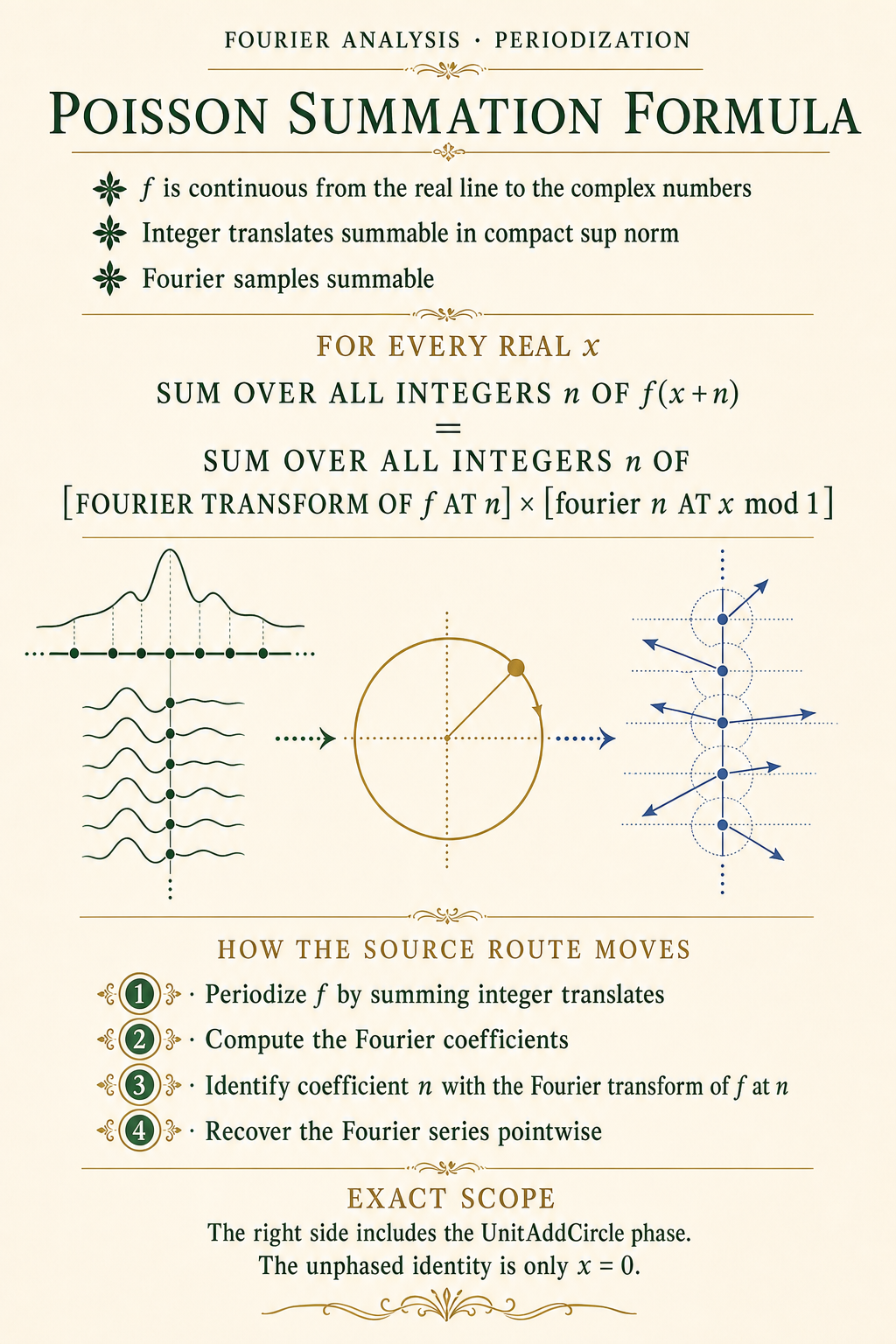
A source-bound editorial overview of the exact Mathlib formulation. The image is explanatory; the statement map, formal type, and pinned source remain authoritative.
Poisson Summation Formula at a glance
Detailed visual description
The poster states the exact general-x relation in words, keeps continuity and both summability hypotheses prominent, and uses an unlabeled spatial-lattice to period-circle to frequency-lattice diagram. Four source-route movements explain coefficient identification and pointwise Fourier recovery, while the footer reserves the unphased identity for x equals zero.
Formal orientation
Statement map
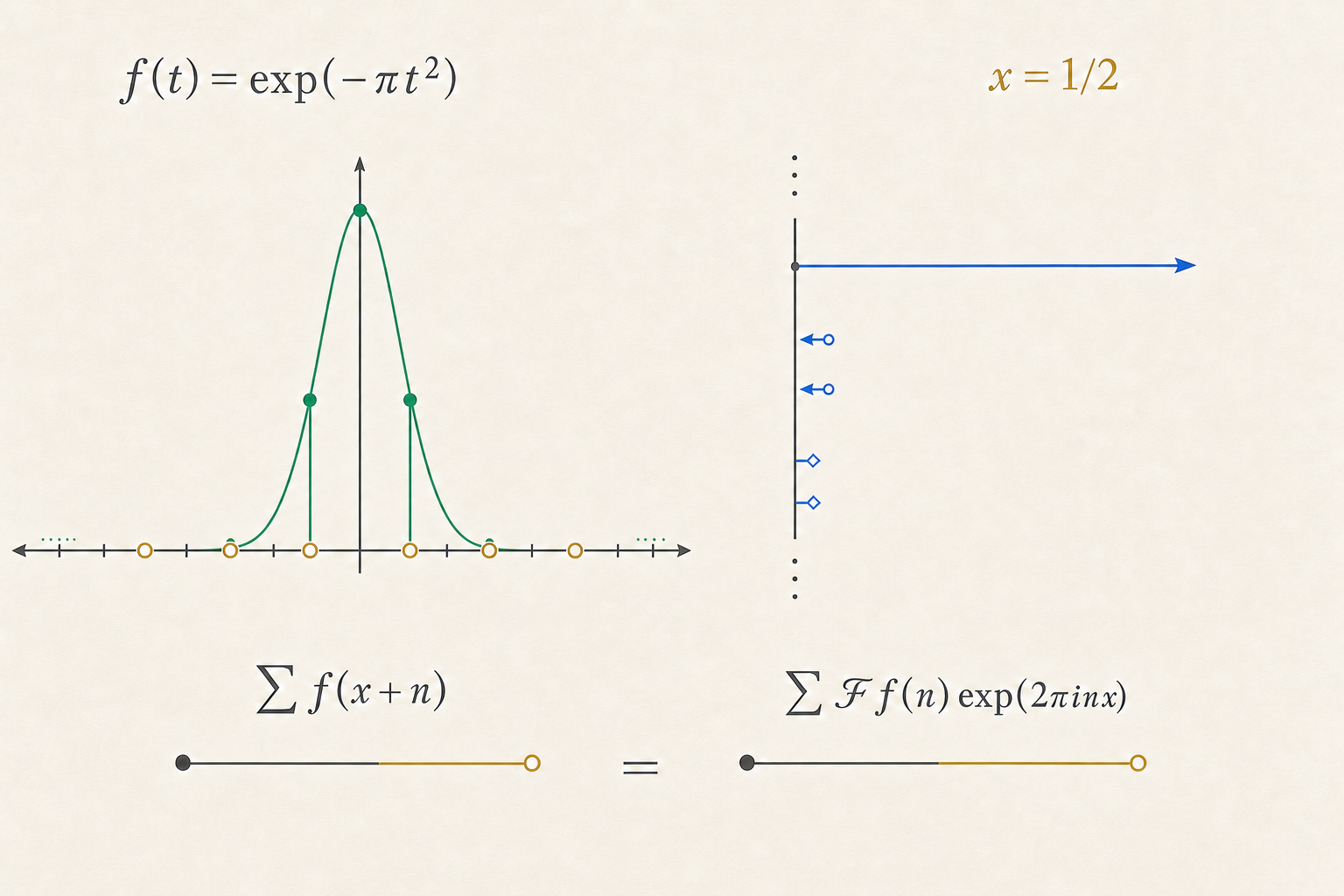
This deterministic map orients the reader from the mathematical summary to the pinned declaration and exact checked form. The HTML statement below is authoritative.
Poisson Summation Formula — scientific diagram
Detailed visual description
This page indexes Mathlib's general one-dimensional Poisson summation declaration for a continuous map f : ℝ → ℂ. It assumes that, for every compact K, the series of sup norms of the integer translates restricted to K is summable, and that the series of integer Fourier-transform samples is summable. The conclusion holds at every real x and weights each Fourier sample by fourier n at x viewed in UnitAddCircle. The familiar unphased formula is the x = 0 specialization, not the displayed conclusion at arbitrary x.
Complementary intuition
A mathematical landmark
Poisson summation is a central bridge between spatial and frequency lattices. It converts a sum of translates into a Fourier series and underlies theta-function identities, sampling arguments, analytic number theory, and many duality calculations.
The low-text schematic gives the theorem a visual identity; it does not replace the source-bound poster or exact statement.
Authoritative formal type
Exact Mathlib statement
theorem Real.tsum_eq_tsum_fourier {f : C(ℝ, ℂ)} (h_norm : ∀ K : Compacts ℝ, Summable fun n : ℤ => ‖(f.comp <| ContinuousMap.addRight n).restrict K‖) (h_sum : Summable fun n : ℤ => 𝓕 (f : ℝ → ℂ) n) (x : ℝ) : ∑' n : ℤ, f (x + n) = ∑' n : ℤ, 𝓕 (f : ℝ → ℂ) n * fourier n (x : UnitAddCircle)Selected evidence declaration text
theorem Real.tsum_eq_tsum_fourier {f : C(ℝ, ℂ)} (h_norm : ∀ K : Compacts ℝ, Summable fun n : ℤ => ‖(f.comp <| ContinuousMap.addRight n).restrict K‖) (h_sum : Summable fun n : ℤ => 𝓕 (f : ℝ → ℂ) n) (x : ℝ) : ∑' n : ℤ, f (x + n) = ∑' n : ℤ, 𝓕 (f : ℝ → ℂ) n * fourier n (x : UnitAddCircle)ProofAtlas record
What has been checked
These states distinguish upstream identity, local reproduction, review, and Atlas acceptance. This page is part of the public, read-only Mathlib landmark collection.
Claim boundary
No new theorem is claimed
This page indexes Mathlib's general one-dimensional Poisson summation declaration for a continuous map f : ℝ → ℂ. It assumes that, for every compact K, the series of sup norms of the integer translates restricted to K is summable, and that the series of integer Fourier-transform samples is summable. The conclusion holds at every real x and weights each Fourier sample by fourier n at x viewed in UnitAddCircle. The familiar unphased formula is the x = 0 specialization, not the displayed conclusion at arbitrary x.
- Proof Atlas did not originate the Poisson summation formula or Mathlib's declaration.
- The selected declaration does not remove either summability hypothesis or assert compact support, Schwartz decay, or a convergence rate.
- It is not a distributional, L², higher-dimensional lattice, or finite discrete Fourier transform statement.
- The generated explanation and visuals are not proof evidence.
Provenance
Origin and evidence stay separate
- Existing declaration
Real.tsum_eq_tsum_fourierin mathlib- Relationship
- The checked artifact is the upstream declaration itself
- Preferred checked artifact
artifact.library.mathlib.poisson-summation-formula.v001- Source handling
- Verified upstream reference; no mirrored source package