Number theory · existing Mathlib declaration
Ostrowski's Theorem
Every nontrivial real-valued absolute value on the rational numbers measures size in one of two ways up to rescaling: like the usual real absolute value, or like the p-adic absolute value for one uniquely determined prime p.
- Ostrowski's theorem
- absolute values
- equivalent absolute values
- Archimedean absolute value
- p-adic absolute value
- rational numbers
The theorem at a glance
Ostrowski's theorem — the real class or one unique p-adic class
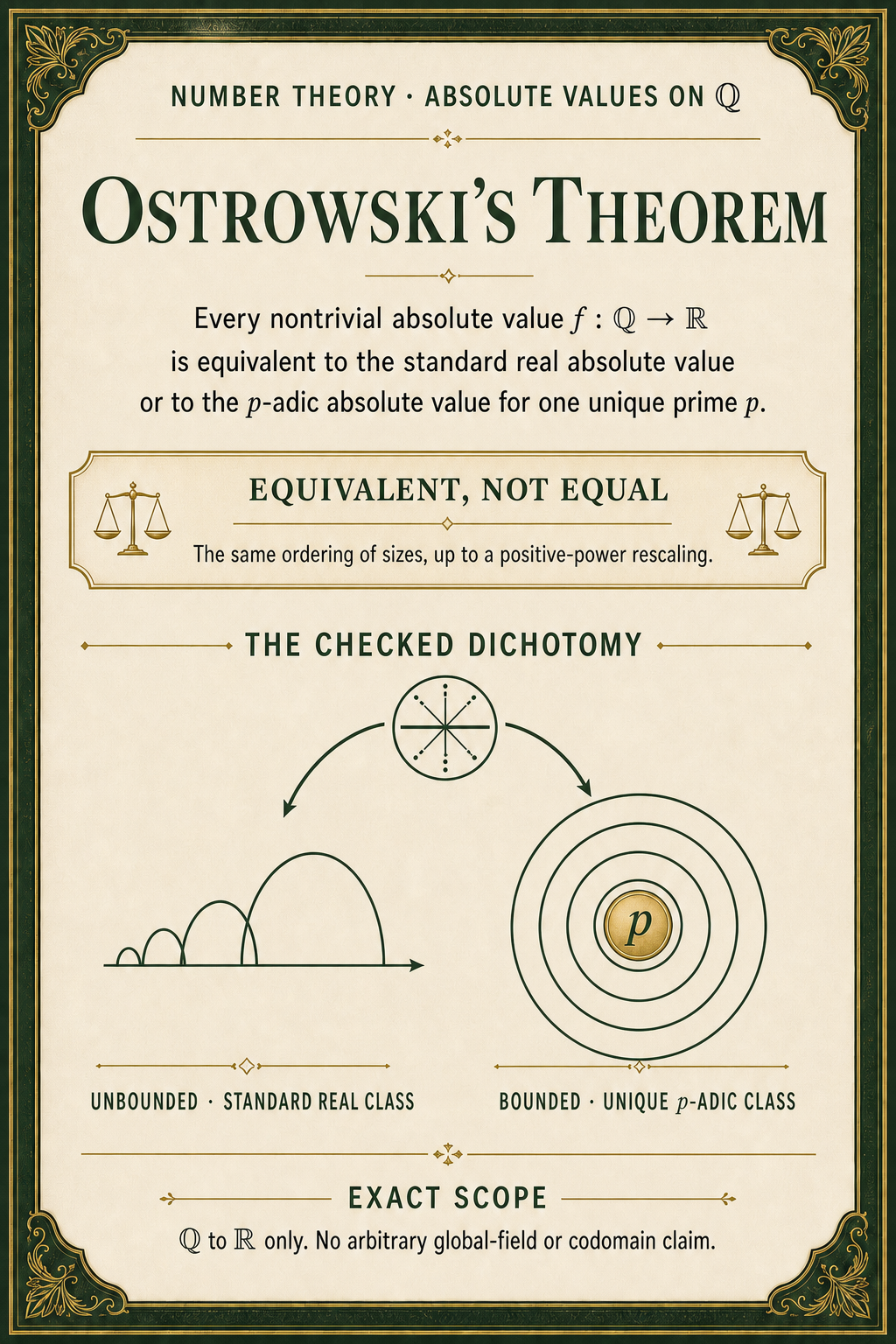
A source-bound editorial overview of the exact Mathlib formulation. The image is explanatory; the statement map, formal type, and pinned source remain authoritative.
Ostrowski's theorem — the real class or one unique p-adic class
Detailed visual description
The sparse engraved poster distinguishes equivalence from equality before splitting a rational fraction-wheel into an unbounded real-distance branch and a bounded nested p-adic branch centered on one gold prime. Its footer keeps the statement within ℚ and ℝ.
Formal orientation
Statement map
This deterministic map orients the reader from the mathematical summary to the pinned declaration and exact checked form. The HTML statement below is authoritative.
Ostrowski's Theorem — scientific diagram
Detailed visual description
This target indexes Mathlib's classification of nontrivial absolute values f : AbsoluteValue ℚ ℝ. The conclusion is equivalence, not equality: f is equivalent to the standard real absolute value, or there is a unique natural number p carrying a prime instance for which f is equivalent to the p-adic absolute value. The declaration concerns ℚ with values in ℝ; it does not classify absolute values over arbitrary global fields or valuations with arbitrary codomains.
Complementary intuition
A mathematical landmark
Ostrowski's theorem gives the definitive classification of nontrivial real-valued absolute values on ℚ, separating the familiar Archimedean size from the p-adic sizes that organize local number theory.
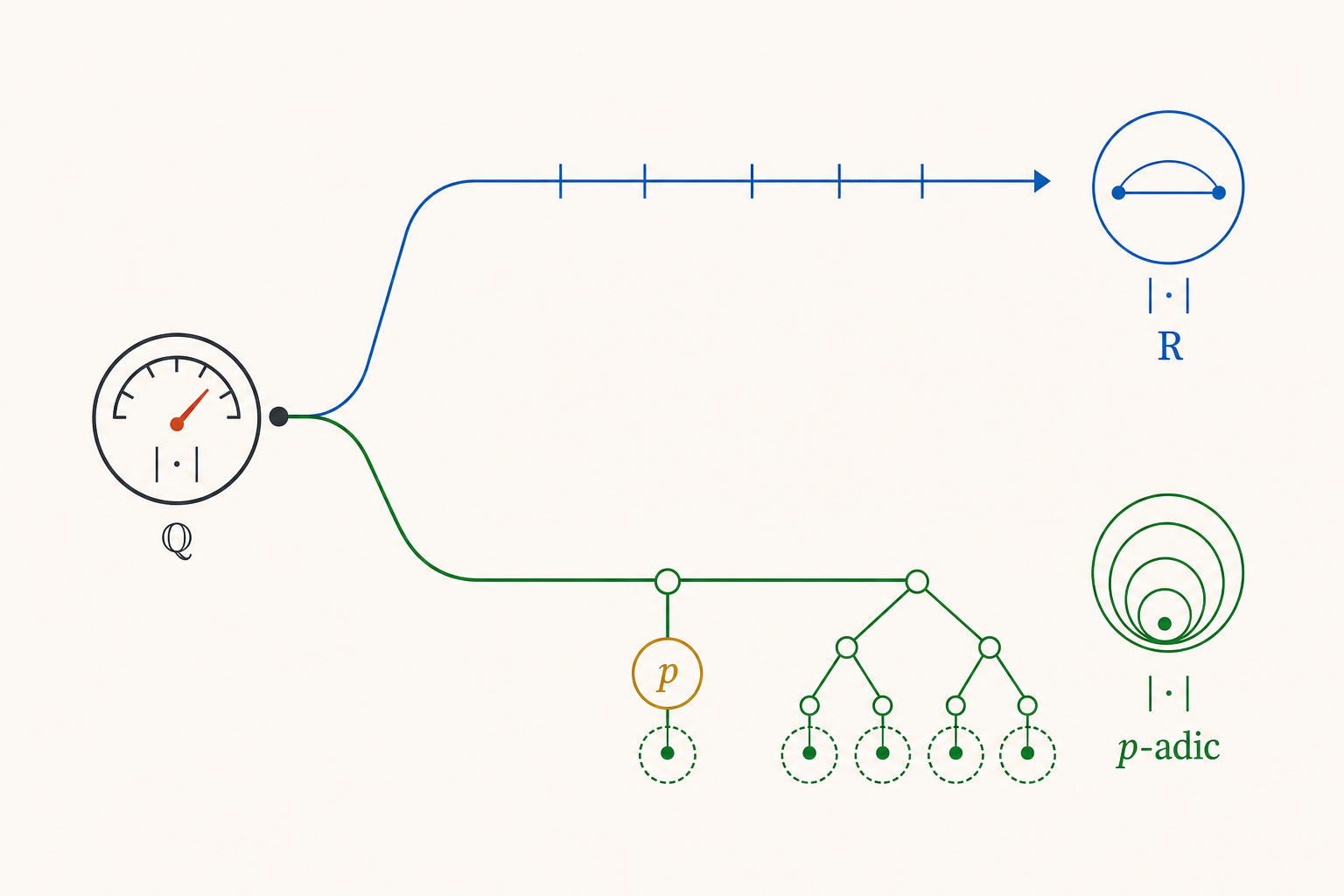
The low-text schematic gives the theorem a visual identity; it does not replace the source-bound poster or exact statement.
Authoritative formal type
Exact Mathlib statement
theorem Rat.AbsoluteValue.equiv_real_or_padic (f : AbsoluteValue ℚ ℝ) (hf_nontriv : f.IsNontrivial) : f ≈ real ∨ ∃! p, ∃ (_ : Fact p.Prime), f ≈ (padic p)Selected evidence declaration text
theorem Rat.AbsoluteValue.equiv_real_or_padic (f : AbsoluteValue ℚ ℝ) (hf_nontriv : f.IsNontrivial) : f ≈ real ∨ ∃! p, ∃ (_ : Fact p.Prime), f ≈ (padic p)ProofAtlas record
What has been checked
These states distinguish upstream identity, local reproduction, review, and Atlas acceptance. This page is part of the public, read-only Mathlib landmark collection.
Claim boundary
No new theorem is claimed
This target indexes Mathlib's classification of nontrivial absolute values f : AbsoluteValue ℚ ℝ. The conclusion is equivalence, not equality: f is equivalent to the standard real absolute value, or there is a unique natural number p carrying a prime instance for which f is equivalent to the p-adic absolute value. The declaration concerns ℚ with values in ℝ; it does not classify absolute values over arbitrary global fields or valuations with arbitrary codomains.
- Equivalent absolute values need not be equal; equivalence preserves comparisons of sizes and, here, corresponds to positive-power rescaling.
- The theorem assumes the absolute value is nontrivial.
- The selected declaration is over ℚ with codomain ℝ, not over arbitrary global fields or arbitrary valuation codomains.
- It is not a product formula, completion theorem, or algorithm for finding a prime from numerical samples.
- ProofAtlas is indexing an existing Mathlib theorem, not claiming new mathematics.
Provenance
Origin and evidence stay separate
- Existing declaration
Rat.AbsoluteValue.equiv_real_or_padicin mathlib- Relationship
- The checked artifact is the upstream declaration itself
- Preferred checked artifact
artifact.library.mathlib.ostrowski-theorem.v001- Source handling
- Verified upstream reference; no mirrored source package