Computability and logic · existing Mathlib declaration
Myhill–Nerode Theorem
For each possible prefix x, look at exactly which suffixes y complete x to a word in the language. The language is regular exactly when only finitely many different suffix-languages arise as x varies.
- regular languages
- left quotients
- deterministic finite automata
- finite ranges
- formal languages
The theorem at a glance
Myhill–Nerode theorem at a glance
A source-bound editorial overview of the exact Mathlib formulation. The image is explanatory; the statement map, formal type, and pinned source remain authoritative.
Myhill–Nerode theorem at a glance
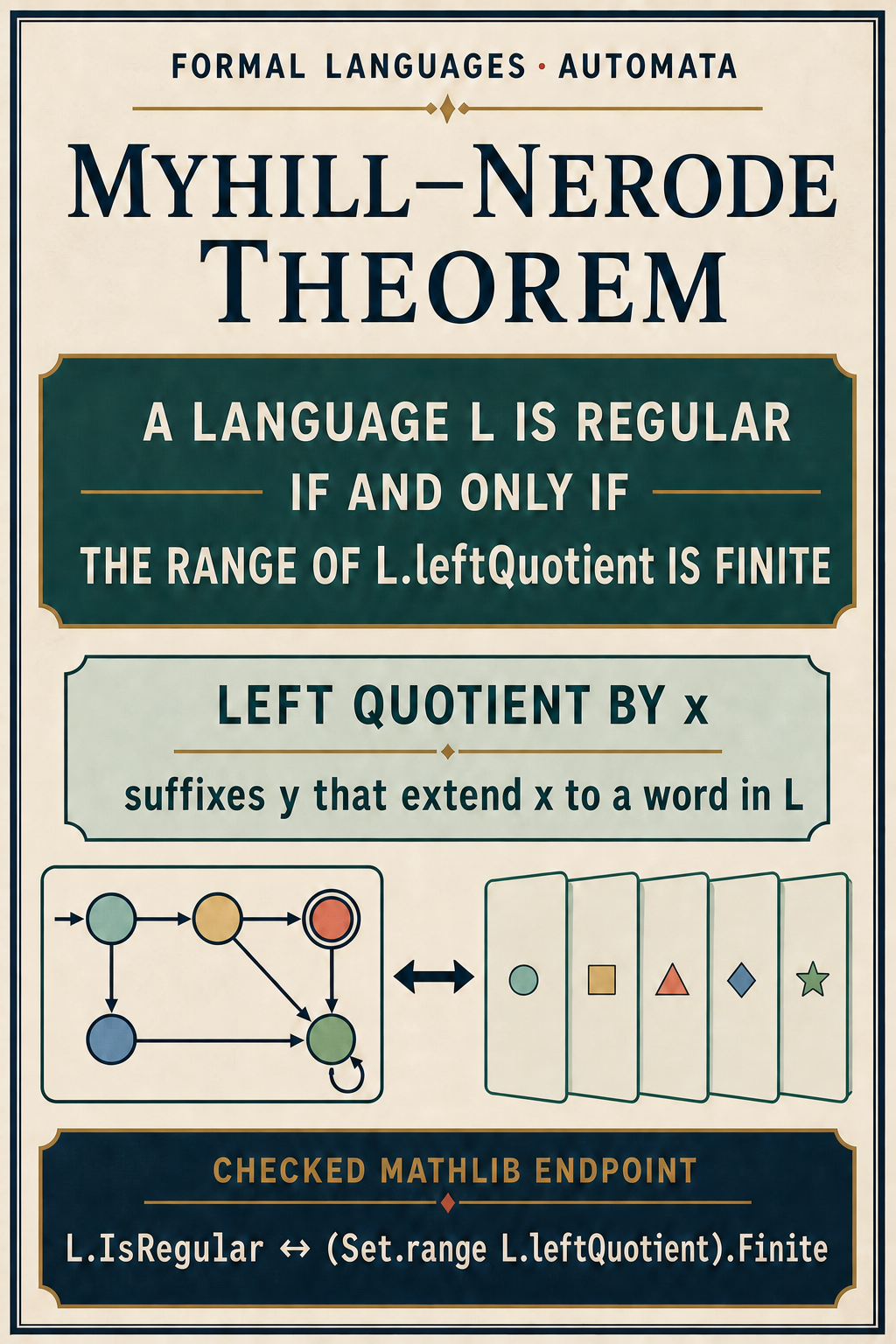
Detailed visual description
A restrained editorial poster gives the exact left-quotient equivalence in large type, defines the left quotient by the suffix condition x ++ y ∈ L, and uses a small two-way automata-and-quotients diagram without adding minimality, Nerode-index, or pumping-lemma claims.
Formal orientation
Statement map
This deterministic map orients the reader from the mathematical summary to the pinned declaration and exact checked form. The HTML statement below is authoritative.
Myhill–Nerode Theorem — scientific diagram
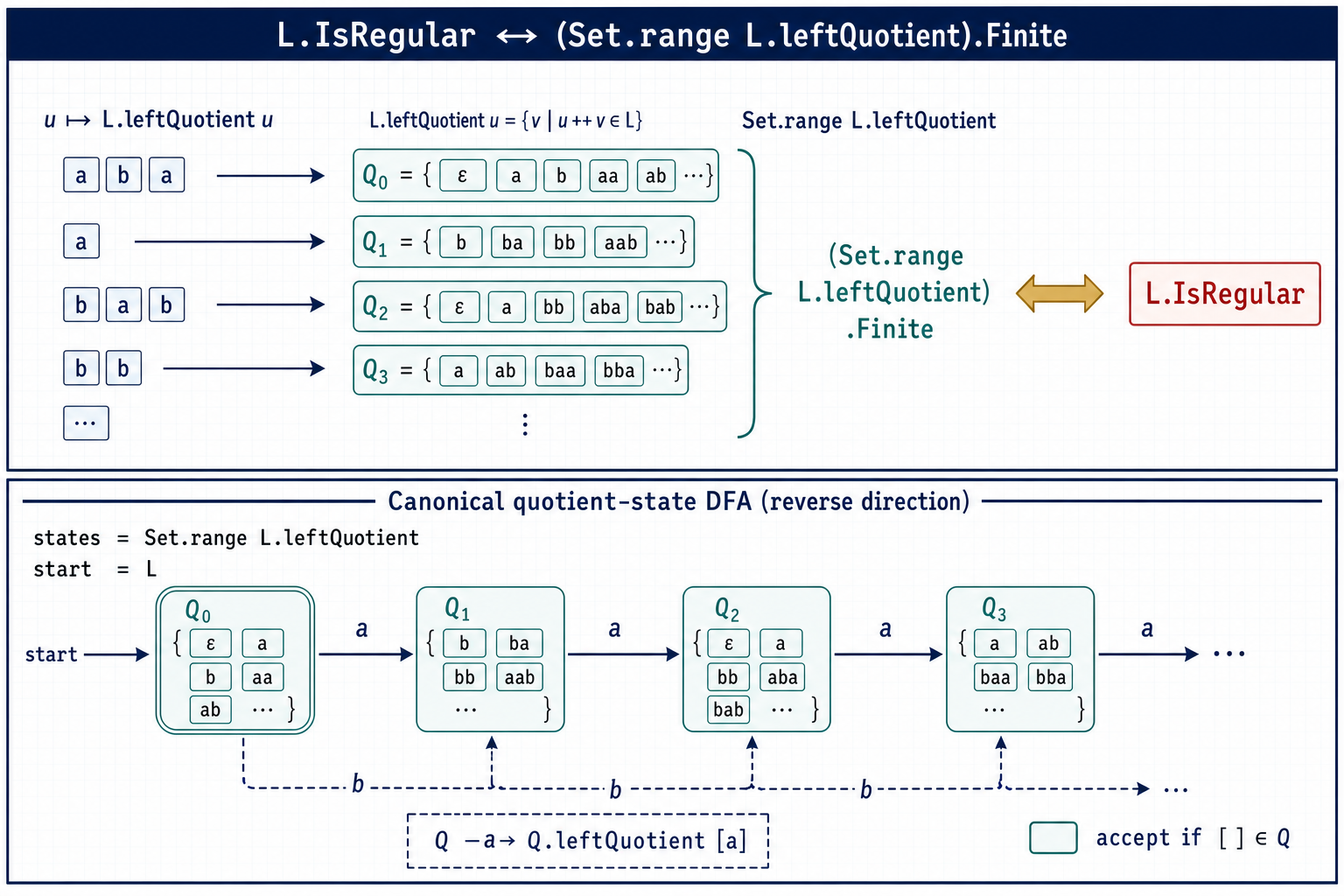
Detailed visual description
This target indexes Mathlib's left-quotient formulation of the Myhill–Nerode theorem. For a language L, leftQuotient sends a word x to the language of suffixes y such that x ++ y ∈ L. The theorem identifies regularity of L with finiteness of the range of that function. It does not, in this declaration, assert uniqueness of a minimal DFA, state finite index of the Nerode equivalence, or derive the pumping lemma.
Complementary intuition
A mathematical landmark
The theorem gives a structural characterization of regular languages: finite-state recognizability is exactly finiteness of the possible residual languages after prefixes. It is a foundational bridge between automata and language semantics.
The low-text schematic gives the theorem a visual identity; it does not replace the source-bound poster or exact statement.
Authoritative formal type
Exact Mathlib statement
theorem Language.isRegular_iff_finite_range_leftQuotient {α : Type u} {L : Language α} : L.IsRegular ↔ (Set.range L.leftQuotient).FiniteSelected evidence declaration text
theorem Language.isRegular_iff_finite_range_leftQuotient {α : Type u} {L : Language α} : L.IsRegular ↔ (Set.range L.leftQuotient).FiniteProofAtlas record
What has been checked
These states distinguish upstream identity, local reproduction, review, and Atlas acceptance. This page is part of the public, read-only Mathlib landmark collection.
Claim boundary
No new theorem is claimed
This target indexes Mathlib's left-quotient formulation of the Myhill–Nerode theorem. For a language L, leftQuotient sends a word x to the language of suffixes y such that x ++ y ∈ L. The theorem identifies regularity of L with finiteness of the range of that function. It does not, in this declaration, assert uniqueness of a minimal DFA, state finite index of the Nerode equivalence, or derive the pumping lemma.
- Proof Atlas did not originate the Myhill–Nerode theorem or Mathlib's declaration.
- The selected declaration does not state uniqueness or minimality of a DFA.
- The selected declaration is not phrased as finiteness of the index of the Nerode equivalence.
- The selected declaration does not state or prove the pumping lemma.
- The generated explanation and visuals are not proof evidence.
Provenance
Origin and evidence stay separate
- Existing declaration
Language.isRegular_iff_finite_range_leftQuotientin mathlib- Relationship
- The checked artifact is the upstream declaration itself
- Preferred checked artifact
artifact.library.mathlib.myhill-nerode-theorem.v001- Source handling
- Verified upstream reference; no mirrored source package