Measure theory and analysis · existing Mathlib declaration
Monotone Convergence Theorem
If measurable nonnegative functions grow pointwise with the sequence index, then integrating their pointwise supremum gives the same extended value as taking the supremum of their integrals.
- monotone convergence
- Lebesgue integration
- nonnegative extended reals
- pointwise suprema
- measurable functions
- lintegrals
The theorem at a glance
Monotone Convergence Theorem at a glance
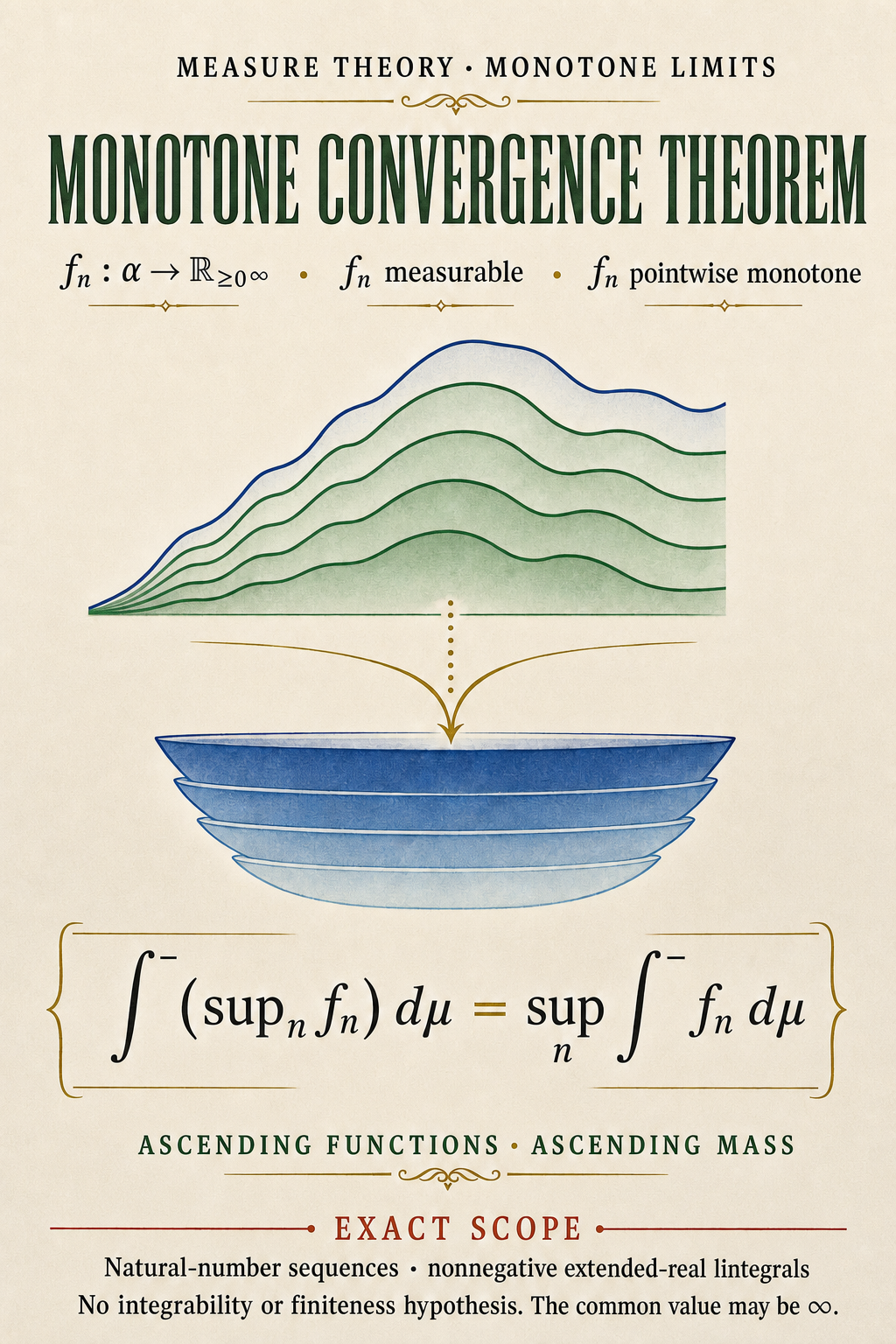
A source-bound editorial overview of the exact Mathlib formulation. The image is explanatory; the statement map, formal type, and pinned source remain authoritative.
Monotone Convergence Theorem at a glance
Detailed visual description
The poster sets four nested green profiles above growing cobalt mass basins and centers the exact nonnegative extended-real lintegral equality. Its footer states the natural-number sequence, absence of integrability or finiteness hypotheses, and possible infinite common value.
Formal orientation
Statement map
This deterministic map orients the reader from the mathematical summary to the pinned declaration and exact checked form. The HTML statement below is authoritative.
Monotone Convergence Theorem — scientific diagram
Detailed visual description
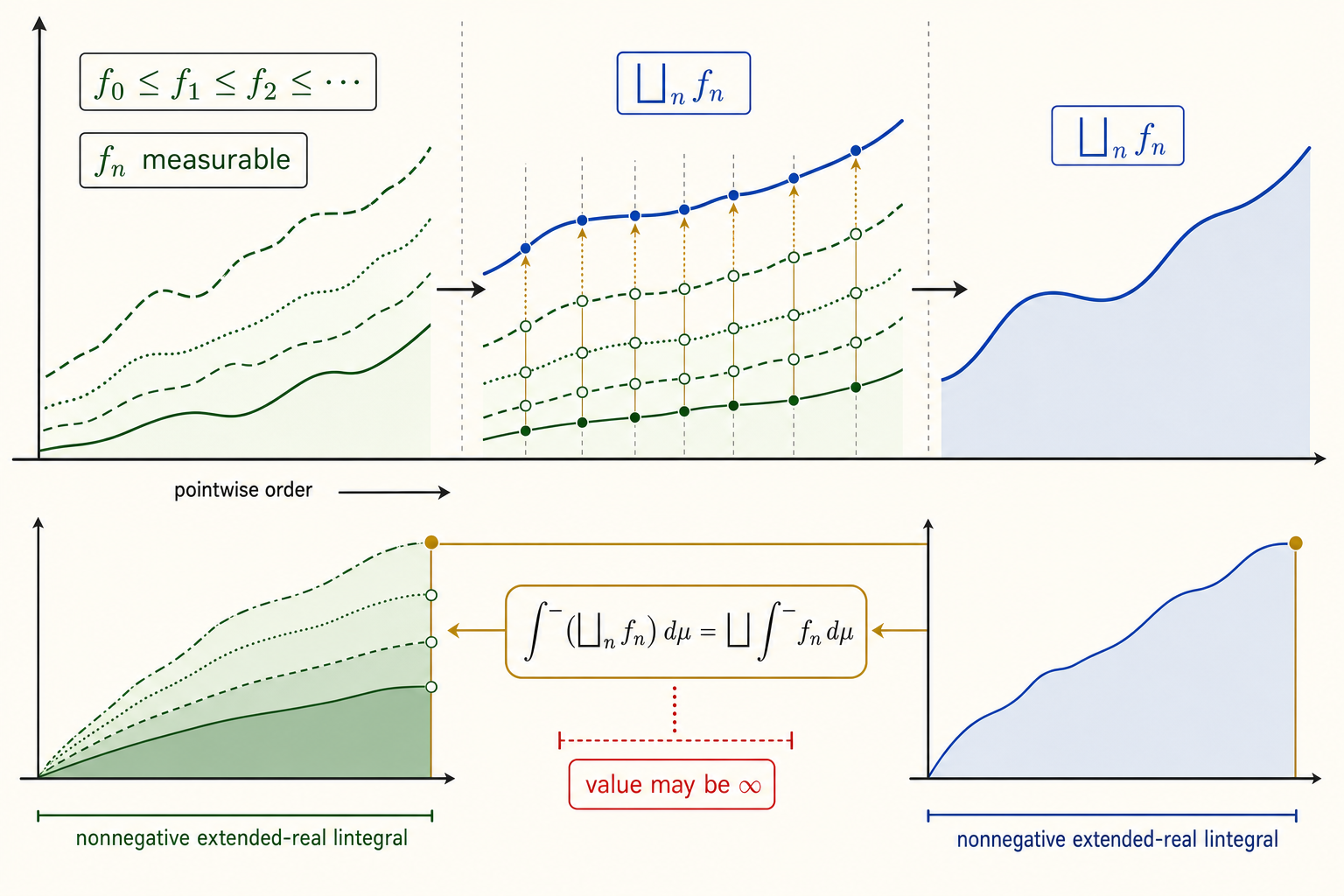
This page indexes Mathlib's monotone convergence theorem for a natural-number-indexed sequence f : ℕ → α → ℝ≥0∞ whose terms are measurable and which is monotone in the pointwise function order. It concludes that the lintegral of the pointwise supremum equals the supremum of the lintegrals. Nonnegativity is encoded by ℝ≥0∞, so no integrability or finiteness hypothesis is required and either side may be ∞. The selected declaration does not state the nearby almost-everywhere-measurable/almost-everywhere-monotone variant, a signed or Bochner-integral theorem, convergence for a nonmonotone sequence, or a quantitative rate.
Complementary intuition
A mathematical landmark
The monotone convergence theorem is a foundational limit-interchange principle in measure theory. It allows nonnegative mass to be assembled through an increasing sequence without an integrable dominating function and underlies the construction and structural properties of the Lebesgue integral.
The low-text schematic gives the theorem a visual identity; it does not replace the source-bound poster or exact statement.
Authoritative formal type
Exact Mathlib statement
theorem MeasureTheory.lintegral_iSup {α : Type*} {m : MeasurableSpace α} {μ : Measure α} {f : ℕ → α → ℝ≥0∞} (hf : ∀ n, Measurable (f n)) (h_mono : Monotone f) : ∫⁻ a, ⨆ n, f n a ∂μ = ⨆ n, ∫⁻ a, f n a ∂μSelected evidence declaration text
theorem MeasureTheory.lintegral_iSup {α : Type*} {m : MeasurableSpace α} {μ : Measure α} {f : ℕ → α → ℝ≥0∞} (hf : ∀ n, Measurable (f n)) (h_mono : Monotone f) : ∫⁻ a, ⨆ n, f n a ∂μ = ⨆ n, ∫⁻ a, f n a ∂μProofAtlas record
What has been checked
These states distinguish upstream identity, local reproduction, review, and Atlas acceptance. This page is part of the public, read-only Mathlib landmark collection.
Claim boundary
No new theorem is claimed
This page indexes Mathlib's monotone convergence theorem for a natural-number-indexed sequence f : ℕ → α → ℝ≥0∞ whose terms are measurable and which is monotone in the pointwise function order. It concludes that the lintegral of the pointwise supremum equals the supremum of the lintegrals. Nonnegativity is encoded by ℝ≥0∞, so no integrability or finiteness hypothesis is required and either side may be ∞. The selected declaration does not state the nearby almost-everywhere-measurable/almost-everywhere-monotone variant, a signed or Bochner-integral theorem, convergence for a nonmonotone sequence, or a quantitative rate.
- Proof Atlas did not originate the monotone convergence theorem or Mathlib's declaration.
- The selected declaration requires ordinary measurability of every term and pointwise monotonicity in the function order, not merely almost-everywhere versions.
- The conclusion concerns ℝ≥0∞-valued lintegrals and permits the common value ∞; it is not a signed or Bochner-integral statement.
- The generated explanation and visuals are not proof evidence.
Provenance
Origin and evidence stay separate
- Existing declaration
MeasureTheory.lintegral_iSupin mathlib- Relationship
- The checked artifact is the upstream declaration itself
- Preferred checked artifact
artifact.library.mathlib.monotone-convergence-theorem.v001- Source handling
- Verified upstream reference; no mirrored source package