Combinatorics · existing Mathlib declaration
Hales–Jewett Theorem
Fix a finite alphabet and finitely many colors. In some sufficiently large finite word space, no matter how every word is colored, there is a family of words obtained by changing one nonempty set of positions together, all with the same color.
- Ramsey theory
- finite word hypercubes
- combinatorial lines
- finite colorings
- color focusing
- product argument
The theorem at a glance
Hales–Jewett Theorem at a glance
A source-bound editorial overview of the exact Mathlib formulation. The image is explanatory; the statement map, formal type, and pinned source remain authoritative.
Hales–Jewett Theorem at a glance
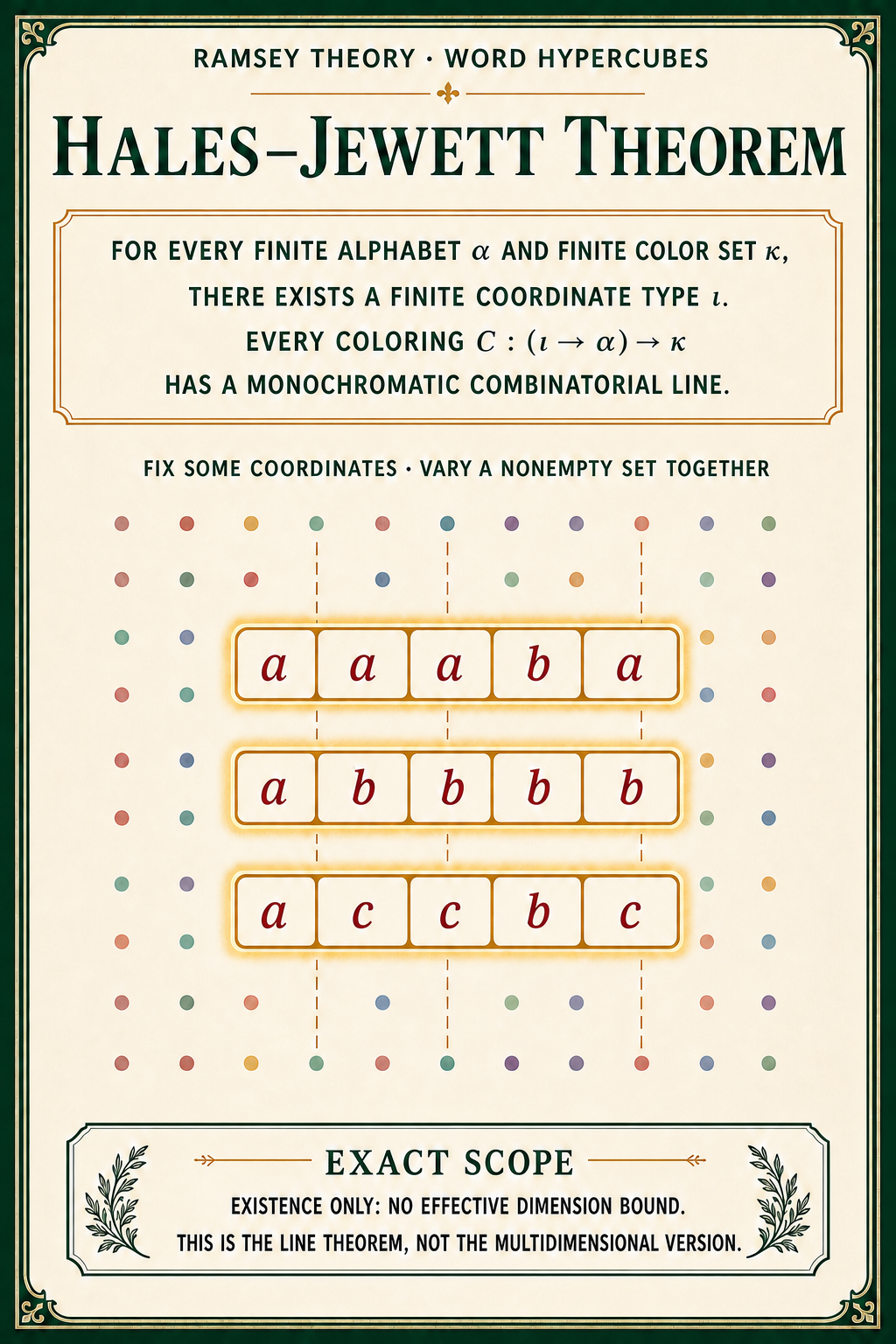
Detailed visual description
The theorem block preserves the finite alphabet and color hypotheses, existential finite coordinate type, universal coloring, and monochromatic-line conclusion. The central example gives the complete line for alphabet {a,b,c} under the pattern (a,x,x,b,x): (a,a,a,b,a), (a,b,b,b,b), and (a,c,c,b,c), all with one whole-word halo. The footer explicitly records the non-effective and one-dimensional boundary.
Formal orientation
Statement map
This deterministic map orients the reader from the mathematical summary to the pinned declaration and exact checked form. The HTML statement below is authoritative.
Hales–Jewett Theorem — scientific diagram
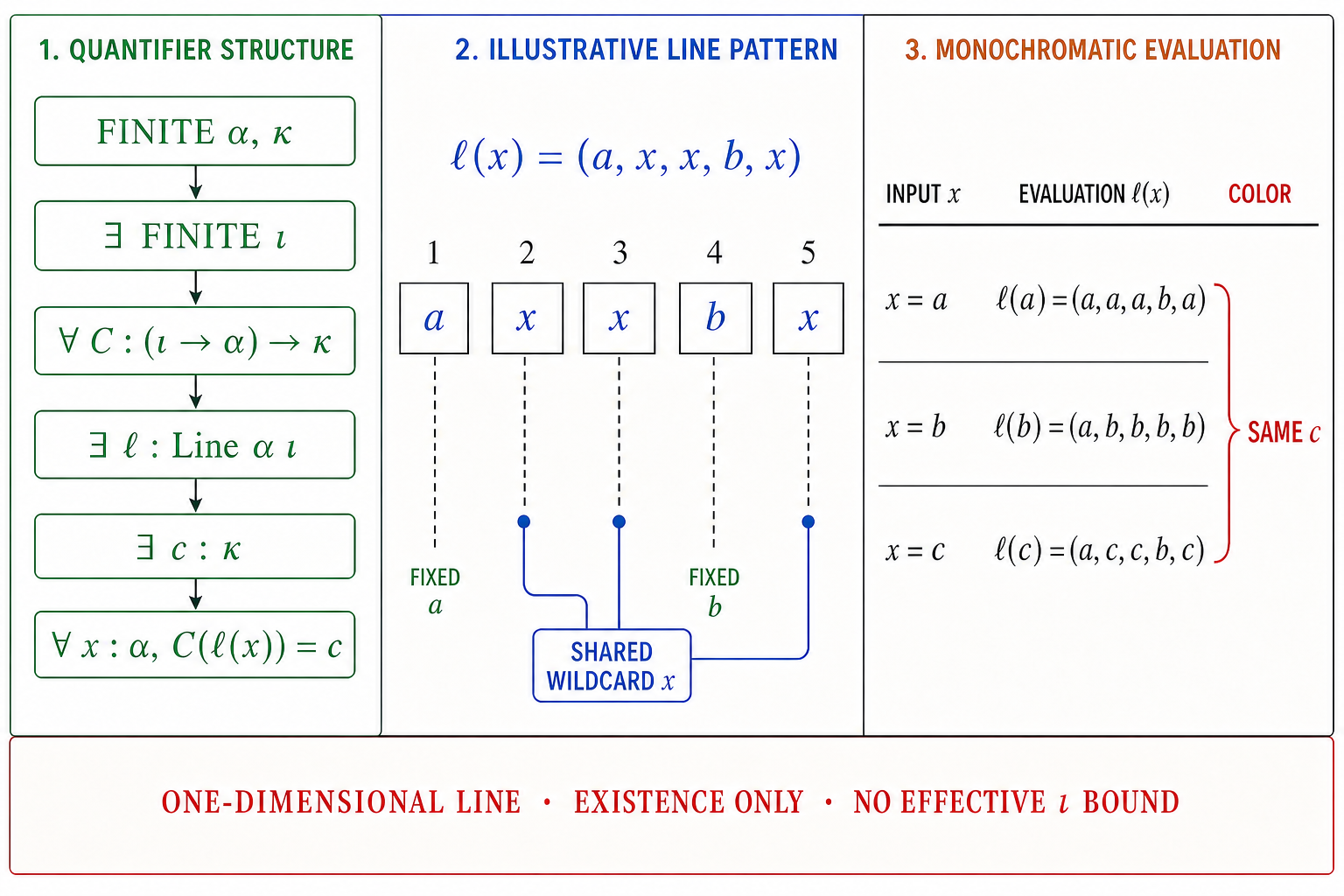
Detailed visual description
This page indexes Mathlib’s combinatorial-line form of the Hales–Jewett theorem for arbitrary finite types α and κ. It produces some finite coordinate type ι before quantifying over every coloring C : (ι → α) → κ. A line fixes some coordinates and varies one nonempty set of coordinates together through a common letter. The selected declaration supplies no effective or least dimension, canonical choice, coloring-independent line, or algorithm, and it is not the separate multidimensional subspace theorem or the Van der Waerden corollary.
Complementary intuition
A mathematical landmark
The Hales–Jewett theorem is a central structural result in Ramsey theory. Mathlib’s source exposes the theorem’s distinctive route through induction on the alphabet, color-focused families, a product argument, and the final impossibility of more distinct focused colors than the finite color type contains.
The low-text schematic gives the theorem a visual identity; it does not replace the source-bound poster or exact statement.
Authoritative formal type
Exact Mathlib statement
theorem Combinatorics.Line.exists_mono_in_high_dimension (α : Type u) [Finite α] (κ : Type v) [Finite κ] : ∃ (ι : Type) (_ : Fintype ι), ∀ C : (ι → α) → κ, ∃ l : Combinatorics.Line α ι, l.IsMono CSelected evidence declaration text
theorem Combinatorics.Line.exists_mono_in_high_dimension (α : Type u) [Finite α] (κ : Type v) [Finite κ] : ∃ (ι : Type) (_ : Fintype ι), ∀ C : (ι → α) → κ, ∃ l : Combinatorics.Line α ι, l.IsMono CProofAtlas record
What has been checked
These states distinguish upstream identity, local reproduction, review, and Atlas acceptance. This page is part of the public, read-only Mathlib landmark collection.
Claim boundary
No new theorem is claimed
This page indexes Mathlib’s combinatorial-line form of the Hales–Jewett theorem for arbitrary finite types α and κ. It produces some finite coordinate type ι before quantifying over every coloring C : (ι → α) → κ. A line fixes some coordinates and varies one nonempty set of coordinates together through a common letter. The selected declaration supplies no effective or least dimension, canonical choice, coloring-independent line, or algorithm, and it is not the separate multidimensional subspace theorem or the Van der Waerden corollary.
- ProofAtlas did not originate the Hales–Jewett theorem or Mathlib’s declaration.
- The selected declaration gives no effective upper bound or least value for the finite coordinate dimension.
- The displayed five-coordinate line is an illustration, not a universally sufficient Hales–Jewett dimension.
- The selected declaration is not the separate multidimensional Hales–Jewett theorem and does not itself state Van der Waerden’s theorem.
- The generated explanation and visuals are not proof evidence.
Provenance
Origin and evidence stay separate
- Existing declaration
Combinatorics.Line.exists_mono_in_high_dimensionin mathlib- Relationship
- The checked artifact is the upstream declaration itself
- Preferred checked artifact
artifact.library.mathlib.hales-jewett-theorem.v001- Source handling
- Verified upstream reference; no mirrored source package