Category theory · existing Mathlib declaration
Freyd–Mitchell Embedding Theorem
Given any abelian category, Mathlib supplies some ring and a way to represent the category inside that ring's module category. Distinct arrows remain distinct, every arrow between represented objects comes from the original category, and finite limit and finite colimit constructions are preserved.
- abelian category
- module category
- full functor
- faithful functor
- finite limits
- finite colimits
- exact embedding
The theorem at a glance
Freyd–Mitchell at a glance
A source-bound editorial overview of the exact Mathlib formulation. The image is explanatory; the statement map, formal type, and pinned source remain authoritative.
Freyd–Mitchell at a glance
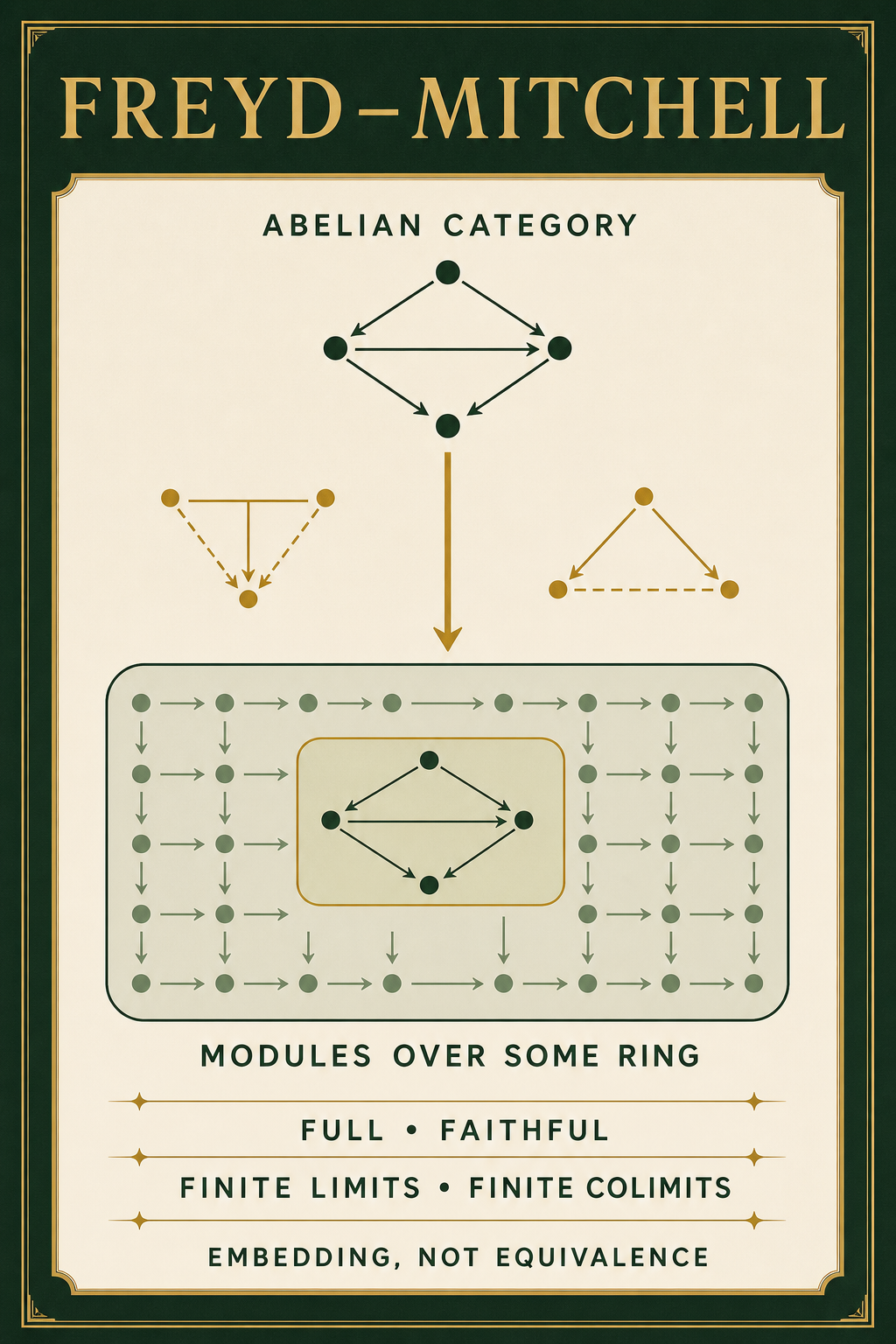
Detailed visual description
The poster pairs a one-way categorical embedding diagram with short boundary-safe copy. The source category reappears as a highlighted proper subdiagram inside the larger module field; the exact declared properties are listed below, followed by an explicit non-equivalence boundary.
Formal orientation
Statement map
This deterministic map orients the reader from the mathematical summary to the pinned declaration and exact checked form. The HTML statement below is authoritative.
Freyd–Mitchell Embedding Theorem — scientific diagram
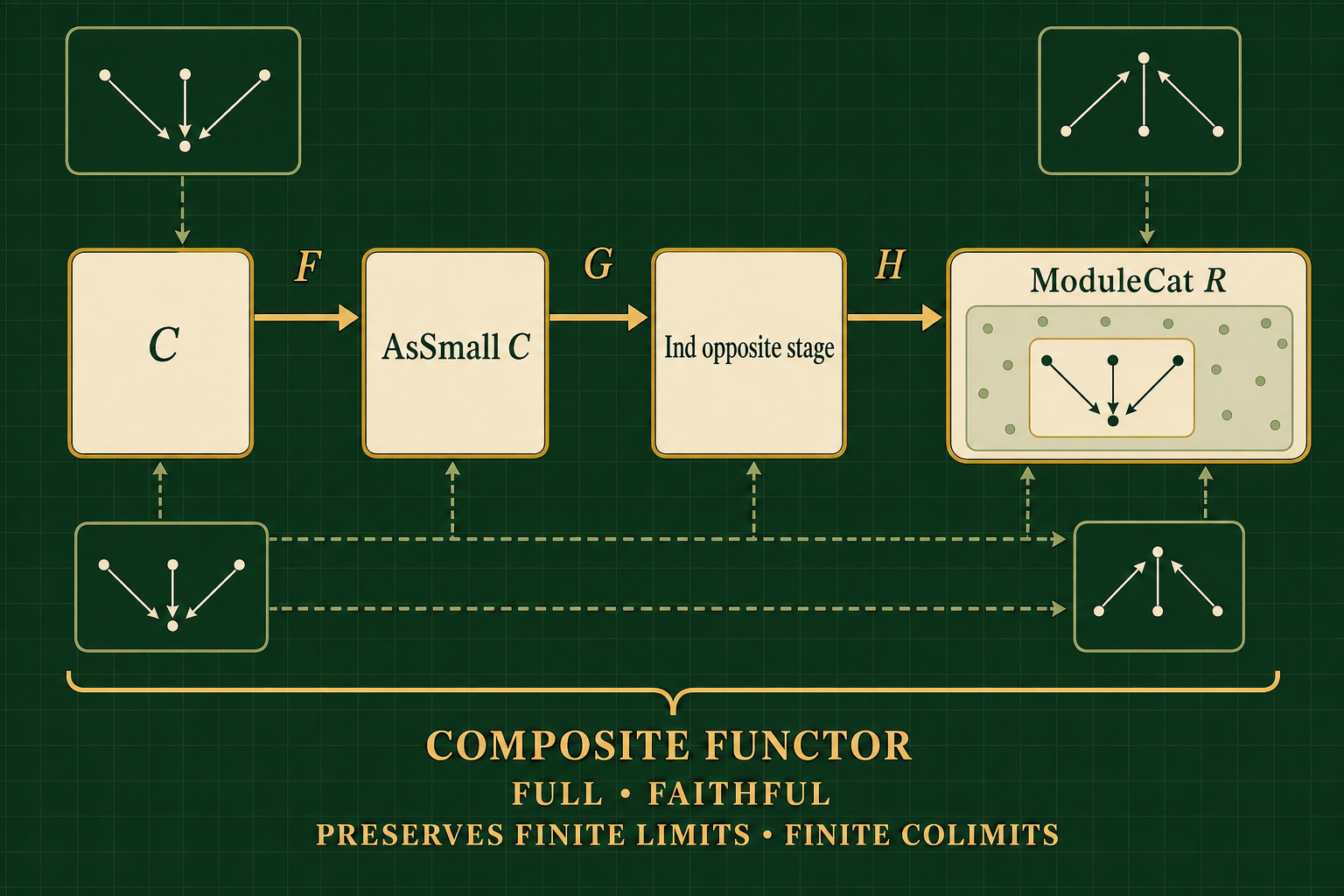
Detailed visual description
This target indexes Mathlib's existential Freyd–Mitchell endpoint for a category C equipped with an Abelian instance: there exist a ring R and a functor F : C ⥤ ModuleCat R that is full, faithful, preserves finite limits, and preserves finite colimits. The universe of R and the module category is max u v. The statement is an embedding into a module category, not an equivalence onto that whole category.
Complementary intuition
A mathematical landmark
The Freyd–Mitchell theorem connects abstract abelian categories with concrete module categories. It explains why many arguments about kernels, cokernels, exact sequences, and diagram chasing can be understood through module-like models without identifying the entire abstract category with every module over a ring.
The low-text schematic gives the theorem a visual identity; it does not replace the source-bound poster or exact statement.
Authoritative formal type
Exact Mathlib statement
theorem CategoryTheory.Abelian.freyd_mitchell (C : Type u) [Category.{v} C] [Abelian C] :
    ∃ (R : Type (max u v)) (_ : Ring R) (F : C ⥤ ModuleCat.{max u v} R),
      F.Full ∧ F.Faithful ∧ PreservesFiniteLimits F ∧ PreservesFiniteColimits F
Selected evidence declaration text
theorem CategoryTheory.Abelian.freyd_mitchell (C : Type u) [Category.{v} C] [Abelian C] :
    ∃ (R : Type (max u v)) (_ : Ring R) (F : C ⥤ ModuleCat.{max u v} R),
      F.Full ∧ F.Faithful ∧ PreservesFiniteLimits F ∧ PreservesFiniteColimits F
ProofAtlas record
What has been checked
These states distinguish upstream identity, local reproduction, review, and Atlas acceptance. This page is part of the public, read-only Mathlib landmark collection.
Claim boundary
No new theorem is claimed
This target indexes Mathlib's existential Freyd–Mitchell endpoint for a category C equipped with an Abelian instance: there exist a ring R and a functor F : C ⥤ ModuleCat R that is full, faithful, preserves finite limits, and preserves finite colimits. The universe of R and the module category is max u v. The statement is an embedding into a module category, not an equivalence onto that whole category.
- Proof Atlas did not originate the Freyd–Mitchell theorem or Mathlib's declaration.
- The selected theorem does not assert that C is equivalent to the entire category of modules over R.
- The existentially supplied ring is not claimed to be a fixed familiar ring or canonical for every purpose.
- The endpoint states preservation of finite limits and finite colimits, not arbitrary limits and colimits.
- The generated explanation and visuals are not proof evidence.
Provenance
Origin and evidence stay separate
- Existing declaration
CategoryTheory.Abelian.freyd_mitchellin mathlib- Relationship
- The checked artifact is the upstream declaration itself
- Preferred checked artifact
artifact.library.mathlib.freyd-mitchell-embedding-theorem.v001- Source handling
- Verified upstream reference; no mirrored source package