Number theory · existing Mathlib declaration
Fermat's Last Theorem for Exponent Four
No three nonzero natural numbers a, b, and c satisfy a⁴ + b⁴ = c⁴.
- Fermat's Last Theorem
- exponent four
- Diophantine equations
- infinite descent
- minimal counterexamples
- primitive Pythagorean triples
The theorem at a glance
Fermat's Last Theorem for Exponent Four — infinite descent
A source-bound editorial overview of the exact Mathlib formulation. The image is explanatory; the statement map, formal type, and pinned source remain authoritative.
Fermat's Last Theorem for Exponent Four — infinite descent
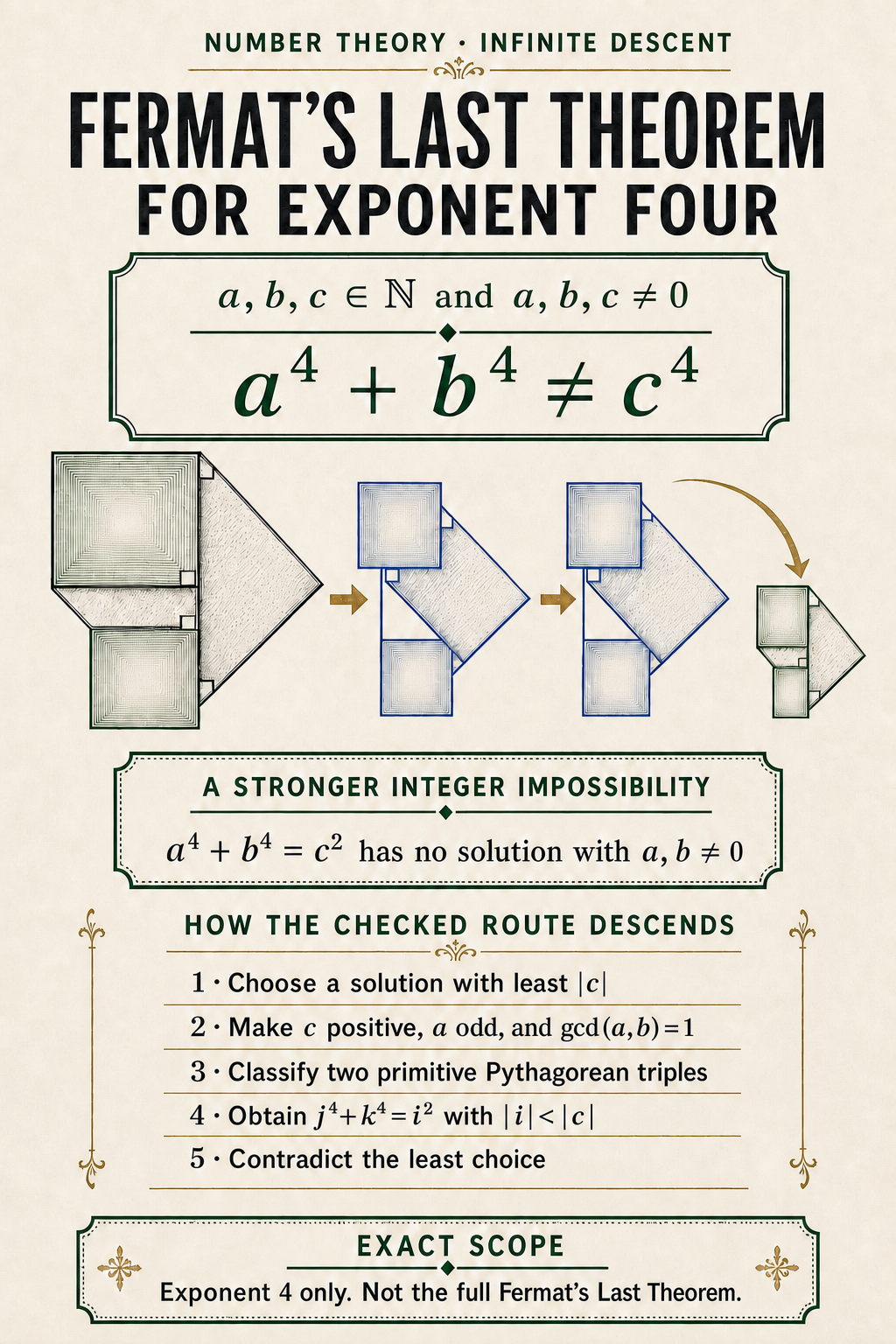
Detailed visual description
The poster centers the exact nonzero-natural conclusion a⁴+b⁴≠c⁴. Below it, an unlabeled engraved square construction shrinks through two successive right-triangle decompositions. A compact stronger-equation panel and five-step route explain the least-counterexample contradiction while the footer limits the result to exponent four.
Formal orientation
Statement map
This deterministic map orients the reader from the mathematical summary to the pinned declaration and exact checked form. The HTML statement below is authoritative.
Fermat's Last Theorem for Exponent Four — scientific diagram
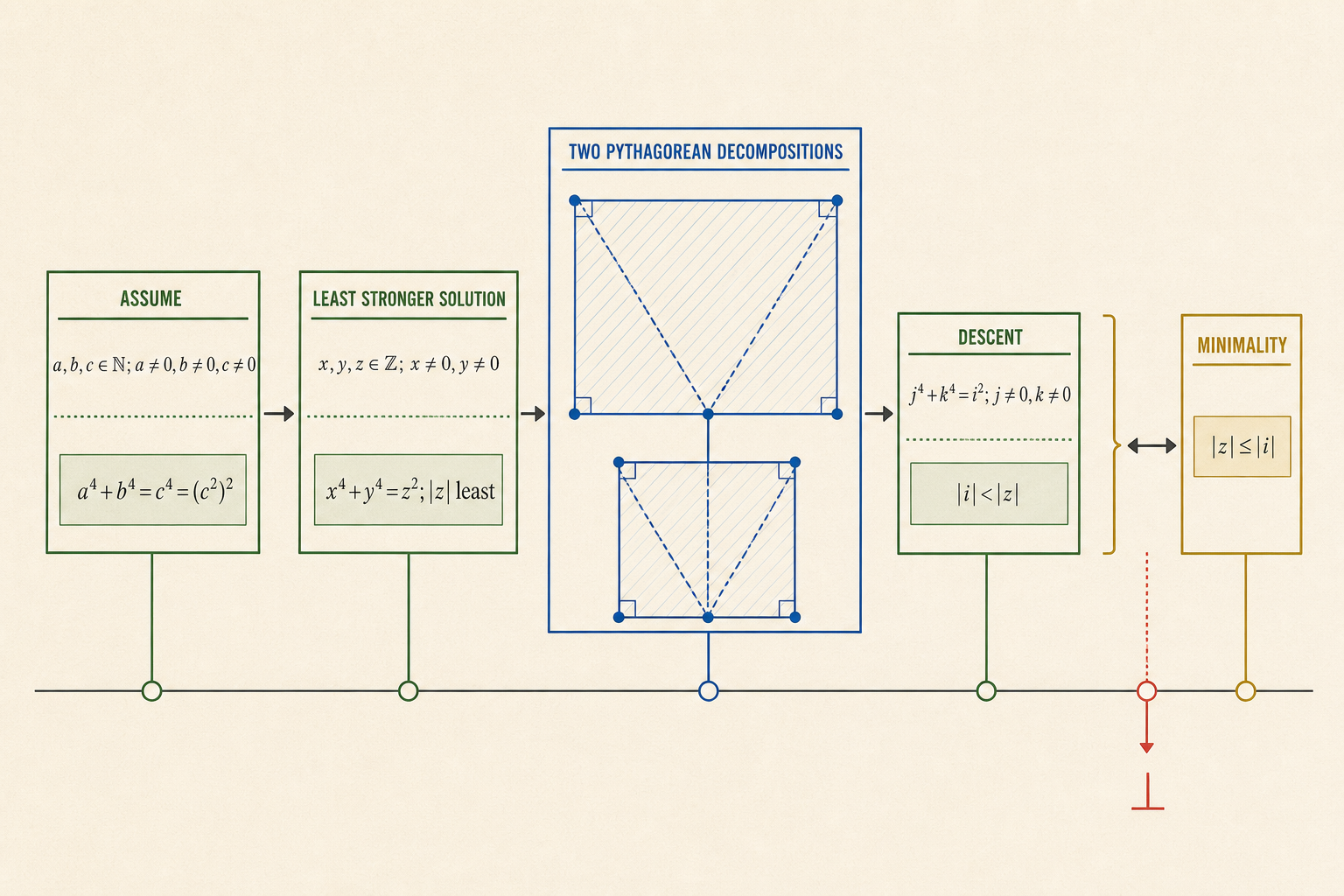
Detailed visual description
This target indexes Mathlib's theorem FermatLastTheoremFor 4. Unfolded, for natural numbers a, b, and c, if all three are nonzero then a ^ 4 + b ^ 4 ≠ c ^ 4. The source proves this through a stronger integer square equation and infinite descent. The declaration is the exponent-four case only, not full Fermat's Last Theorem, an exponent-general theorem, or new ProofAtlas mathematics.
Complementary intuition
A mathematical landmark
The exponent-four case is a classical landmark in Diophantine analysis: a minimal hypothetical solution to a stronger square equation is transformed into a smaller one, giving a canonical example of infinite descent.
The low-text schematic gives the theorem a visual identity; it does not replace the source-bound poster or exact statement.
Authoritative formal type
Exact Mathlib statement
theorem fermatLastTheoremFour : FermatLastTheoremFor 4Selected evidence declaration text
theorem fermatLastTheoremFour : FermatLastTheoremFor 4ProofAtlas record
What has been checked
These states distinguish upstream identity, local reproduction, review, and Atlas acceptance. This page is part of the public, read-only Mathlib landmark collection.
Claim boundary
No new theorem is claimed
This target indexes Mathlib's theorem FermatLastTheoremFor 4. Unfolded, for natural numbers a, b, and c, if all three are nonzero then a ^ 4 + b ^ 4 ≠ c ^ 4. The source proves this through a stronger integer square equation and infinite descent. The declaration is the exponent-four case only, not full Fermat's Last Theorem, an exponent-general theorem, or new ProofAtlas mathematics.
- The checked declaration proves the case n = 4 only; it does not prove Fermat's Last Theorem for every exponent.
- The exact statement is over natural numbers and assumes that a, b, and c are all nonzero.
- The stronger integer equation a ^ 4 + b ^ 4 = c ^ 2 is the source's proof route, not an expansion of the declaration's public statement.
- The theorem is an impossibility result; it does not enumerate solutions, provide a finite search bound, or assert a computational method.
- ProofAtlas is indexing an existing Mathlib theorem, not claiming mathematical novelty.
Provenance
Origin and evidence stay separate
- Existing declaration
fermatLastTheoremFourin mathlib- Relationship
- The checked artifact is the upstream declaration itself
- Preferred checked artifact
artifact.library.mathlib.fermat-last-theorem-exponent-four.v001- Source handling
- Verified upstream reference; no mirrored source package