Combinatorics · existing Mathlib declaration
Erdős–Ko–Rado Theorem
Choose many r-element subsets of an n-element ground set, requiring every two chosen subsets to share at least one element. When r is no more than half of n, Erdős–Ko–Rado gives the numerical ceiling binom(n−1,r−1) for the number of chosen subsets.
- intersecting set families
- uniform set families
- extremal combinatorics
- iterated shadows
- Kruskal–Katona theorem
The theorem at a glance
Erdős–Ko–Rado at a glance
A source-bound editorial overview of the exact Mathlib formulation. The image is explanatory; the statement map, formal type, and pinned source remain authoritative.
Erdős–Ko–Rado at a glance
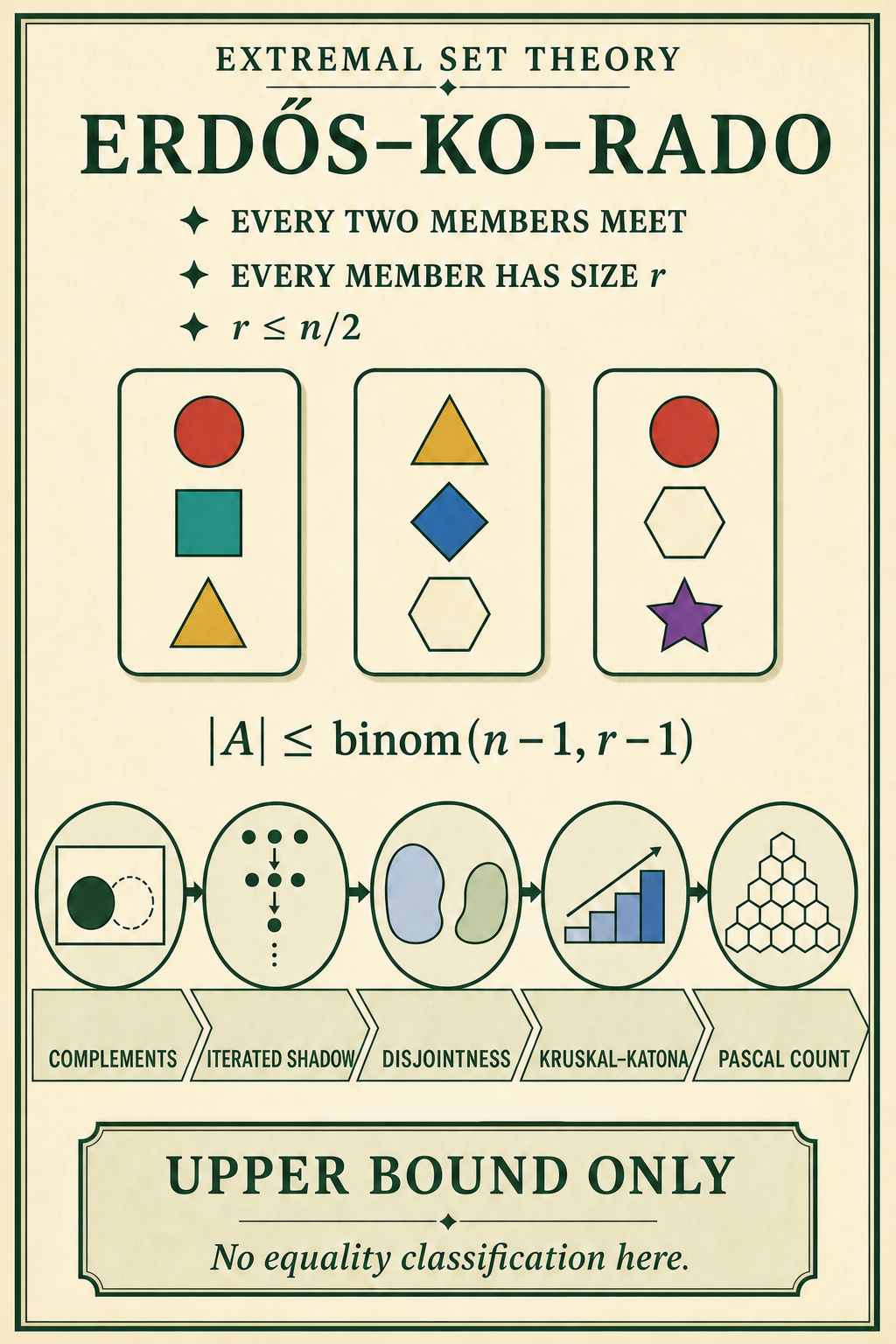
Detailed visual description
The poster makes the three hypotheses and upper bound primary, using a three-card example whose pairwise overlaps are different. Its source route takes complements, descends by an iterated shadow, uses disjointness from the original family, invokes the Lovász Kruskal–Katona bound, and finishes with Pascal’s binomial identity. The footer excludes equality classification.
Formal orientation
Statement map
This deterministic map orients the reader from the mathematical summary to the pinned declaration and exact checked form. The HTML statement below is authoritative.
Erdős–Ko–Rado Theorem — scientific diagram
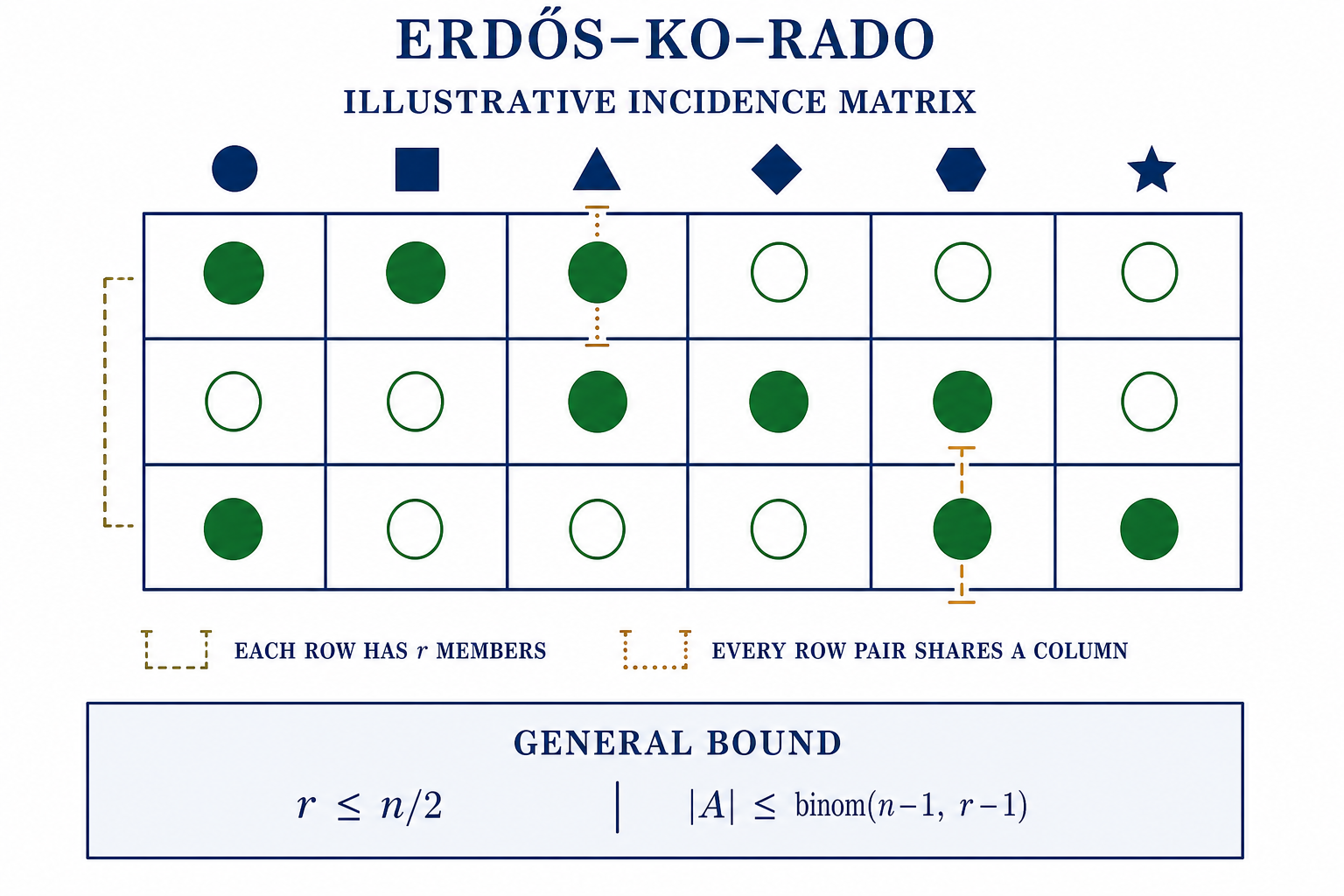
Detailed visual description
This page indexes Mathlib’s finite-family theorem for 𝒜 : Finset (Finset (Fin n)). The family is pairwise intersecting, every member has exactly r elements, and the hypothesis is exactly r ≤ n / 2. The selected declaration proves only #𝒜 ≤ (n−1).choose (r−1); it does not construct a star family, prove a separate sharpness result, or classify equality cases.
Complementary intuition
A mathematical landmark
Erdős–Ko–Rado is a foundational extremal set theorem. Mathlib derives its upper bound through complements, an iterated shadow, disjointness, and the Lovász form of Kruskal–Katona, giving the page a theorem-specific checked proof architecture.
The low-text schematic gives the theorem a visual identity; it does not replace the source-bound poster or exact statement.
Authoritative formal type
Exact Mathlib statement
theorem Finset.erdos_ko_rado {n : ℕ} {𝒜 : Finset (Finset (Fin n))} {r : ℕ} (h𝒜 : (𝒜 : Set (Finset (Fin n))).Intersecting) (h₂ : (𝒜 : Set (Finset (Fin n))).Sized r) (h₃ : r ≤ n / 2) : #𝒜 ≤ (n - 1).choose (r - 1)Selected evidence declaration text
theorem Finset.erdos_ko_rado {n : ℕ} {𝒜 : Finset (Finset (Fin n))} {r : ℕ} (h𝒜 : (𝒜 : Set (Finset (Fin n))).Intersecting) (h₂ : (𝒜 : Set (Finset (Fin n))).Sized r) (h₃ : r ≤ n / 2) : #𝒜 ≤ (n - 1).choose (r - 1)ProofAtlas record
What has been checked
These states distinguish upstream identity, local reproduction, review, and Atlas acceptance. This page is part of the public, read-only Mathlib landmark collection.
Claim boundary
No new theorem is claimed
This page indexes Mathlib’s finite-family theorem for 𝒜 : Finset (Finset (Fin n)). The family is pairwise intersecting, every member has exactly r elements, and the hypothesis is exactly r ≤ n / 2. The selected declaration proves only #𝒜 ≤ (n−1).choose (r−1); it does not construct a star family, prove a separate sharpness result, or classify equality cases.
- ProofAtlas did not originate the Erdős–Ko–Rado theorem or Mathlib’s declaration.
- The selected declaration is not a theorem about arbitrary infinite set families.
- It does not assert that all members share one common element.
- It does not formalize an extremal construction or classify equality cases.
- The generated explanation and visuals are not proof evidence.
Provenance
Origin and evidence stay separate
- Existing declaration
Finset.erdos_ko_radoin mathlib- Relationship
- The checked artifact is the upstream declaration itself
- Preferred checked artifact
artifact.library.mathlib.erdos-ko-rado-theorem.v001- Source handling
- Verified upstream reference; no mirrored source package