Algebra and number theory · existing Mathlib declaration
Eisenstein Criterion
Choose a prime ideal P in an integral domain. If every coefficient below the leading term lies in P, the leading coefficient stays outside P, the constant coefficient stays outside P², and the polynomial is primitive with positive degree, then the polynomial cannot factor into two nonunits.
- polynomial irreducibility
- prime ideals
- primitive polynomials
- quotient rings
- fraction fields
- Eisenstein criterion
The theorem at a glance
Eisenstein Criterion at a glance
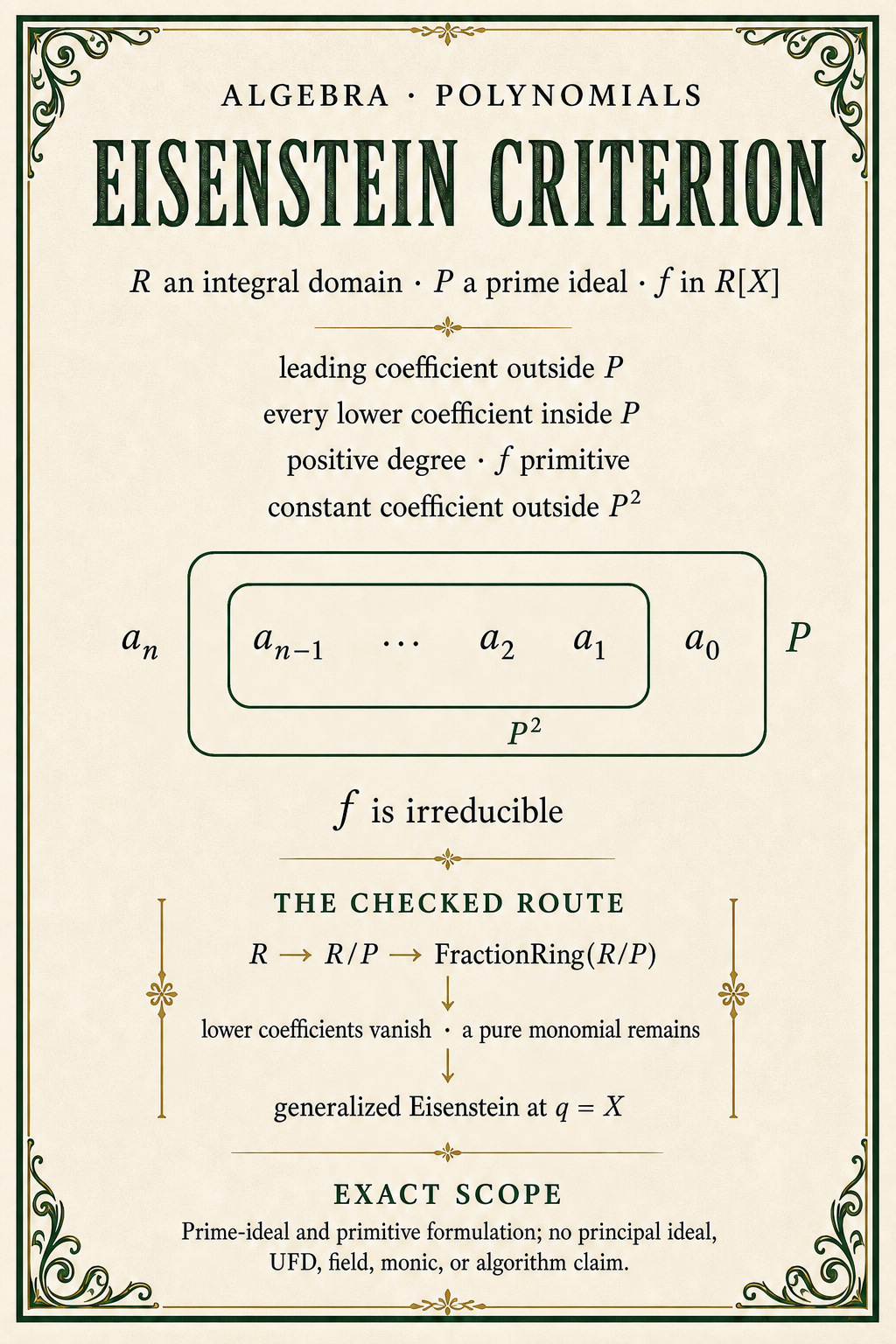
A source-bound editorial overview of the exact Mathlib formulation. The image is explanatory; the statement map, formal type, and pinned source remain authoritative.
Eisenstein Criterion at a glance
Detailed visual description
The poster centers the exact hypotheses above a coefficient row with the leading coefficient outside P and constant coefficient outside P². A sparse route below passes through R/P and FractionRing(R/P), where the lower coefficients vanish and generalized Eisenstein is applied at q = X.
Formal orientation
Statement map
This deterministic map orients the reader from the mathematical summary to the pinned declaration and exact checked form. The HTML statement below is authoritative.
Eisenstein Criterion — scientific diagram
![Separate Scientific inspection passed at original 1536 × 1024 pixels. The exact hypothesis labels are complete and legible: f in R[X] with P prime, leading coefficient outside P, lower coefficients in P below degree f, constant coefficient outside P², positive degree, and f.IsPrimitive. The large P region encloses precisely the lower coefficient cells, the leading cell is separate outside it, and the smaller P² region is nested away from the constant cell. The lower route reads R/P to FractionRing(R/P), notes that lower coefficients vanish, then reaches a pure monomial, generalized Eisenstein at q = X, and Irreducible f. The figure is a distinct flat Scientific diagram rather than a restyled concept image, and it makes no principal-ideal, maximal-ideal, UFD, field, monic, unit-leading-coefficient, or algorithm claim.](/assets/theorem-visual-styles/scientific-v1/mathlib/eisenstein-criterion/theorem-schematic-scientific-v1.png)
Detailed visual description
This target indexes Mathlib's prime-ideal Eisenstein criterion for a polynomial over a commutative integral domain. The conclusion requires a prime ideal P, positive degree, primitivity, leading coefficient outside P, every coefficient strictly below the degree inside P, and constant coefficient outside P². It concludes irreducibility in R[X]; it is not an unrestricted prime-element or algorithmic criterion.
Complementary intuition
A mathematical landmark
Eisenstein's criterion is a fundamental and widely used test for polynomial irreducibility. Mathlib states it in a general prime-ideal form and derives it from a generalized quotient-and-fraction-field criterion, making the exact role of primitivity and the P² obstruction explicit.
The low-text schematic gives the theorem a visual identity; it does not replace the source-bound poster or exact statement.
Authoritative formal type
Exact Mathlib statement
theorem Polynomial.irreducible_of_eisenstein_criterion {R : Type*} [CommRing R] [IsDomain R] {f : R[X]} {P : Ideal R} (hP : P.IsPrime) (hfl : f.leadingCoeff ∉ P) (hfP : ∀ n : ℕ, ↑n < degree f → f.coeff n ∈ P) (hfd0 : 0 < degree f) (h0 : f.coeff 0 ∉ P ^ 2) (hu : f.IsPrimitive) : Irreducible fSelected evidence declaration text
theorem Polynomial.irreducible_of_eisenstein_criterion {R : Type*} [CommRing R] [IsDomain R] {f : R[X]} {P : Ideal R} (hP : P.IsPrime) (hfl : f.leadingCoeff ∉ P) (hfP : ∀ n : ℕ, ↑n < degree f → f.coeff n ∈ P) (hfd0 : 0 < degree f) (h0 : f.coeff 0 ∉ P ^ 2) (hu : f.IsPrimitive) : Irreducible fProofAtlas record
What has been checked
These states distinguish upstream identity, local reproduction, review, and Atlas acceptance. This page is part of the public, read-only Mathlib landmark collection.
Claim boundary
No new theorem is claimed
This target indexes Mathlib's prime-ideal Eisenstein criterion for a polynomial over a commutative integral domain. The conclusion requires a prime ideal P, positive degree, primitivity, leading coefficient outside P, every coefficient strictly below the degree inside P, and constant coefficient outside P². It concludes irreducibility in R[X]; it is not an unrestricted prime-element or algorithmic criterion.
- Proof Atlas did not originate Eisenstein's criterion or Mathlib's declaration.
- The selected declaration does not assume or conclude that P is principal or maximal, R is a UFD or field, f is monic, or its leading coefficient is a unit.
- The theorem does not provide a factorization or irreducibility algorithm, and it does not remove the primitivity or positive-degree hypotheses.
- The generated explanation and visuals are not proof evidence.
Provenance
Origin and evidence stay separate
- Existing declaration
Polynomial.irreducible_of_eisenstein_criterionin mathlib- Relationship
- The checked artifact is the upstream declaration itself
- Preferred checked artifact
artifact.library.mathlib.eisenstein-criterion.v001- Source handling
- Verified upstream reference; no mirrored source package