Number theory · existing Mathlib declaration
Divergence of the Reciprocal-Prime Series
The real family that assigns the reciprocal 1/p to every prime p cannot have a finite sum.
- reciprocals of primes
- nonsummable families
- smooth numbers
- rough numbers
- vanishing tails
The theorem at a glance
Divergence of Prime Reciprocals — a nonvanishing tail
A source-bound editorial overview of the exact Mathlib formulation. The image is explanatory; the statement map, formal type, and pinned source remain authoritative.
Divergence of Prime Reciprocals — a nonvanishing tail
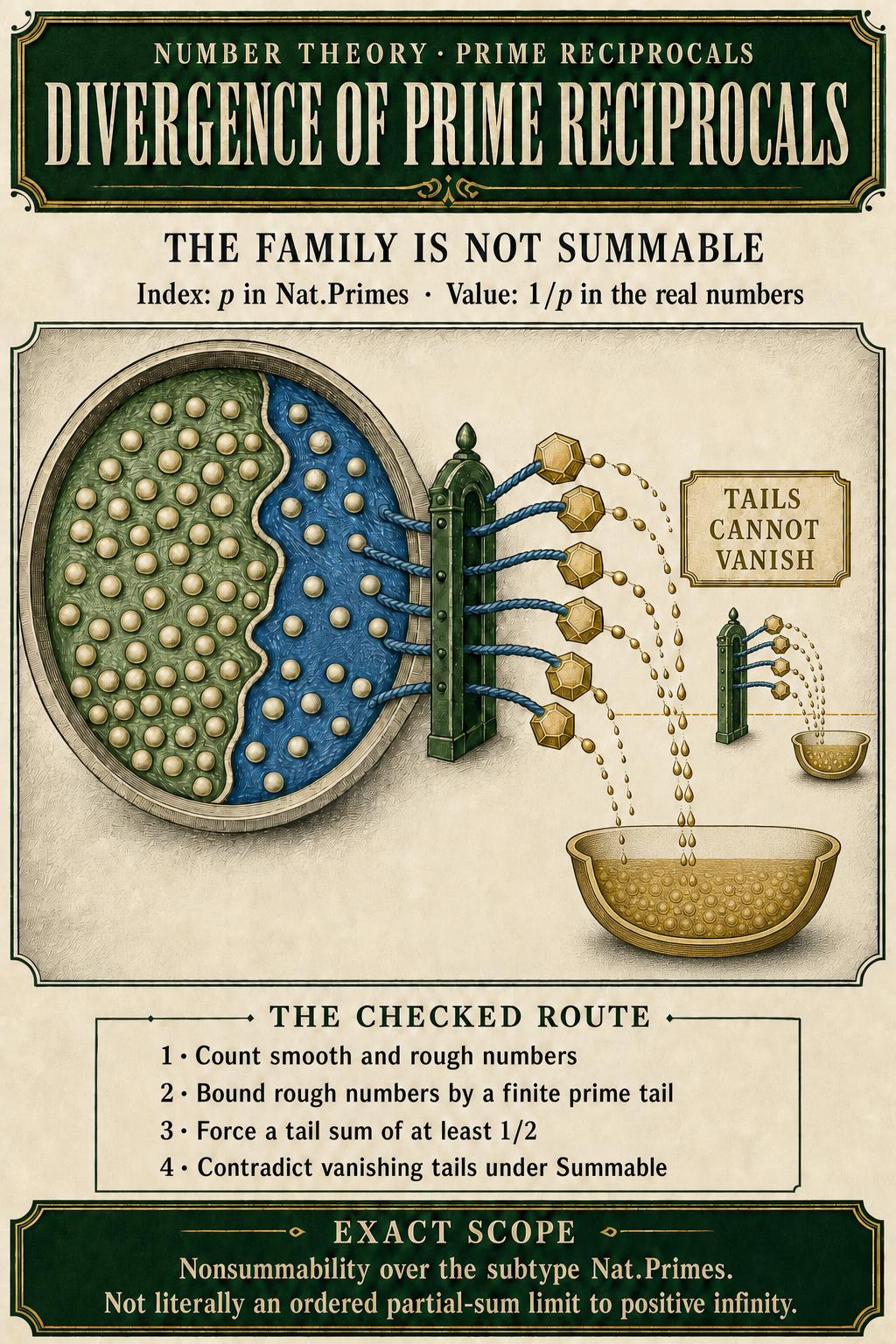
Detailed visual description
The exact subtype-indexed conclusion leads into the checked Erdős route: split bounded naturals into smooth and rough parts, control the smooth part by a square-root estimate, charge the rough part to primes beyond one cutoff, and repeat the visible tail-basin mechanism beyond a farther cutoff. The second gate makes the obstruction to summable tails explicit rather than presenting one isolated finite sum.
Formal orientation
Statement map
This deterministic map orients the reader from the mathematical summary to the pinned declaration and exact checked form. The HTML statement below is authoritative.
Divergence of the Reciprocal-Prime Series — scientific diagram
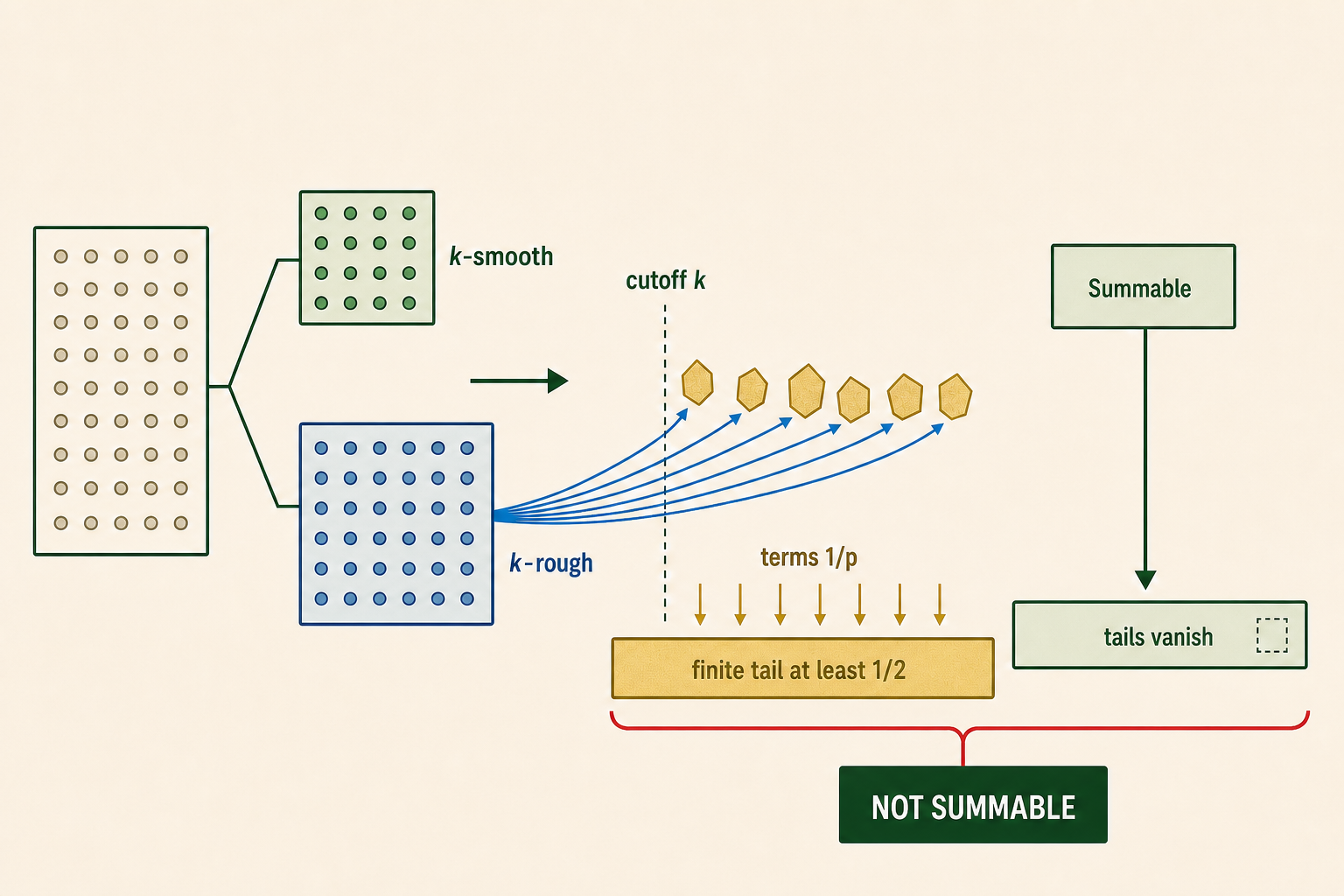
Detailed visual description
This target indexes Mathlib's order-independent subtype form: the real-valued family p ↦ 1/p on Nat.Primes is not Summable. The declaration is not literally phrased as convergence of ordered partial sums to +∞, and it supplies no divergence rate or asymptotic estimate.
Complementary intuition
A mathematical landmark
Euler's theorem that the sum of prime reciprocals diverges is a classical bridge between elementary series and the distribution of primes. Mathlib retains a particularly visual Erdős proof in which smooth and rough number counts force a uniform lower bound on arbitrarily remote finite prime tails.
The low-text schematic gives the theorem a visual identity; it does not replace the source-bound poster or exact statement.
Authoritative formal type
Exact Mathlib statement
theorem Nat.Primes.not_summable_one_div : ¬ Summable (fun p : Nat.Primes ↦ (1 / p : ℝ))Selected evidence declaration text
theorem Nat.Primes.not_summable_one_div : ¬ Summable (fun p : Nat.Primes ↦ (1 / p : ℝ))ProofAtlas record
What has been checked
These states distinguish upstream identity, local reproduction, review, and Atlas acceptance. This page is part of the public, read-only Mathlib landmark collection.
Claim boundary
No new theorem is claimed
This target indexes Mathlib's order-independent subtype form: the real-valued family p ↦ 1/p on Nat.Primes is not Summable. The declaration is not literally phrased as convergence of ordered partial sums to +∞, and it supplies no divergence rate or asymptotic estimate.
- The exact endpoint is nonsummability over the subtype Nat.Primes, independent of any chosen enumeration.
- The declaration is not literally a statement that one ordered sequence of partial sums tends to +∞.
- It gives no quantitative divergence rate, asymptotic formula, or estimate for the prime-counting function.
- ProofAtlas is indexing an existing Mathlib theorem, not claiming new mathematics.
Provenance
Origin and evidence stay separate
- Existing declaration
Nat.Primes.not_summable_one_divin mathlib- Relationship
- The checked artifact is the upstream declaration itself
- Preferred checked artifact
artifact.library.mathlib.divergence-prime-reciprocal-series.v001- Source handling
- Verified upstream reference; no mirrored source package