Algebra · existing Mathlib declaration
Cauchy's Theorem for Finite Groups
If a prime p divides the number of elements in a finite group G, then G contains at least one element whose order is exactly p.
- finite groups
- prime divisors
- element order
- product-one tuples
- cyclic rotation
- fixed-point counting
The theorem at a glance
Cauchy's theorem for finite groups at a glance
A source-bound editorial overview of the exact Mathlib formulation. The image is explanatory; the statement map, formal type, and pinned source remain authoritative.
Cauchy's theorem for finite groups at a glance
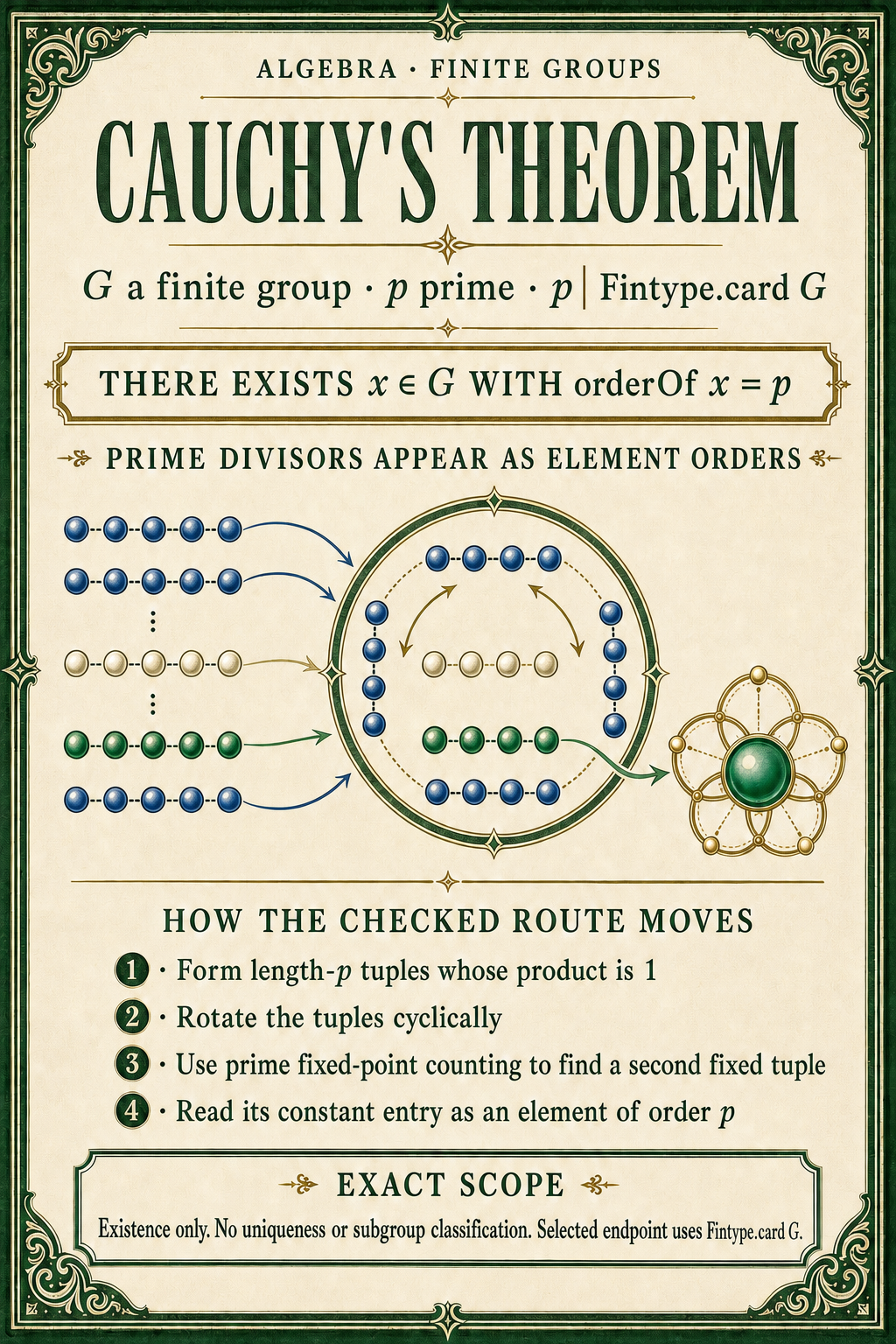
Detailed visual description
The poster foregrounds the Fintype.card divisibility implication and then follows the checked source route through length-p product-one tuples, cyclic rotation, prime fixed-point counting, a second constant fixed tuple, and extraction of an element of order p. Its footer keeps existence and the selected Fintype endpoint explicit.
Formal orientation
Statement map
This deterministic map orients the reader from the mathematical summary to the pinned declaration and exact checked form. The HTML statement below is authoritative.
Cauchy's Theorem for Finite Groups — scientific diagram
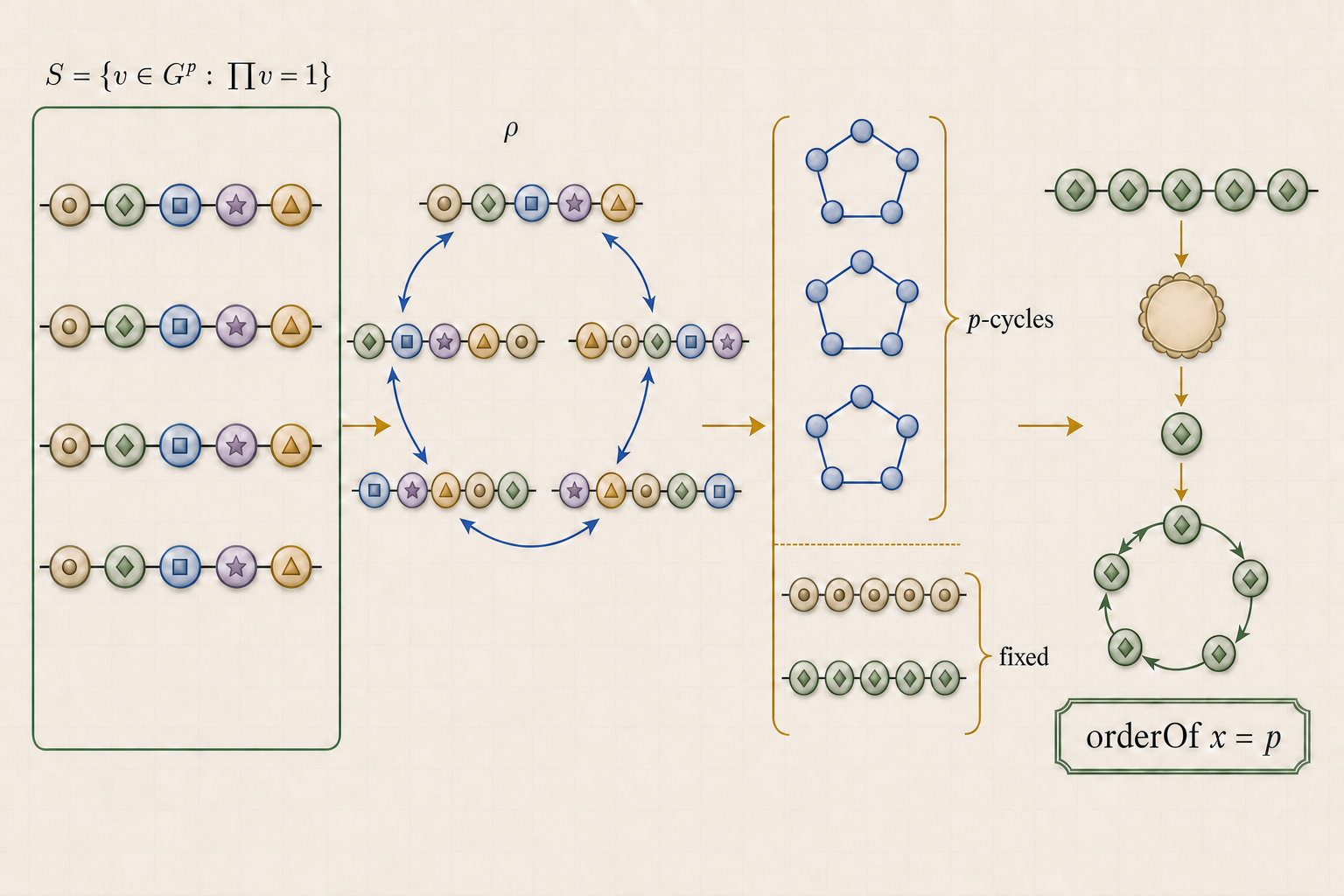
Detailed visual description
This page indexes Mathlib's Fintype-cardinality form of Cauchy's theorem for finite groups: for [Group G], [Fintype G], prime p supplied by Fact, and p dividing Fintype.card G, there exists x : G with orderOf x = p. It asserts one existential witness; it does not assert uniqueness, classify the generated subgroup or any other subgroups, or state the nearby apostrophe variant using [Finite G] and Nat.card G.
Complementary intuition
A mathematical landmark
Cauchy's theorem reveals how the prime divisors of a finite group's size must appear inside the group's element structure. Mathlib's proof is especially instructive: a cyclic action on product-one tuples converts divisibility into a fixed point and then into an element of exact prime order.
The low-text schematic gives the theorem a visual identity; it does not replace the source-bound poster or exact statement.
Authoritative formal type
Exact Mathlib statement
theorem exists_prime_orderOf_dvd_card {G : Type*} [Group G] [Fintype G] (p : ℕ) [hp : Fact p.Prime] (hdvd : p ∣ Fintype.card G) : ∃ x : G, orderOf x = pSelected evidence declaration text
theorem exists_prime_orderOf_dvd_card {G : Type*} [Group G] [Fintype G] (p : ℕ) [hp : Fact p.Prime] (hdvd : p ∣ Fintype.card G) : ∃ x : G, orderOf x = pProofAtlas record
What has been checked
These states distinguish upstream identity, local reproduction, review, and Atlas acceptance. This page is part of the public, read-only Mathlib landmark collection.
Claim boundary
No new theorem is claimed
This page indexes Mathlib's Fintype-cardinality form of Cauchy's theorem for finite groups: for [Group G], [Fintype G], prime p supplied by Fact, and p dividing Fintype.card G, there exists x : G with orderOf x = p. It asserts one existential witness; it does not assert uniqueness, classify the generated subgroup or any other subgroups, or state the nearby apostrophe variant using [Finite G] and Nat.card G.
- The selected declaration gives existence of an element of exact order p; it does not claim that the element is unique or canonical.
- The declaration does not classify the cyclic subgroup generated by the witness or any other subgroups of G.
- The selected endpoint uses [Fintype G] and Fintype.card G, not the nearby apostrophe variant using [Finite G] and Nat.card G.
- ProofAtlas is indexing an existing Mathlib theorem, and generated explanations and visuals are not proof evidence.
Provenance
Origin and evidence stay separate
- Existing declaration
exists_prime_orderOf_dvd_cardin mathlib- Relationship
- The checked artifact is the upstream declaration itself
- Preferred checked artifact
artifact.library.mathlib.cauchy-theorem-finite-groups.v001- Source handling
- Verified upstream reference; no mirrored source package