Number theory · existing Mathlib declaration
Basel Problem
The sum of the reciprocals of the positive perfect squares is exactly π squared divided by six.
- Basel problem
- reciprocal-square series
- Bernoulli functions
- Fourier coefficients
- even zeta values
The theorem at a glance
Basel Problem — reciprocal squares sum to π²/6
A source-bound editorial overview of the exact Mathlib formulation. The image is explanatory; the statement map, formal type, and pinned source remain authoritative.
Basel Problem — reciprocal squares sum to π²/6
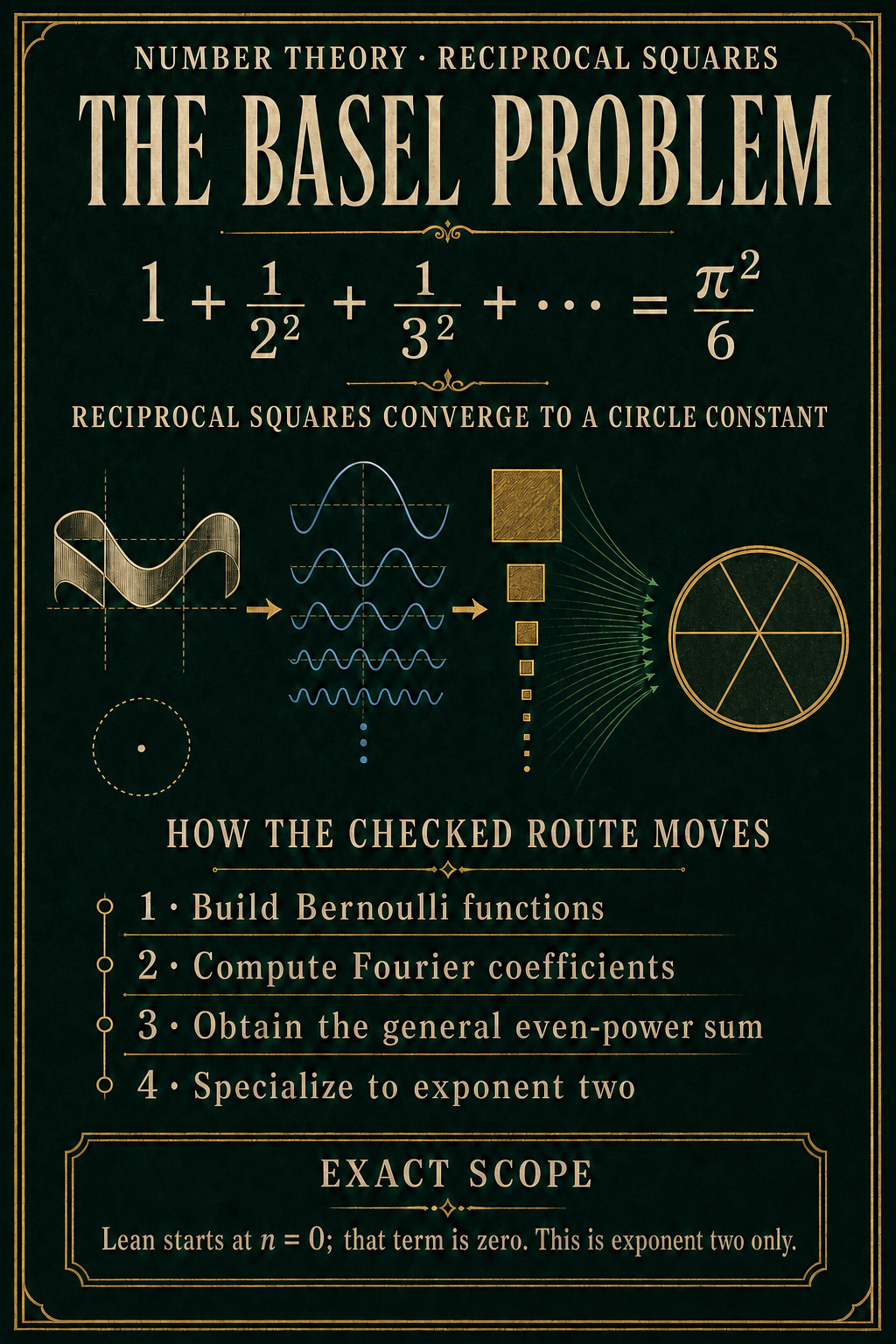
Detailed visual description
The familiar reciprocal-square equation dominates a sparse engraved poster. A periodic Bernoulli ribbon, harmonics with square-diminishing amplitudes, and a six-bay circle-and-square seal support four short source movements and an exact-scope footer explaining the natural-index zero term.
Formal orientation
Statement map
This deterministic map orients the reader from the mathematical summary to the pinned declaration and exact checked form. The HTML statement below is authoritative.
Basel Problem — scientific diagram
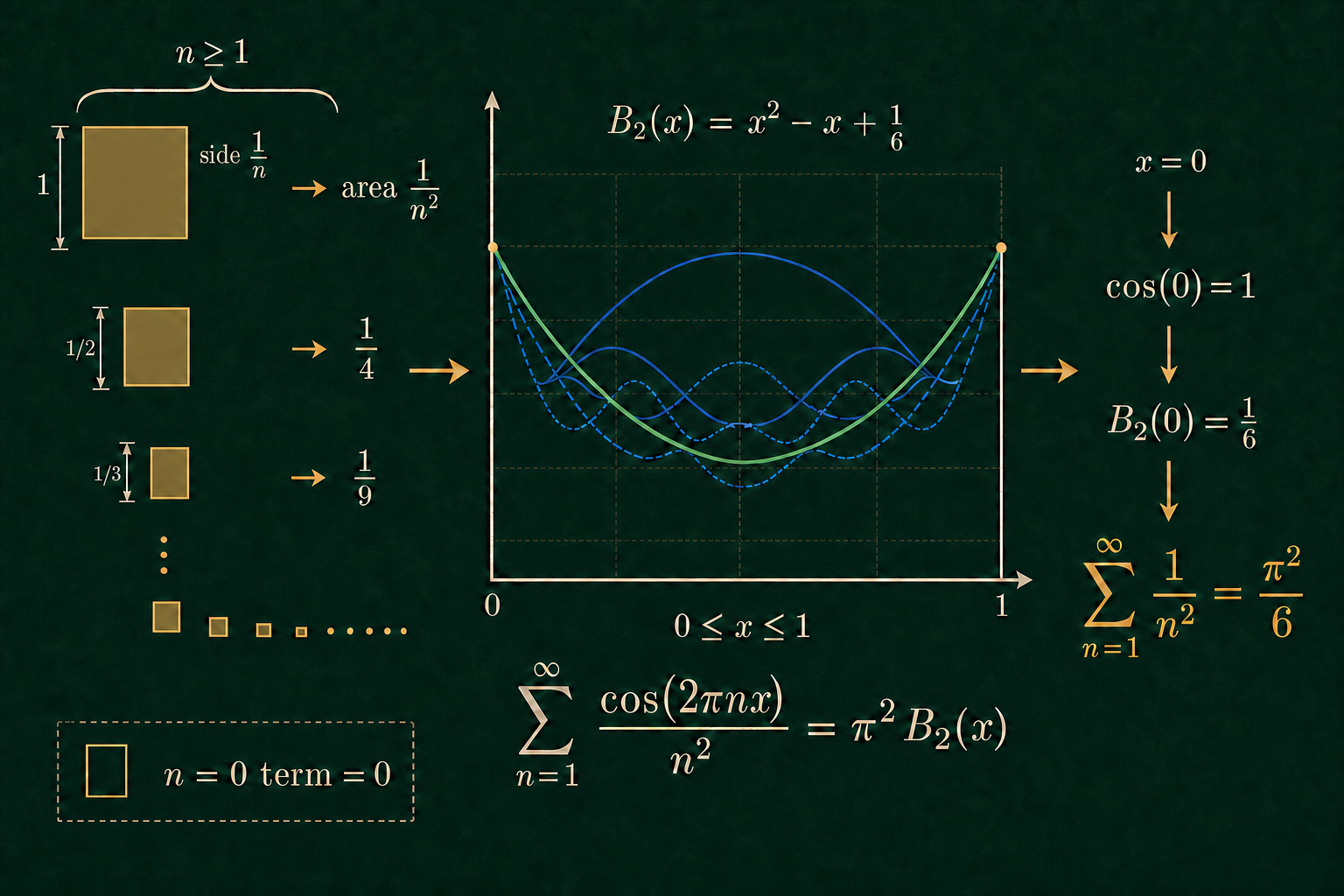
Detailed visual description
This page presents Mathlib's real HasSum statement for n ↦ 1/(n:ℝ)^2 with value π^2/6. Its natural-number indexing includes n = 0, whose term is zero under Lean's totalized real division, so it represents the usual series over positive integers. The selected declaration is only the exponent-two specialization, not a generic theorem about all zeta values.
Complementary intuition
A mathematical landmark
The Basel problem is one of the most recognizable exact evaluations of an infinite series. Mathlib's declaration exposes it as a concise specialization resting on a substantial Bernoulli-function and Fourier-coefficient development.
The low-text schematic gives the theorem a visual identity; it does not replace the source-bound poster or exact statement.
Authoritative formal type
Exact Mathlib statement
theorem hasSum_zeta_two : HasSum (fun n : ℕ => (1 : ℝ) / (n : ℝ) ^ 2) (π ^ 2 / 6)Selected evidence declaration text
theorem hasSum_zeta_two : HasSum (fun n : ℕ => (1 : ℝ) / (n : ℝ) ^ 2) (π ^ 2 / 6)ProofAtlas record
What has been checked
These states distinguish upstream identity, local reproduction, review, and Atlas acceptance. This page is part of the public, read-only Mathlib landmark collection.
Claim boundary
No new theorem is claimed
This page presents Mathlib's real HasSum statement for n ↦ 1/(n:ℝ)^2 with value π^2/6. Its natural-number indexing includes n = 0, whose term is zero under Lean's totalized real division, so it represents the usual series over positive integers. The selected declaration is only the exponent-two specialization, not a generic theorem about all zeta values.
- The exact declaration is a real HasSum statement indexed by natural numbers.
- The n = 0 term is zero because real division in Lean is totalized; the nonzero terms form the usual positive-index series.
- The selected declaration concerns exponent two only and is not itself the general even-zeta theorem.
- It gives an exact sum, not a quantitative convergence rate or error bound.
- ProofAtlas is indexing an existing Mathlib theorem, not claiming a new proof or new mathematics.
- The generated explanation and visuals are not proof evidence.
Provenance
Origin and evidence stay separate
- Existing declaration
hasSum_zeta_twoin mathlib- Relationship
- The checked artifact is the upstream declaration itself
- Preferred checked artifact
artifact.library.mathlib.basel-problem.v001- Source handling
- Verified upstream reference; no mirrored source package