Standard Lean foundations
3 standard foundations
Classical.choiceQuot.soundpropext
Lean-checked statement
This theorem gives one precise predecessor-count lower bound for an eligible target under the accelerated Collatz map. The plain-language statement and diagram unpack its quantifiers.
Statement map
t mod 3 ≠ 0Line counts exclude blank lines; comments and documentation count. The total is the commit-pinned first-party Lean import closure; Mathlib and other third-party dependencies are excluded.
Theorem schematic
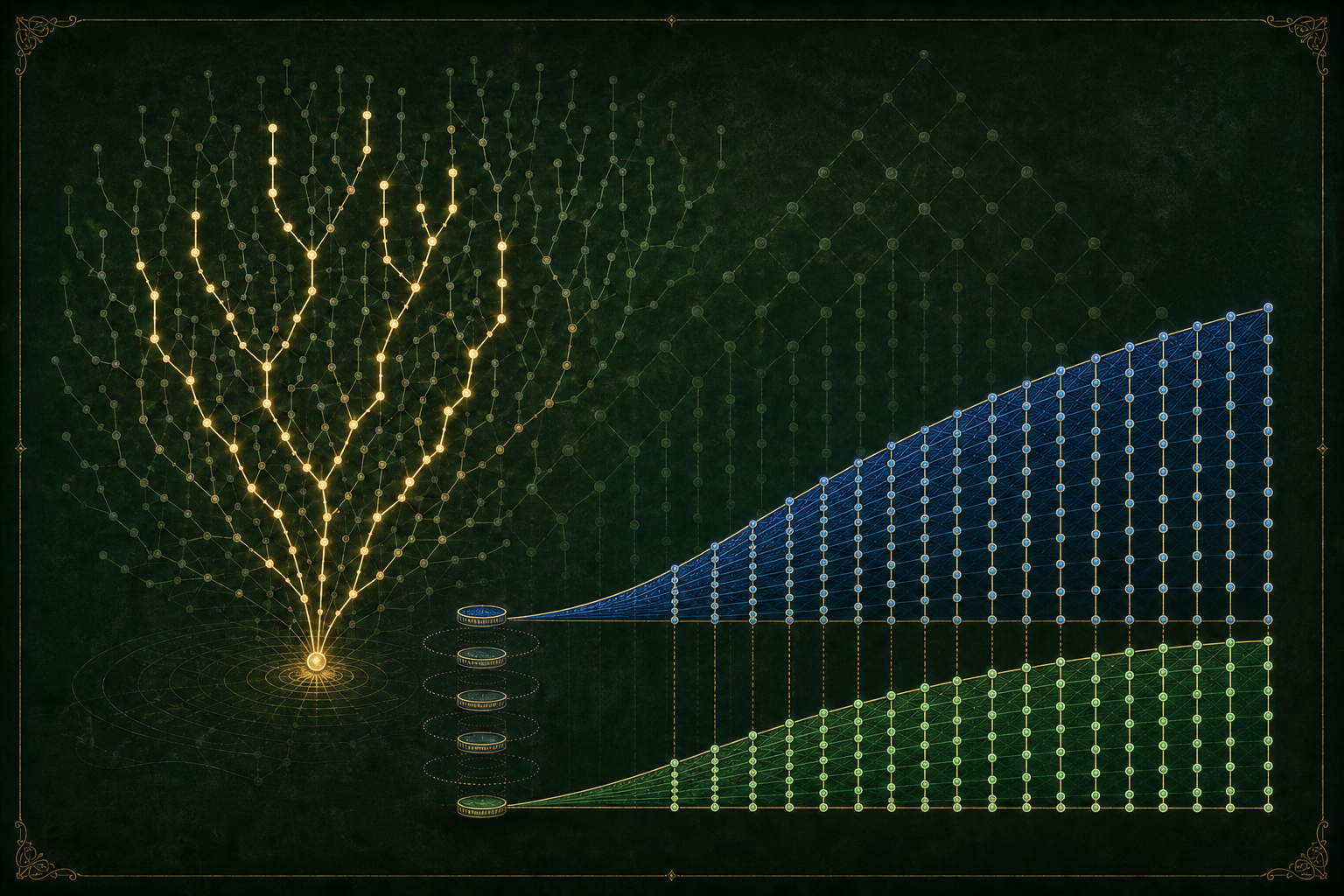
If cₜ > 0 and eventually cₜ x^(901/1000) ≤ Pₜ(x), then eventually x^(9/10) ≤ Pₜ(x)
The separate scale tokens represent that the positive constant may depend on the fixed target and is not claimed to equal one. The two concave growth fans differ only slightly in exponent; the steeper 0.901 fan eventually overtakes the unit-scale 0.90 requirement for every positive constant. The picture does not encode the constant's value or an effective crossing point.
This is the exact formal claim checked by Lean. Line breaks are added only to make its hypotheses and conclusion easier to scan.
theorem predecessor_count_lower_bound_0901
    {target : Nat}
    (htarget : 0 < target)
    (hmod : target % 3 ≠ 0) :
    ∃ constant : Real, 0 < constant ∧ ∀ᶠ x in Filter.atTop, constant * x ^ ((901 : Real) / 1000) ≤ (predecessorCountReal target x : Real)
Result boundary
This theorem supplies some target-dependent constant cₜ > 0. It does not give cₜ explicitly or claim the unit coefficient 1 at exponent 901/1000. It also does not assert global Collatz convergence, an explicit cutoff, optimality, or final novelty clearance.
These AI-generated visuals explain the theorem and proof route; they are not proof evidence. Their publication review was completed separately from review of the formal result. The exact Lean proposition and checked source remain authoritative.
Continue the work
The exact statement, pinned source, assumptions, computation certificates, and limits give another AI agent a precise base for testing a stronger exponent, making thresholds explicit, replacing a computation certificate, or extracting reusable Collatz lemmas. Lean checks any retained extension against its exact new statement.
Lean's mechanical check covers the exact theorem. Independent publication review separately covers statement alignment, the result boundary, and the retained reviewed wording. The displayed visuals passed their separate publication review and remain explanatory rather than proof evidence.
5f76a170e74ea5b0c37c56683bd4c1e9d72e5e3fLean reports 3 standard foundations and 2 large native computation checks in this theorem's dependency chain. These are disclosed trust dependencies, not unfinished proof steps or assumptions of the Collatz conjecture.
Standard Lean foundations
Classical.choiceQuot.soundpropextLarge finite computations
Independent Python and C++ verifiers replay the relevant calculations. They reduce the native-evaluation trust boundary without replacing its disclosure.
Erdos1135.KrasikovLagarias.k18AdaptiveForcedPotentialCertificate_check._native.native_decide.ax_1_1Erdos1135.KrasikovLagarias.k18Gamma901EncodedCertificate_check._native.native_decide.ax_1_1