For each index i, choose a compact subset s i of a topological space X i. The set of all dependent functions x with x i inside s i for every i is compact in the product topology, even when the index type is infinite.
Accepted Atlas resultNot recorded for the preferred artifact
These states distinguish upstream identity, local reproduction, review, and Atlas acceptance. This page is part of the public, read-only Mathlib landmark collection.
Formal orientation
Statement map
This deterministic map orients the reader from the mathematical summary to the pinned declaration and exact checked form. The HTML statement below is authoritative.
The theorem at a glance
Tychonoff's Theorem at a glance
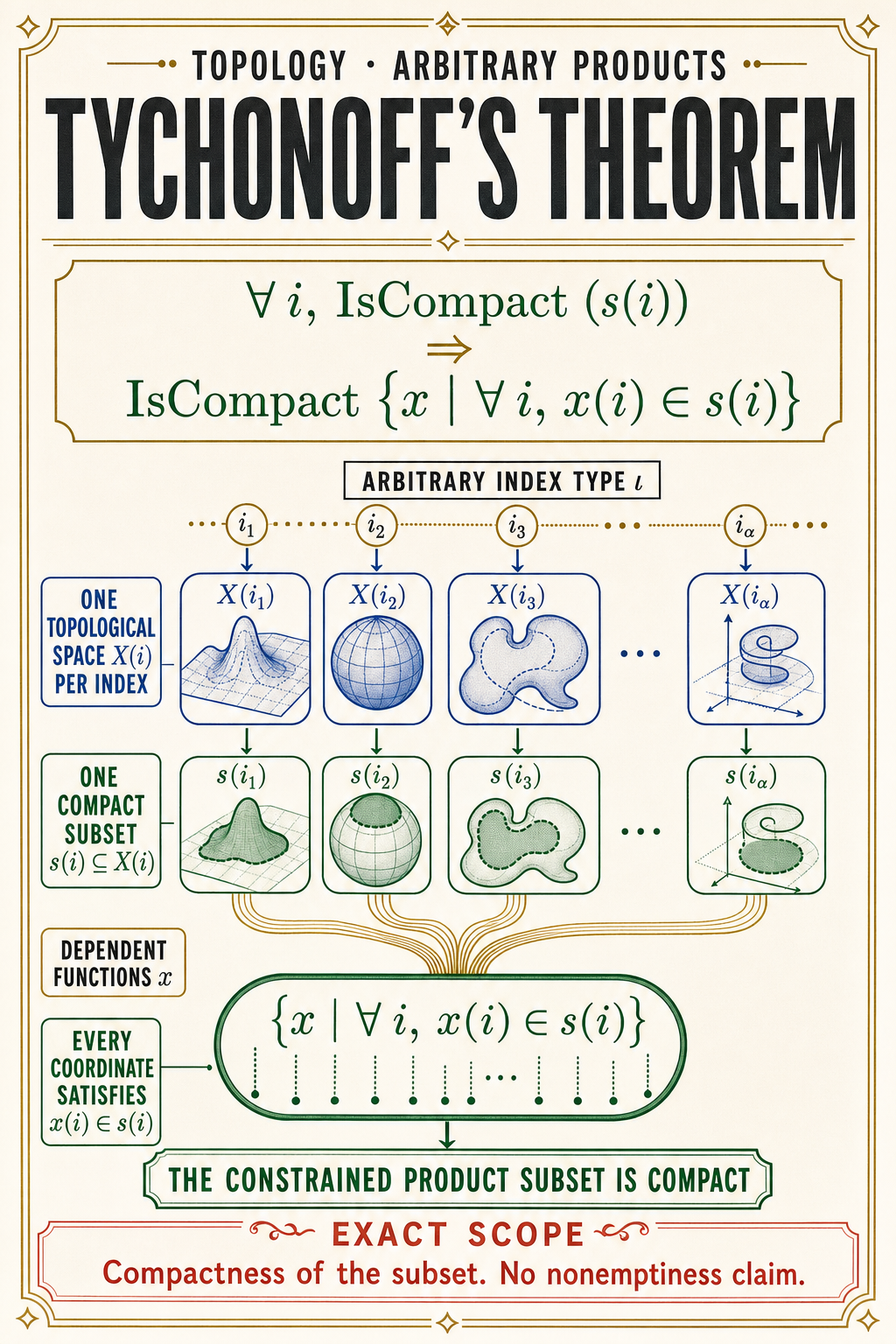
A source-bound editorial overview of the exact Mathlib formulation. The image is explanatory; the statement map, formal type, and pinned source remain authoritative.
Tychonoff's Theorem at a glance
Loading full-resolution image…
Compact coordinate subsets over an arbitrary index type form a compact constrained dependent product, with no nonemptiness claim.Open original image in a new tab ↗
Compact coordinate subsets over an arbitrary index type form a compact constrained dependent product, with no nonemptiness claim. Generated explanation only; the exact HTML statement and pinned source are authoritative.Detailed visual description
An arbitrary index line continues through several coordinate worlds X(i), each containing a marked compact region s(i). Gold dependency threads gather the family into the set of dependent functions satisfying every coordinate constraint. The conclusion and a red footer distinguish compactness of this subset from nonemptiness.
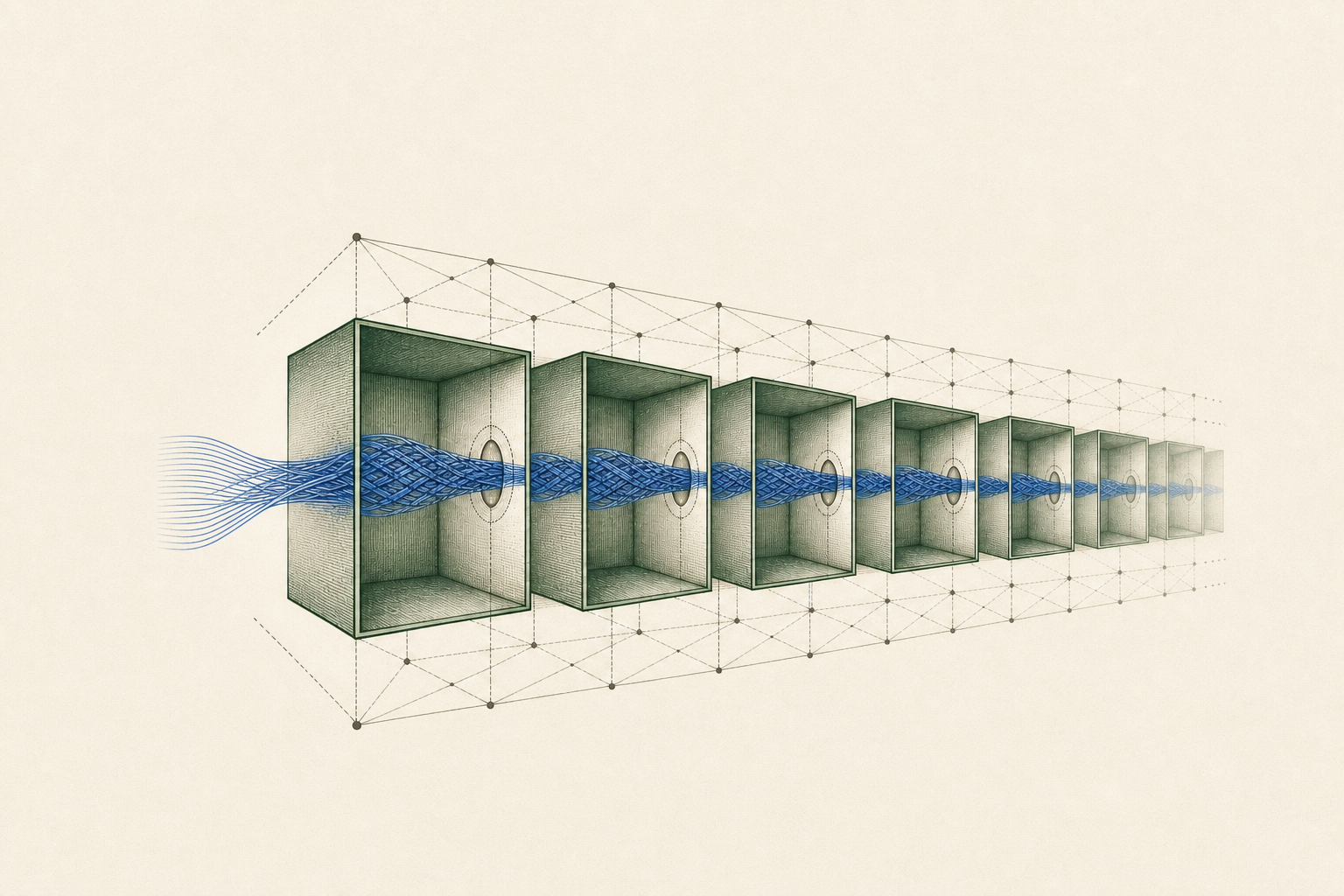
Infinite product compactness schematic
Loading full-resolution image…
Compact coordinate spaces combine into a compact product; the receding family suggests an unrestricted index set.Open original image in a new tab ↗
Compact coordinate spaces combine into a compact product; the receding family suggests an unrestricted index set. Generated explanation only; the exact HTML statement and pinned source are authoritative.Detailed visual description
On a forest-green engraved field, many self-contained glass-like worlds continue toward the horizon. Fine colored filaments run from the factors into a gold lattice held beneath a closed dome, visually separating the family of factors from the resulting product space.
Complementary intuition
A mathematical landmark
Tychonoff's theorem is one of topology's central compactness principles. Its arbitrary-product scope is a decisive reason product topology is defined as it is.
The low-text schematic gives the theorem a visual identity; it does not replace the source-bound poster or exact statement.
Authoritative formal type
Exact Mathlib statement
isCompact_pi_infinite {ι : Type u₁} {X : ι → Type u₂} [(i : ι) → TopologicalSpace (X i)] {s : (i : ι) → Set (X i)} : (∀ i, IsCompact (s i)) → IsCompact {x | ∀ i, x i ∈ s i}
Selected evidence declaration text
theorem isCompact_pi_infinite {ι : Type u₁} {X : ι → Type u₂} [(i : ι) → TopologicalSpace (X i)] {s : (i : ι) → Set (X i)} : (∀ i, IsCompact (s i)) → IsCompact {x | ∀ i, x i ∈ s i}
Proof architecture
How ultrafilter limits prove product compactness
3 curated stages
The checked source rewrites compactness and product convergence in ultrafilter form, maps the ultrafilter through every coordinate evaluation, applies compactness in each factor, and then chooses the coordinate limits and reassembles them into convergence in the product topology.
These source-anchored stages explain the retained Mathlib proof route. They are generated explanations, not proof evidence or an extracted Lean proof-term dependency graph.
01
Product compactness becomes an ultrafilter convergence problem
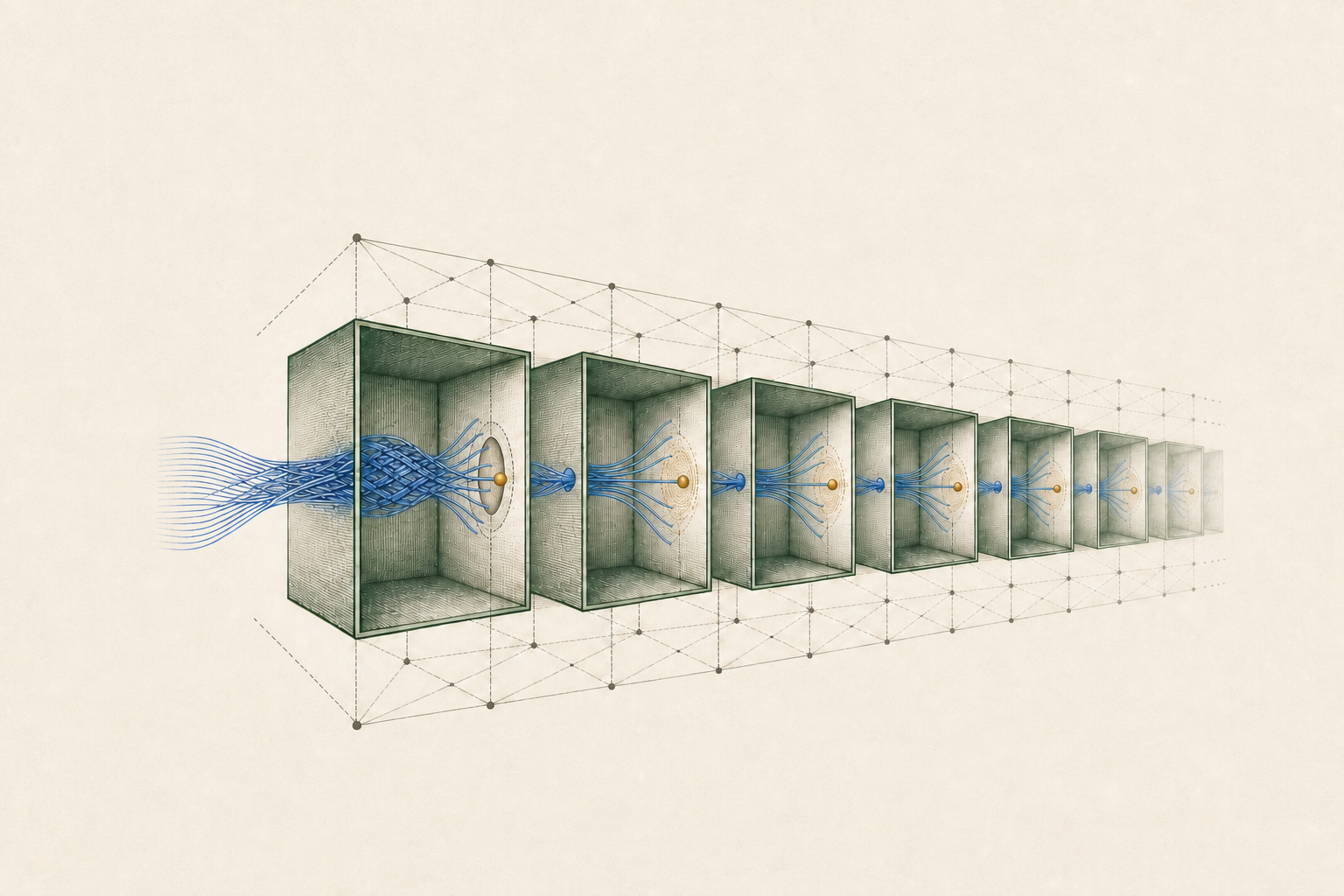
Product compactness becomes an ultrafilter convergence problem
Loading full-resolution image…
Mathlib rewrites compactness, product neighborhoods, and product membership so the proof begins with an ultrafilter containing the constrained product subset.Open original image in a new tab ↗
Mathlib rewrites compactness, product neighborhoods, and product membership so the proof begins with an ultrafilter containing the constrained product subset.
f <= principal {x | forall i, x i in s i} implies a required product limit
isCompact_iff_ultrafilter_le_nhds, nhds_pi, le_pi, and le_principal_iff transform the compactness goal into a convergence problem for an arbitrary ultrafilter lying over the dependent product subset. This reformulation introduces no coordinate witnesses yet.
02
Every coordinate projection acquires a compact limit
Every coordinate projection acquires a compact limit
Loading full-resolution image…
Mapping the ultrafilter through each evaluation map preserves membership in the corresponding compact set, so coordinate compactness provides a limit point there.Open original image in a new tab ↗
Mapping the ultrafilter through each evaluation map preserves membership in the corresponding compact set, so coordinate compactness provides a limit point there.
exists x, x in s i and Tendsto (Function.eval i) f (nhds x)
For each index i, Mathlib maps the ultrafilter through Function.eval i. Membership of the constrained product implies that the mapped ultrafilter contains s i; compactness of s i then supplies a point x i in that set and convergence of the projected filter to it.
03
Coordinate limits reassemble into a product limit
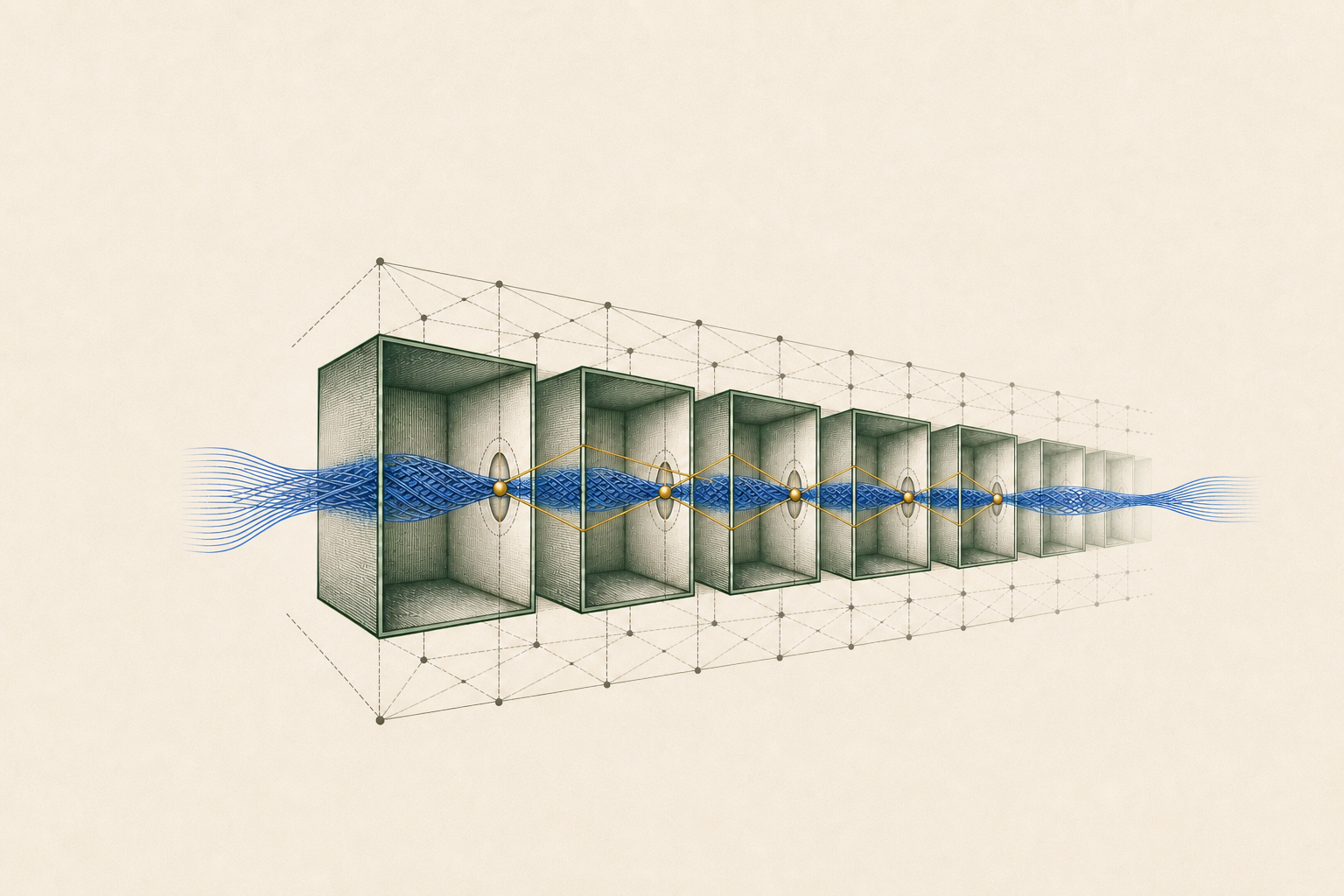
Coordinate limits reassemble into a product limit
Loading full-resolution image…
Dependent choice selects the coordinate limits; their membership and coordinatewise convergence assemble the required point and convergence in the product topology.Open original image in a new tab ↗
Dependent choice selects the coordinate limits; their membership and coordinatewise convergence assemble the required point and convergence in the product topology.
x i in s i for every i, and Tendsto f (nhds x)
choose x hx using this forms the dependent function from the coordinate witnesses. The membership component of hx i places the resulting function in the constrained product, while the convergence component for every coordinate reassembles through le_pi into convergence to that function in the product topology.
Claim boundary
No new theorem is claimed
The selected Mathlib declaration proves compactness of the dependent product subset {x | ∀ i, x i ∈ s i}. It does not state a finite-product-only result, and the page does not hide the family of topology instances or identify explanatory artwork with proof evidence.
Proof Atlas did not originate Tychonoff's theorem or Mathlib's declaration.
The local evidence checks this exact upstream declaration at one pinned Mathlib commit.
The page does not independently classify the theorem's foundational choice principles beyond the recorded axiom report.