On a compact space, a real algebra of continuous functions that can distinguish every pair of points can approximate every continuous real-valued target as closely as desired in uniform distance.
Accepted Atlas resultNot recorded for the preferred artifact
These states distinguish upstream identity, local reproduction, review, and Atlas acceptance. This page is part of the public, read-only Mathlib landmark collection.
Formal orientation
Statement map
This deterministic map orients the reader from the mathematical summary to the pinned declaration and exact checked form. The HTML statement below is authoritative.
The theorem at a glance
Stone–Weierstrass Theorem at a glance
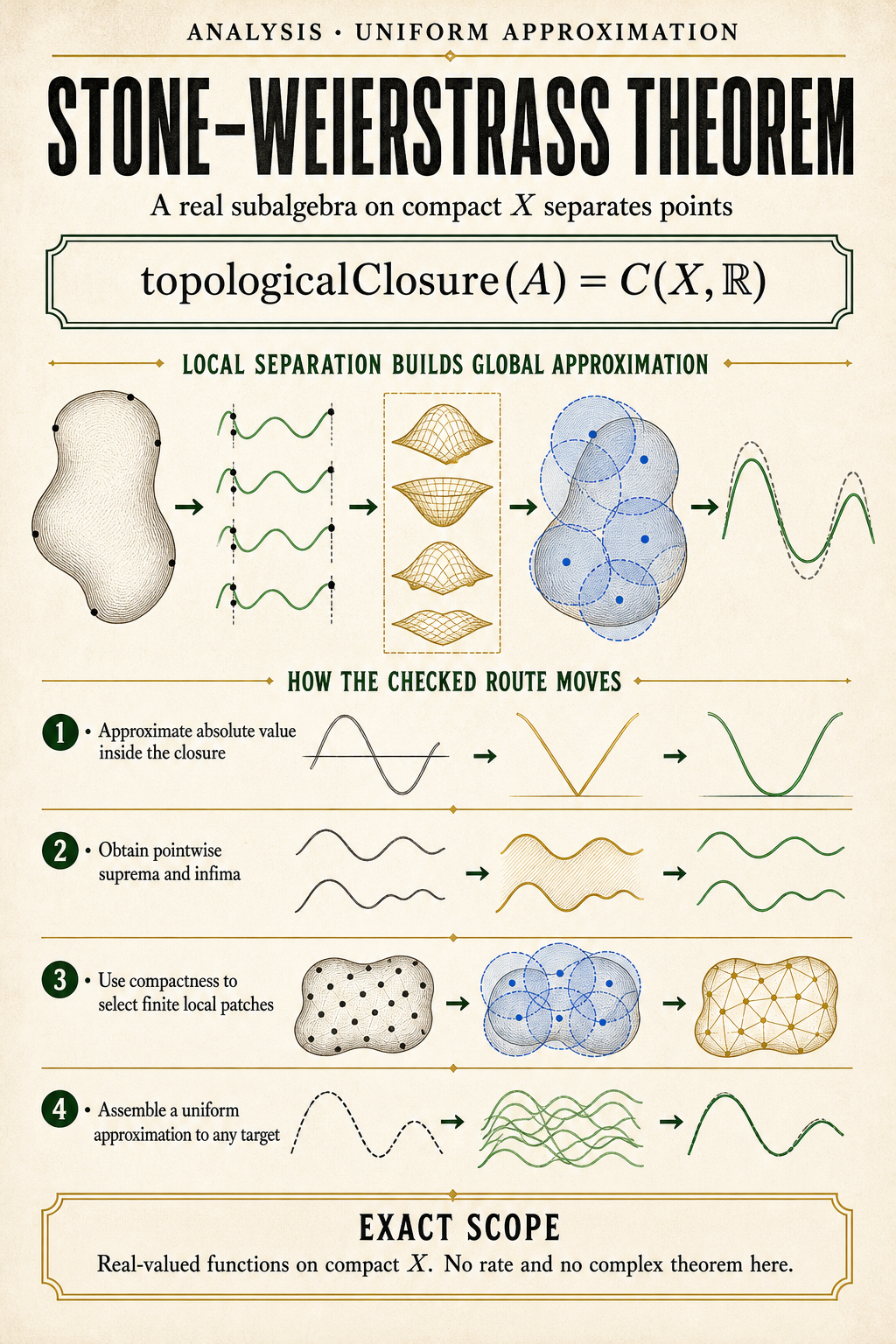
A source-bound editorial overview of the exact Mathlib formulation. The image is explanatory; the statement map, formal type, and pinned source remain authoritative.
Stone–Weierstrass Theorem at a glance
Loading full-resolution image…
A point-separating real subalgebra is uniformly dense in the continuous real-valued functions on a compact space.Open original image in a new tab ↗
A point-separating real subalgebra is uniformly dense in the continuous real-valued functions on a compact space. Generated explanation only; the exact HTML statement and pinned source are authoritative.Detailed visual description
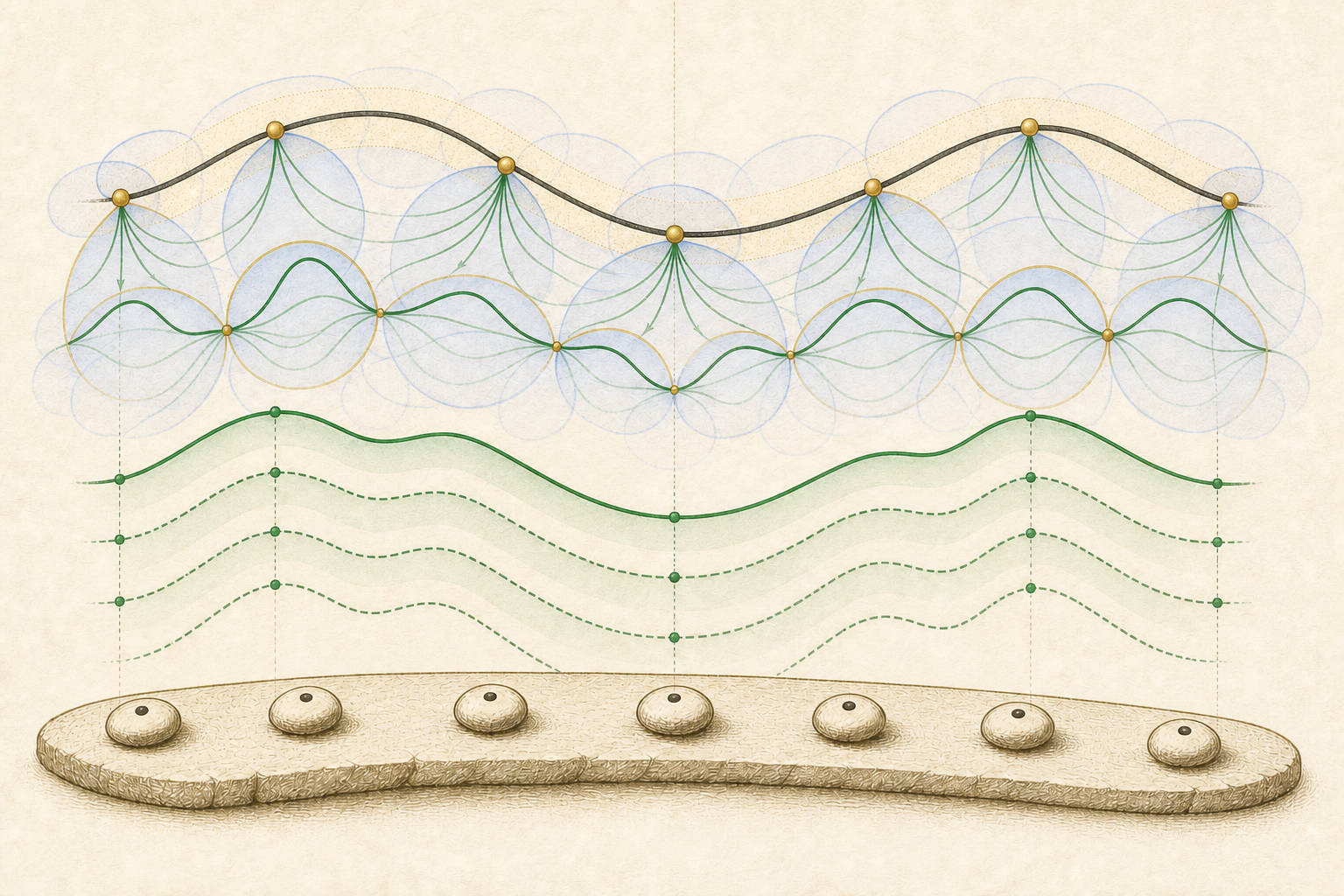
The poster presents the exact compact real-valued theorem and the four checked movements from absolute-value closure through finite lattice patching to uniform approximation, without claiming a rate or complex version.
Stone–Weierstrass Theorem schematic
Loading full-resolution image…
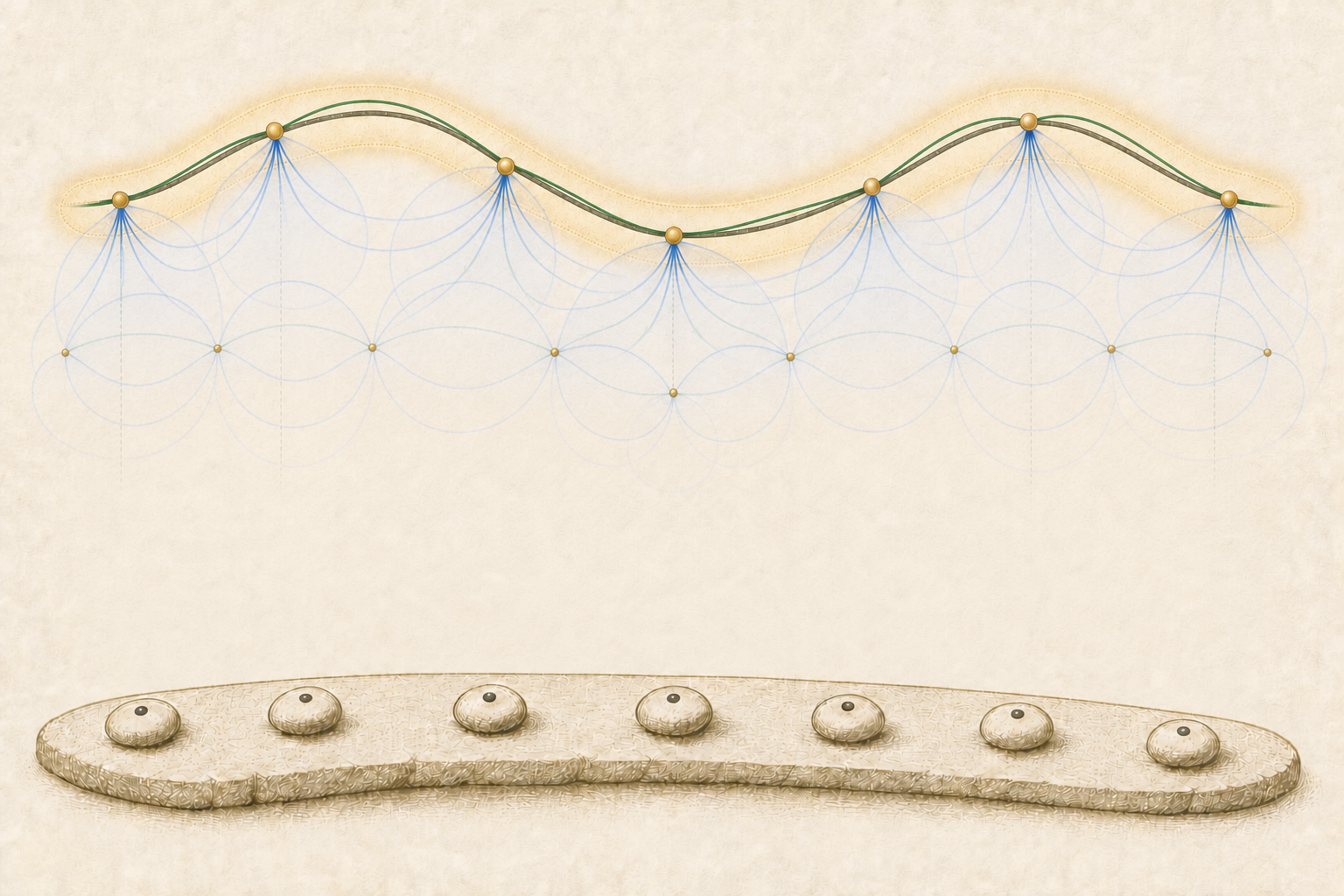
Point separation, lattice closure, and compact finite patching produce uniform approximation of every real continuous target.Open original image in a new tab ↗
Point separation, lattice closure, and compact finite patching produce uniform approximation of every real continuous target. Generated explanation only; the exact HTML statement and pinned source are authoritative.Detailed visual description
A fixed compact domain carries a target curve and a point-separating algebra. Absolute-value and finite lattice operations convert local approximants selected by compactness into a final curve that remains uniformly close to the target.
Complementary intuition
A mathematical landmark
Stone–Weierstrass turns a local ability to separate points into a global density theorem. It is a central bridge among algebra, topology, compactness, and approximation theory.
The low-text schematic gives the theorem a visual identity; it does not replace the source-bound poster or exact statement.
Mathlib's real Stone–Weierstrass route first places absolute values in the closure, uses them to obtain a function lattice, turns point separation into finitely many local approximants by compactness, and combines those patches into a uniform approximation of every continuous target.
These source-anchored stages explain the retained Mathlib proof route. They are generated explanations, not proof evidence or an extracted Lean proof-term dependency graph.
01
Absolute value enters the topological closure
Absolute value enters the topological closure
Loading full-resolution image…
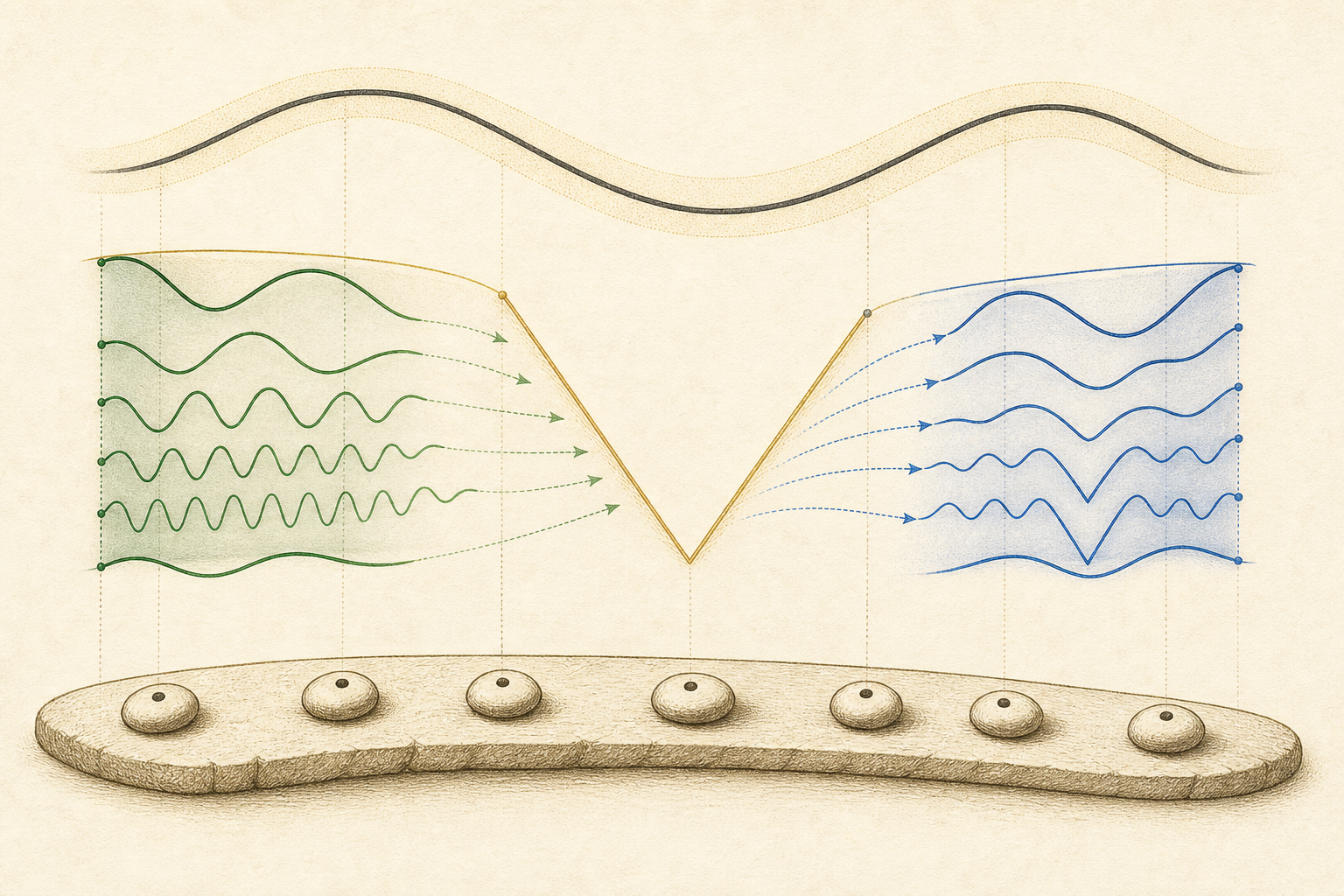
Uniform polynomial approximation on the bounded range of a continuous function brings its pointwise absolute value into the closure.Open original image in a new tab ↗
Uniform polynomial approximation on the bounded range of a continuous function brings its pointwise absolute value into the closure.
f ∈ A → |f| ∈ A.topologicalClosure
For f in the subalgebra, compactness bounds its range. Weierstrass approximation on the resulting real interval approximates the absolute-value function by polynomials; evaluating those polynomials at f shows |f| belongs to A.topologicalClosure.
02
The closure is stable under pointwise maxima and minima
The closure is stable under pointwise maxima and minima
Loading full-resolution image…
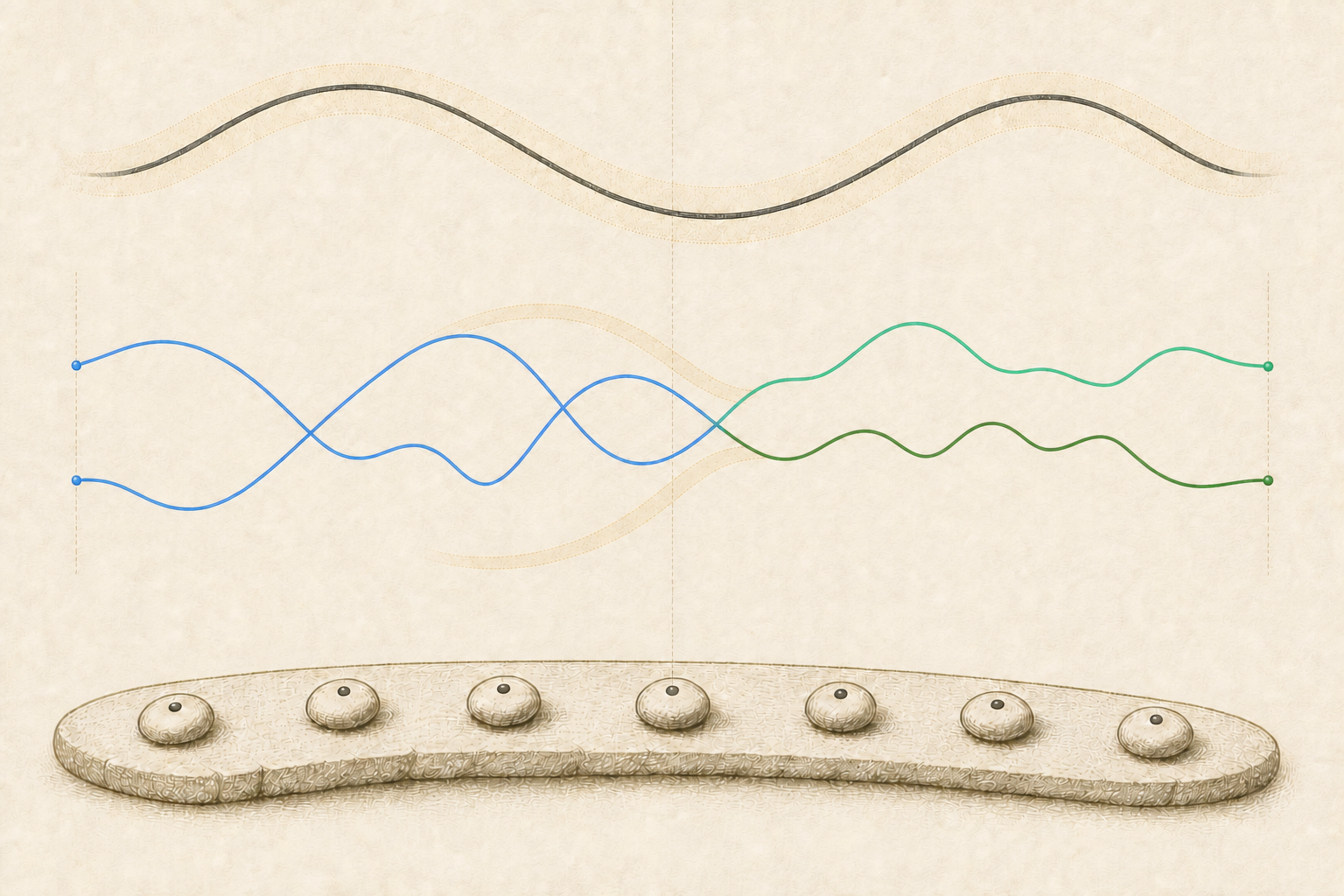
Combining addition, subtraction, and absolute value turns the closed subalgebra into a sublattice of continuous functions.Open original image in a new tab ↗
Combining addition, subtraction, and absolute value turns the closed subalgebra into a sublattice of continuous functions.
f,g ∈ closure(A) → f ⊔ g, f ⊓ g ∈ closure(A)
The checked route uses the familiar identities expressing pointwise supremum and infimum through sums, differences, and absolute values. Because the topological closure is a subalgebra containing these absolute values, it contains both lattice operations.
03
Pairwise interpolants become finite global envelopes
Pairwise interpolants become finite global envelopes
Loading full-resolution image…
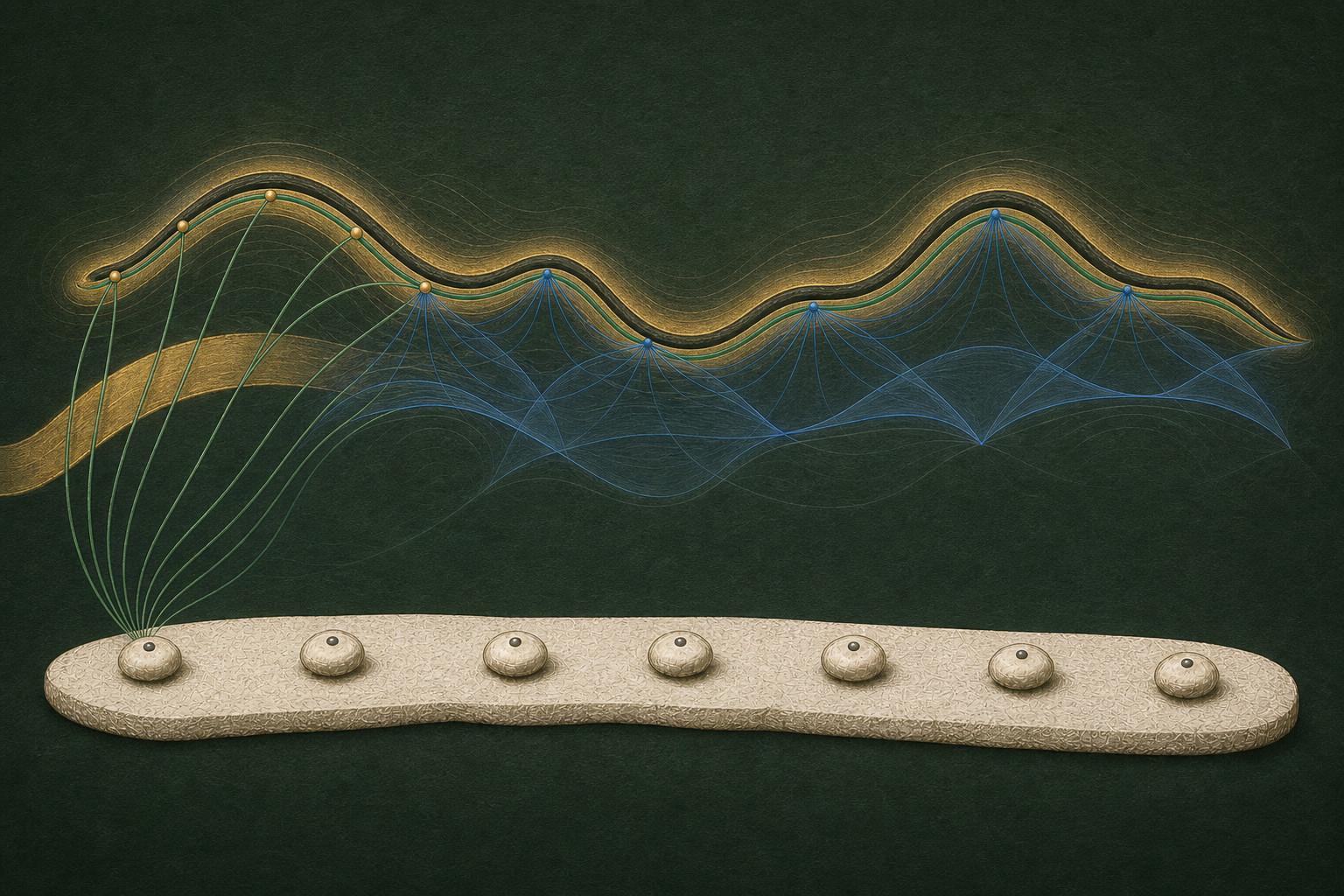
Point separation creates functions matching a target at chosen points; compactness reduces their neighborhoods to finite covers.Open original image in a new tab ↗
Point separation creates functions matching a target at chosen points; compactness reduces their neighborhoods to finite covers.
finite suprema and infima from compact subcovers
For points x and y, strong point separation supplies a function agreeing with the target at both points. Continuity keeps it close on neighborhoods. Compactness selects finitely many such patches. Finite suprema produce functions above the target minus the error while still anchored at a chosen point; a second finite cover prepares the final infimum.
04
A finite infimum closes the uniform error band
A finite infimum closes the uniform error band
Loading full-resolution image…
The final finite infimum stays between the target minus and plus the chosen error everywhere, so every continuous function lies in the closure.Open original image in a new tab ↗
The final finite infimum stays between the target minus and plus the chosen error everywhere, so every continuous function lies in the closure.
A.topologicalClosure = ⊤
The source verifies the two pointwise inequalities for the finite infimum k, obtaining uniform distance below the prescribed positive error. Applying this density result to L = A.topologicalClosure, which is nonempty, lattice-closed, and point-separating, proves that the closure is the entire real continuous-function algebra.
Claim boundary
No new theorem is claimed
This target indexes Mathlib's real compact-space subalgebra theorem: a subalgebra of continuous real-valued functions that separates points has topological closure equal to the whole function algebra. It does not state the complex version or approximation rates.
Proof Atlas did not originate the Stone–Weierstrass Theorem or Mathlib's declaration.
The selected declaration is real-valued on a compact space and provides no quantitative approximation rate.
The generated explanation and visuals are not proof evidence.