Linear algebra · existing Mathlib theorem
Rank–Nullity Theorem
A linear map collapses the directions in its kernel and carries the surviving quotient directions into its range. Those two cardinal-rank contributions recover the rank of the original domain.
- linear map
- kernel
- range
- quotient module
- cardinal rank
Four separate status axes
These states distinguish upstream identity, local reproduction, review, and Atlas acceptance. This page is part of the public, read-only Mathlib landmark collection.
Formal orientation
Statement map
This deterministic map orients the reader from the mathematical summary to the pinned declaration and exact checked form. The HTML statement below is authoritative.
The theorem at a glance
Rank–Nullity Theorem at a glance
A source-bound editorial overview of the exact Mathlib formulation. The image is explanatory; the statement map, formal type, and pinned source remain authoritative.
Rank–Nullity Theorem at a glance
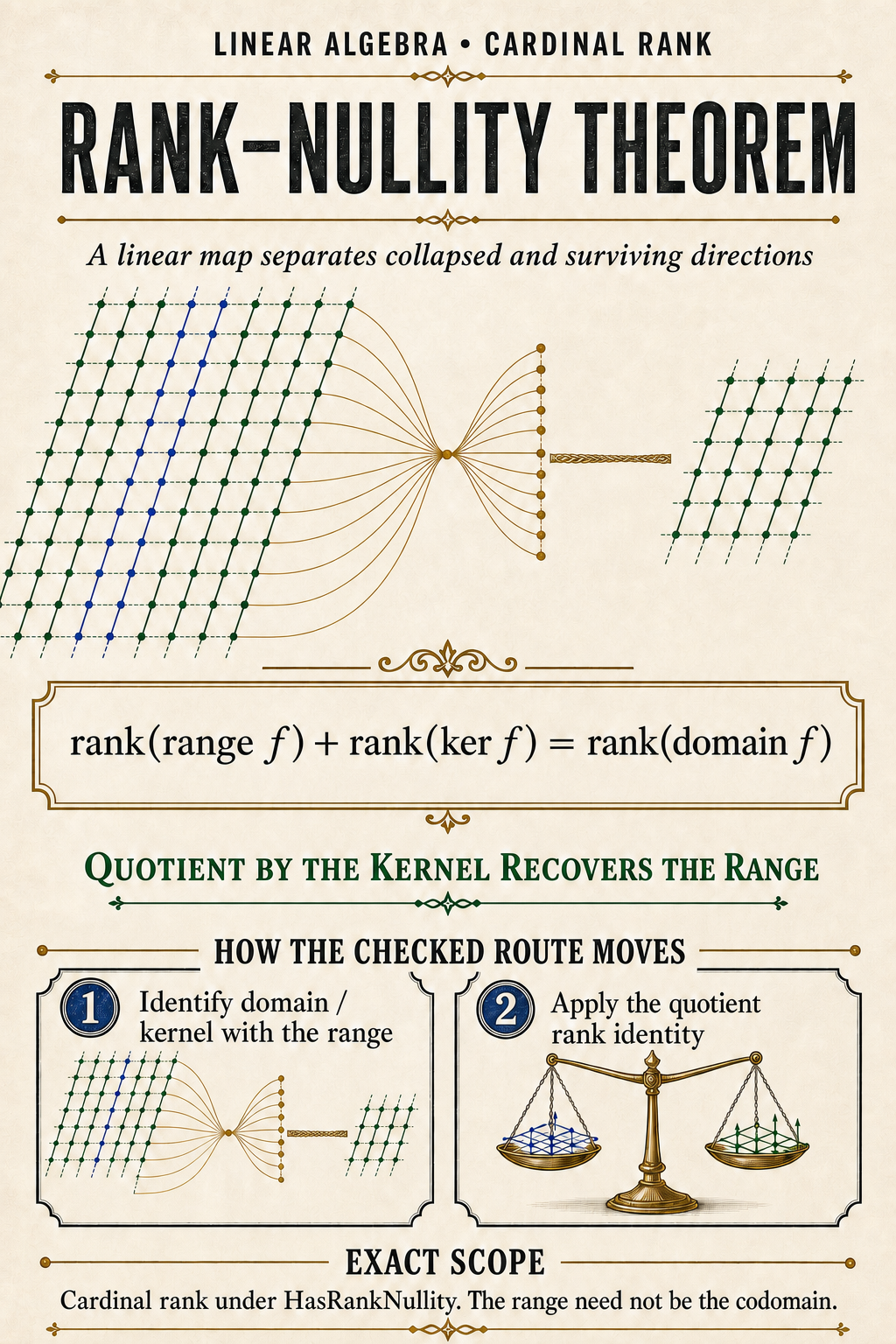
Detailed visual description
The poster separates collapsed kernel directions from the surviving quotient, connects that quotient to the range, and states the exact cardinal-rank theorem without replacing it by a finite matrix example.
Rank–Nullity Theorem schematic

Detailed visual description
Parallel kernel-direction fibers foliate the entire domain rather than splitting it into complementary regions. Collapsing each full coset produces the quotient; a central gold equivalence carries those classes to the range, while the encompassing brace relates the kernel and range contributions back to the domain without assuming finite dimension.
Complementary intuition
A mathematical landmark
Rank–nullity is the structural accounting principle behind linear equations, kernels, images, quotient spaces, and dimension arguments. Mathlib's selected declaration records the stronger cardinal-rank form rather than only the familiar finite-dimensional formula.
The low-text schematic gives the theorem a visual identity; it does not replace the source-bound poster or exact statement.
Authoritative formal type
Exact Mathlib statement
theorem LinearMap.rank_range_add_rank_ker {R M M₁ : Type*} [Ring R] [AddCommGroup M] [AddCommGroup M₁] [Module R M] [Module R M₁] [HasRankNullity R] (f : M →ₗ[R] M₁) : Module.rank R f.range + Module.rank R f.ker = Module.rank R MSelected evidence declaration text
theorem LinearMap.rank_range_add_rank_ker {R M M₁ : Type*} [Ring R] [AddCommGroup M] [AddCommGroup M₁] [Module R M] [Module R M₁] [HasRankNullity R] (f : M →ₗ[R] M₁) : Module.rank R f.range + Module.rank R f.ker = Module.rank R MClaim boundary
No new theorem is claimed
This target indexes Mathlib's cardinal-rank identity for a linear map under its HasRankNullity hypothesis: the ranks of the range and kernel add to the rank of the domain. It is not merely the finite-dimensional natural-number formula and does not claim a new proof.
- Proof Atlas did not originate the Rank–Nullity Theorem or Mathlib's declaration.
- The range is not asserted to equal the codomain, and the map need not be injective or surjective.
- The generated explanation and visuals are not proof evidence.
Provenance
Origin and evidence stay separate
- Existing declaration
LinearMap.rank_range_add_rank_kerin mathlib- Relationship
- The checked artifact is the upstream declaration itself
- Preferred checked artifact
artifact.library.mathlib.rank-nullity-theorem.v001- Source handling
- Verified upstream reference; no mirrored source package