If a real-valued function is continuous on a closed interval and differentiable between its endpoints, then at some strictly interior point its instantaneous rate of change equals its average rate of change across the interval.
Accepted Atlas resultNot recorded for the preferred artifact
These states distinguish upstream identity, local reproduction, review, and Atlas acceptance. This page is part of the public, read-only Mathlib landmark collection.
Formal orientation
Statement map
This deterministic map orients the reader from the mathematical summary to the pinned declaration and exact checked form. The HTML statement below is authoritative.
The theorem at a glance
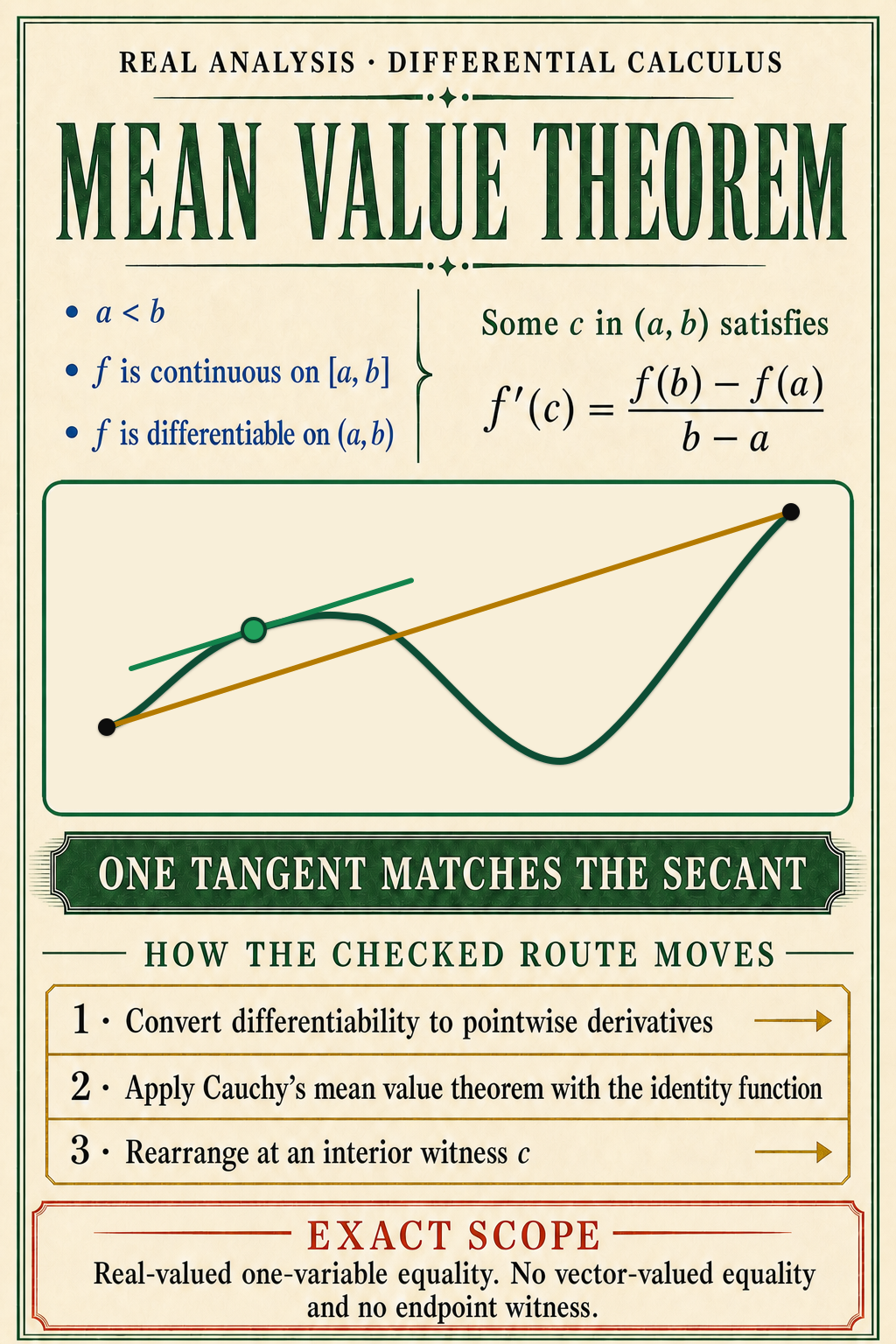
Mean Value Theorem at a glance
A source-bound editorial overview of the exact Mathlib formulation. The image is explanatory; the statement map, formal type, and pinned source remain authoritative.
Continuity and differentiability force an interior derivative to equal the endpoint secant slope. Generated explanation only; the exact HTML statement and pinned source are authoritative.Detailed visual description
The poster presents the closed-interval and open-interval hypotheses, the exact real-valued slope equality, the Cauchy mean-value route used by the selected source, and the theorem's nonclaims.
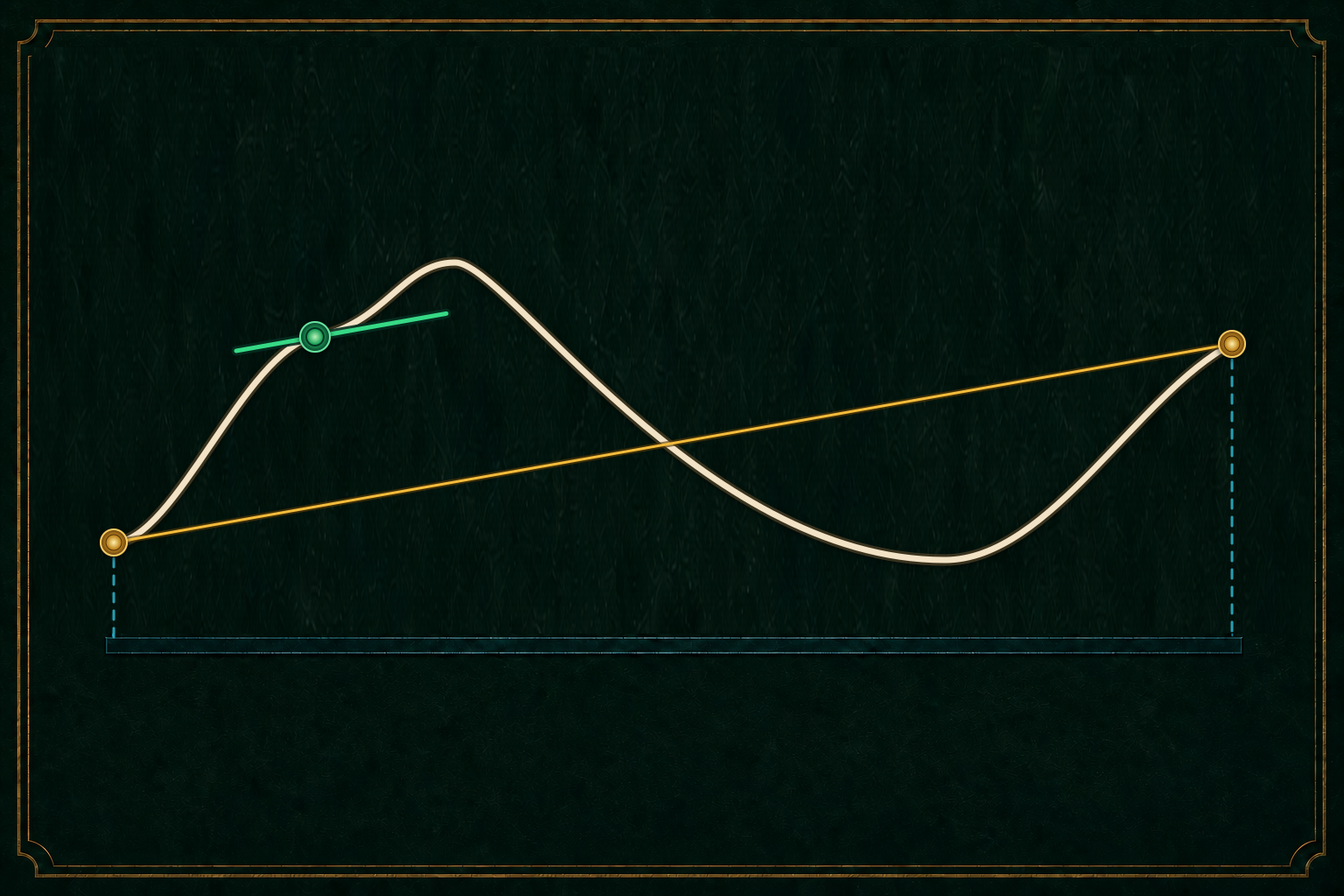
An interior tangent matches the secant between the two endpoint values. Generated explanation only; the exact HTML statement and pinned source are authoritative.Detailed visual description
A low-text engraved curve schematic isolates the theorem's two endpoints, one strictly interior witness, and the matching directions of the endpoint secant and witness tangent.
Complementary intuition
A mathematical landmark
The Mean Value Theorem turns local derivative information into a statement about finite change. It underlies fundamental estimates, monotonicity arguments, and much of one-variable calculus.
The low-text schematic gives the theorem a visual identity; it does not replace the source-bound poster or exact statement.
Authoritative formal type
Exact Mathlib statement
theorem exists_deriv_eq_slope (f : ℝ → ℝ) {a b : ℝ} (hab : a < b) (hfc : ContinuousOn f (Set.Icc a b)) (hfd : DifferentiableOn ℝ f (Set.Ioo a b)) : ∃ c ∈ Set.Ioo a b, deriv f c = (f b - f a) / (b - a)
Selected evidence declaration text
theorem exists_deriv_eq_slope (f : ℝ → ℝ) {a b : ℝ} (hab : a < b) (hfc : ContinuousOn f (Set.Icc a b)) (hfd : DifferentiableOn ℝ f (Set.Ioo a b)) : ∃ c ∈ Set.Ioo a b, deriv f c = (f b - f a) / (b - a)
Proof architecture
How an interior derivative reaches the endpoint slope
3 curated stages
Mathlib reaches the real one-variable Mean Value Theorem through Cauchy's auxiliary construction: equalize endpoint values, invoke Rolle for an interior zero derivative, specialize the second function to the identity, and divide by the nonzero interval length.
These source-anchored stages explain the retained Mathlib proof route. They are generated explanations, not proof evidence or an extracted Lean proof-term dependency graph.
01
Cauchy's auxiliary folds the endpoint differences together
Cauchy's auxiliary folds the endpoint differences together
Loading full-resolution image…
A weighted difference of the function and the identity function has equal values at the two endpoints, preparing a Rolle witness.Open original image in a new tab ↗
A weighted difference of the function and the identity function has equal values at the two endpoints, preparing a Rolle witness.
h x = (g b - g a) * f x - (f b - f a) * g x and h a = h b
Mathlib proves Cauchy's mean value theorem by defining h x = (g b - g a) * f x - (f b - f a) * g x. Direct algebra gives h a = h b. For Lagrange's theorem the second function will be the identity, but the equal-endpoint construction is established first.
02
Rolle's theorem finds a horizontal auxiliary tangent
Rolle's theorem finds a horizontal auxiliary tangent
Loading full-resolution image…
Continuity, interior differentiability, and equal endpoint values produce an interior point where the auxiliary derivative vanishes.Open original image in a new tab ↗
Continuity, interior differentiability, and equal endpoint values produce an interior point where the auxiliary derivative vanishes.
(b - a) * f' c = (f b - f a) * 1 for some c in (a,b)
The source differentiates the auxiliary, proves it continuous on the closed interval, and invokes exists_hasDerivAt_eq_zero. Specializing the second function to the identity turns the resulting equality into the cross-multiplied Lagrange relation at one point strictly inside the interval.
03
The interior derivative matches the endpoint secant
The interior derivative matches the endpoint secant
Loading full-resolution image…
Division by the nonzero interval length and the derivative bridge turn the cross-multiplied witness into the exact selected equality.Open original image in a new tab ↗
Division by the nonzero interval length and the derivative bridge turn the cross-multiplied witness into the exact selected equality.
∃ c ∈ (a,b), deriv f c = (f b - f a) / (b - a)
Since a<b, the interval length is nonzero, so the source rearranges the cross-multiplied equation into the secant-slope formula. exists_deriv_eq_slope then converts differentiability at the interior point to HasDerivAt with deriv f, yielding an interior c whose derivative equals the endpoint slope.
Claim boundary
No new theorem is claimed
This page indexes the real one-variable Lagrange mean-value theorem: continuity on [a,b] and differentiability on (a,b) produce an interior point whose derivative equals the secant slope. It does not claim a vector-valued equality or a new proof.
Proof Atlas did not originate the Mean Value Theorem or Mathlib's declaration.
The theorem does not choose a unique witness or allow an endpoint witness.
The generated explanation and visuals are not proof evidence.