Topology and analysis · existing Mathlib theorem
Intermediate Value Theorem
If f is continuous from a to b and f(a) is below f(b), then no value between those endpoint outputs can be skipped: each one equals f(x) for some x between a and b.
- intermediate values
- continuity
- closed intervals
- connectedness
- image inclusion
Four separate status axes
These states distinguish upstream identity, local reproduction, review, and Atlas acceptance. This page is part of the public, read-only Mathlib landmark collection.
Formal orientation
Statement map
This deterministic map orients the reader from the mathematical summary to the pinned declaration and exact checked form. The HTML statement below is authoritative.
The theorem at a glance
Intermediate Value Theorem — exact interval-image form
A source-bound editorial overview of the exact Mathlib formulation. The image is explanatory; the statement map, formal type, and pinned source remain authoritative.
Intermediate Value Theorem — exact interval-image form
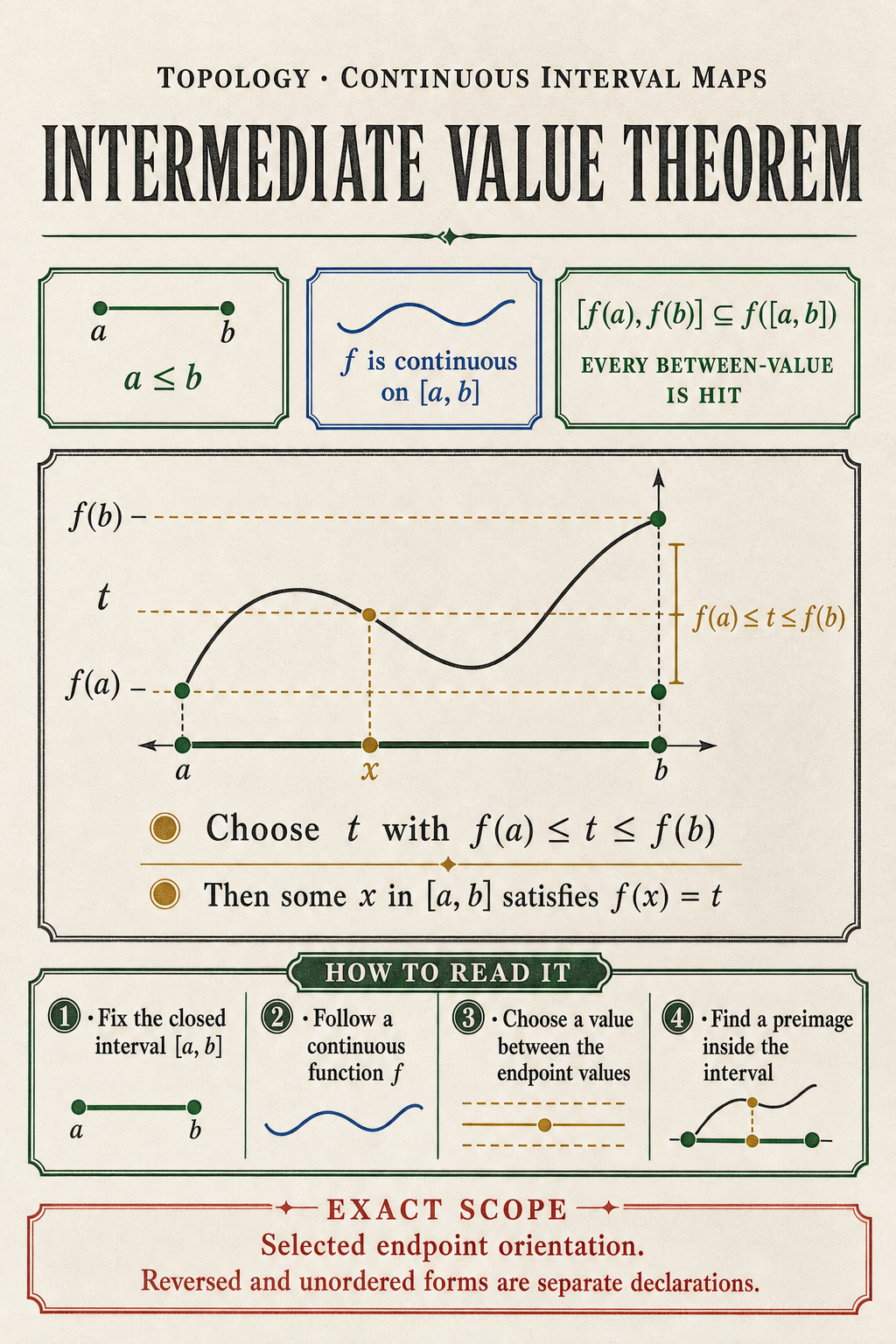
Detailed visual description
The retained poster presents the domain order, continuity hypothesis, image inclusion, pointwise reading, and boundary separating the reversed and unordered forms.
Every level between the endpoints is reached
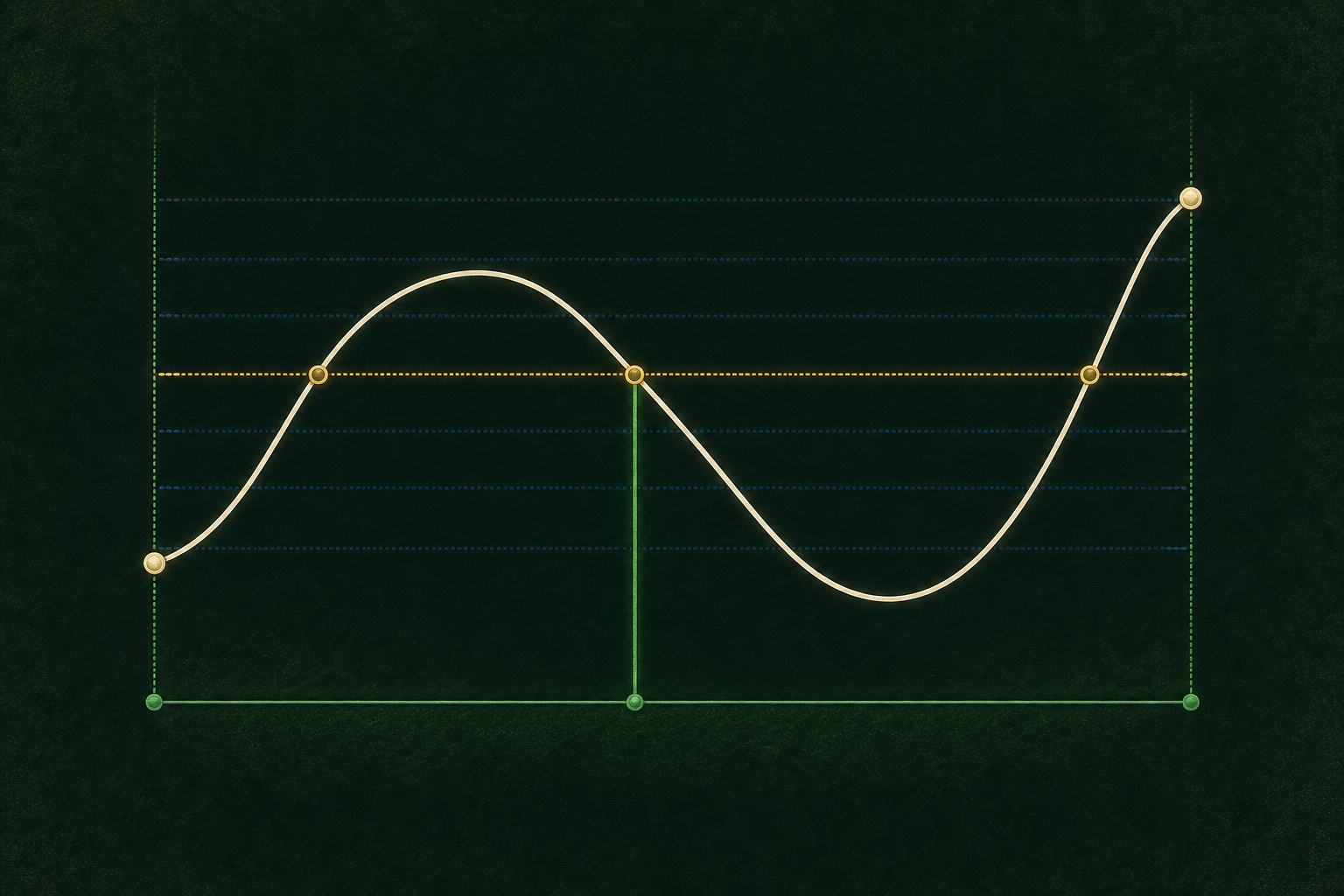
Detailed visual description
The theorem turns continuity on Icc a b and the endpoint order into an inclusion of the entire output interval inside the image of the input interval.
Complementary intuition
A mathematical landmark
The Intermediate Value Theorem captures the no-jumps consequence of continuity. It is central to real analysis, root existence, connectedness, and numerical bracketing arguments.
The low-text schematic gives the theorem a visual identity; it does not replace the source-bound poster or exact statement.
Authoritative formal type
Exact Mathlib statement
theorem intermediate_value_Icc {α : Type*} [ConditionallyCompleteLinearOrder α] [TopologicalSpace α] [OrderTopology α] [DenselyOrdered α] {δ : Type*} [LinearOrder δ] [TopologicalSpace δ] [OrderClosedTopology δ] {a b : α} (hab : a ≤ b) {f : α → δ} (hf : ContinuousOn f (Set.Icc a b)) : Set.Icc (f a) (f b) ⊆ f '' Set.Icc a bSelected evidence declaration text
theorem intermediate_value_Icc {α : Type*} [ConditionallyCompleteLinearOrder α] [TopologicalSpace α] [OrderTopology α] [DenselyOrdered α] {δ : Type*} [LinearOrder δ] [TopologicalSpace δ] [OrderClosedTopology δ] {a b : α} (hab : a ≤ b) {f : α → δ} (hf : ContinuousOn f (Set.Icc a b)) : Set.Icc (f a) (f b) ⊆ f '' Set.Icc a bClaim boundary
No new theorem is claimed
This target indexes Mathlib's ordered interval-image inclusion for a continuous function on [a,b]: every value between f(a) and f(b) occurs when a is at most b. The selected orientation uses Icc(f a)(f b), so it does not separately state the reversed-endpoint form.
- The selected declaration fixes the endpoint-value orientation from f(a) to f(b).
- Reversed and unordered endpoint-value forms are separate Mathlib declarations.
- ProofAtlas is indexing an existing Mathlib theorem, not claiming new mathematics.
Provenance
Origin and evidence stay separate
- Existing declaration
intermediate_value_Iccin mathlib- Relationship
- The checked artifact is the upstream declaration itself
- Preferred checked artifact
artifact.library.mathlib.intermediate-value-theorem.v001- Source handling
- Verified upstream reference; no mirrored source package