Accepted Atlas resultNot recorded for the preferred artifact
These states distinguish upstream identity, local reproduction, review, and Atlas acceptance. This page is part of the public, read-only Mathlib landmark collection.
Formal orientation
Statement map
This deterministic map orients the reader from the mathematical summary to the pinned declaration and exact checked form. The HTML statement below is authoritative.
The theorem at a glance
Infinitely Many Primes at a glance
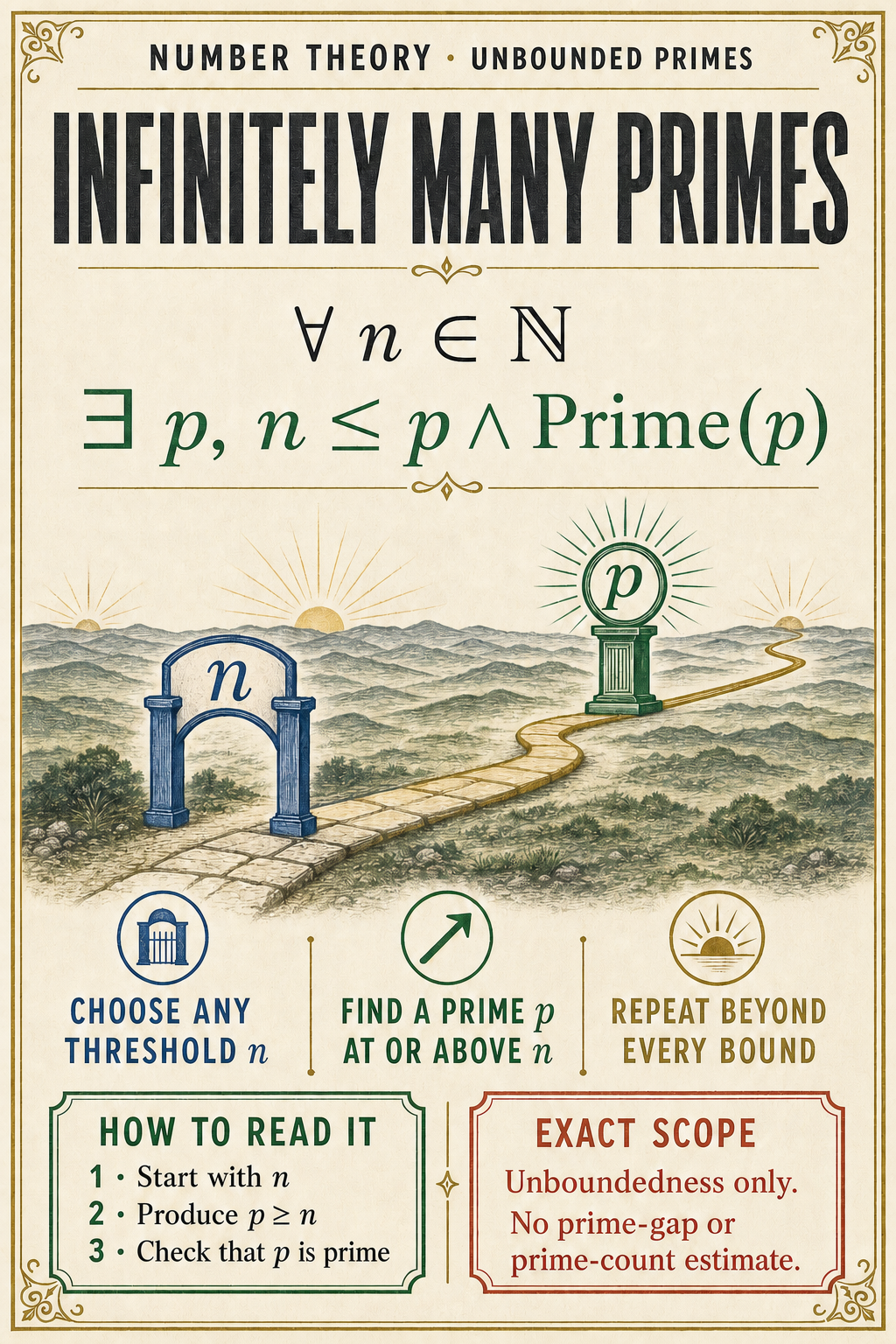
A source-bound editorial overview of the exact Mathlib formulation. The image is explanatory; the statement map, formal type, and pinned source remain authoritative.
Infinitely Many Primes at a glance
Loading full-resolution image…
Every threshold has a prime at or above it; the poster presents unboundedness without implying a prime-gap or counting estimate.Open original image in a new tab ↗
Every threshold has a prime at or above it; the poster presents unboundedness without implying a prime-gap or counting estimate. Generated explanation only; the exact HTML statement and pinned source are authoritative.Detailed visual description
A blue threshold gate labeled n opens onto a gold path toward a green prime beacon p and a repeating horizon. The formal threshold-existence statement sits above, while lower panels explain the three reading steps and explicitly exclude prime-gap and prime-count estimates.
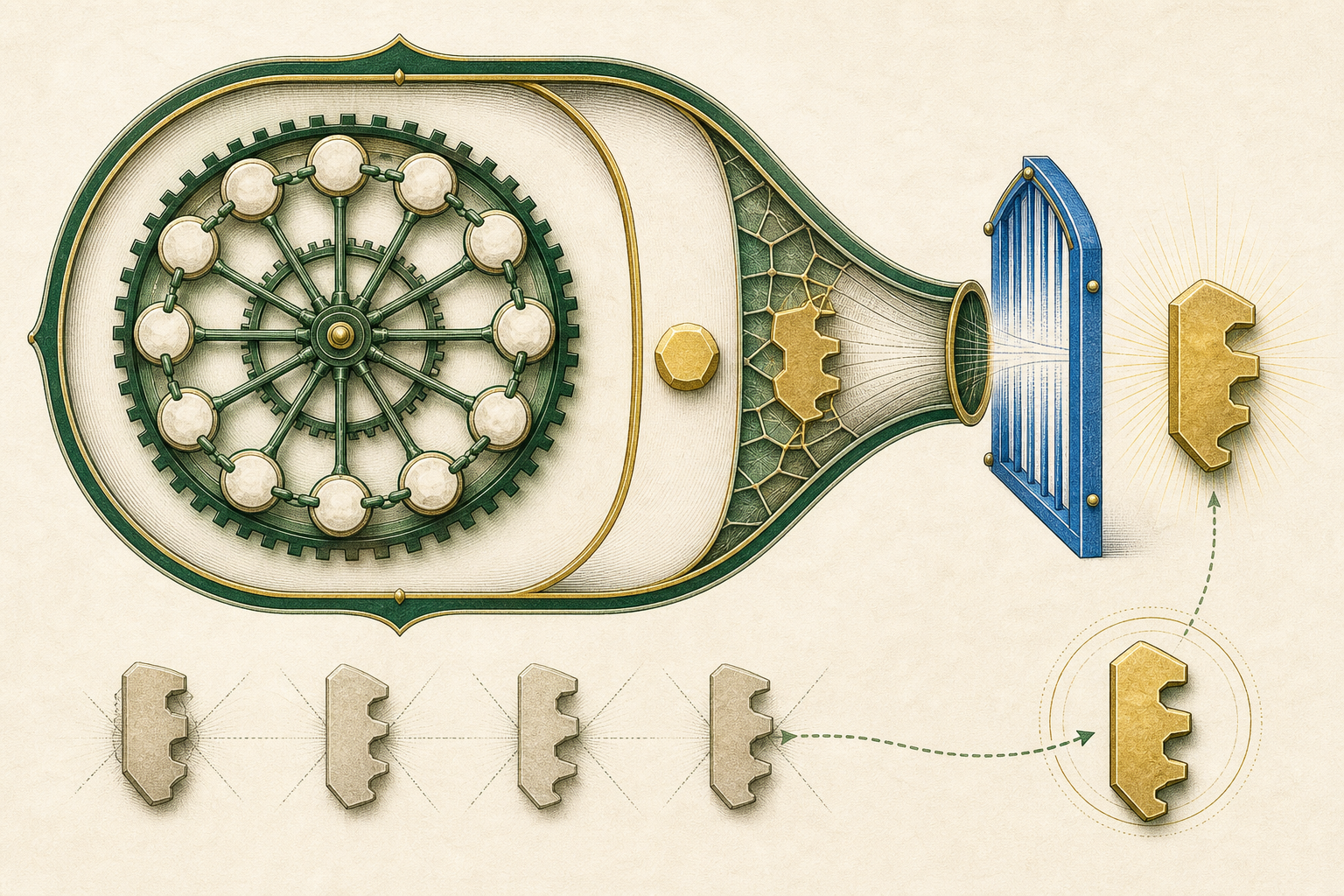
Beyond any chosen threshold, another prime can be found. Generated explanation only; the exact HTML statement and pinned source are authoritative.Detailed visual description
An engraved road crosses a foreground gate and climbs through a forest-green landscape. Gold beacons continue after the gate toward a luminous open horizon, while irregular stone clusters sit away from the path.
Complementary intuition
A mathematical landmark
Euclid's theorem is the archetypal infinitude argument in number theory. This threshold formulation states unboundedness of the prime numbers directly.
The low-text schematic gives the theorem a visual identity; it does not replace the source-bound poster or exact statement.
Authoritative formal type
Exact Mathlib statement
Nat.exists_infinite_primes (n : ℕ) : ∃ p, n ≤ p ∧ Nat.Prime p
Selected evidence declaration text
theorem Nat.exists_infinite_primes (n : ℕ) : ∃ p, n ≤ p ∧ Nat.Prime p
Proof architecture
A least-prime-factor route beyond every threshold
3 curated stages
Mathlib chooses p as the least prime factor of n! + 1, proves p prime, and rules out p below the arbitrary threshold because such a p would divide both n! and n! + 1 and therefore divide one. The result is unboundedness of primes, not a next-prime or prime-gap theorem.
These source-anchored stages explain the retained Mathlib proof route. They are generated explanations, not proof evidence or an extracted Lean proof-term dependency graph.
01
Select the least prime factor of the factorial successor
Select the least prime factor of the factorial successor
Loading full-resolution image…
From the factorial successor, select its least prime factor; the source proves that this selected factor is prime.Open original image in a new tab ↗
From the factorial successor, select its least prime factor; the source proves that this selected factor is prime.
p := minFac (n! + 1) and Nat.Prime p
The source defines p to be minFac (n! + 1). Factorial positivity shows n! + 1 is not one, so minFac_prime proves that this specifically selected least factor p is prime.
02
A factor at or below the threshold would divide one
A factor at or below the threshold would divide one
Loading full-resolution image…
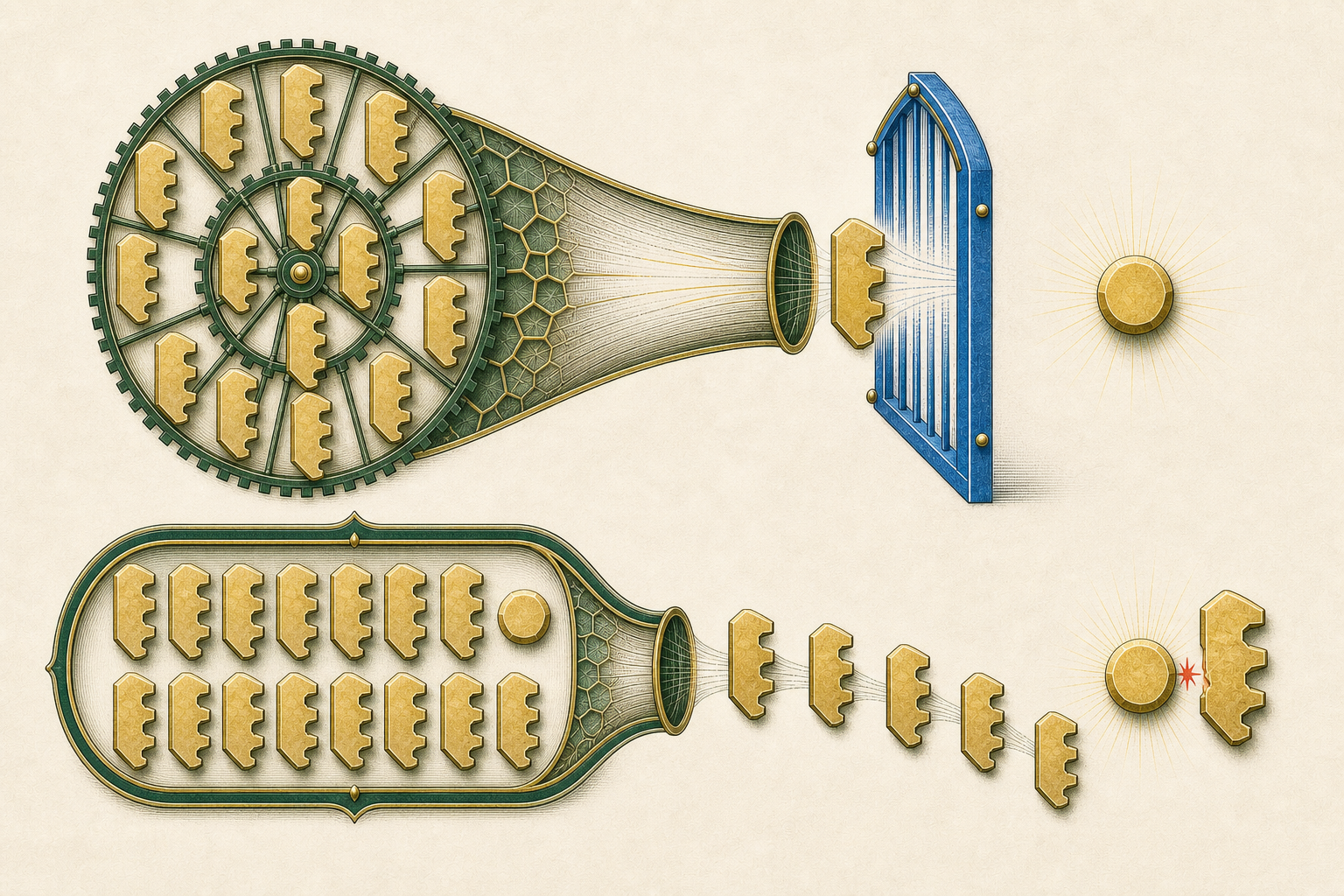
If the selected prime factor lay at or below the threshold, it would divide both the factorial and its successor, hence divide one—impossible for a prime.Open original image in a new tab ↗
If the selected prime factor lay at or below the threshold, it would divide both the factorial and its successor, hence divide one—impossible for a prime.
p ∣ n! and p ∣ n! + 1 imply p ∣ 1, contradicting Nat.Prime p
Assume contrariwise that p lies at or below n. Positivity of p and dvd_factorial then give p ∣ n!, while minFac_dvd gives p ∣ n! + 1; the addition divisibility lemma forces p ∣ 1, contradicting the fact that p is prime.
03
A prime exists at or above every threshold
A prime exists at or above every threshold
Loading full-resolution image…
The contradiction places the selected prime at or above the arbitrary threshold, establishing that primes are unbounded.Open original image in a new tab ↗
The contradiction places the selected prime at or above the arbitrary threshold, establishing that primes are unbounded.
∃ p, n ≤ p ∧ Nat.Prime p
The divisibility contradiction proves n ≤ p. Pairing that bound with the already established primality of p yields the witness ⟨p, np, pp⟩ for the arbitrary threshold n, which is exactly the theorem's unbounded-primes conclusion.
Claim boundary
No new theorem is claimed
This is the exact threshold-existence form in Mathlib. It proves a prime exists at or above every natural-number bound; it does not give a quantitative prime-gap estimate or a count of primes below a bound.
Proof Atlas did not originate Euclid's theorem or Mathlib's declaration.
The page indexes and locally reproduces an upstream theorem.
No quantitative distribution theorem for primes is asserted.