Number theory · existing Mathlib theorem
Fundamental Theorem of Arithmetic
Prime factors are unique apart from their order: if a list contains only primes and multiplies to n, it contains exactly the same prime factors, with the same multiplicities, as n.primeFactorsList.
- prime factorization
- unique factorization
- list permutation
- natural numbers
Four separate status axes
These states distinguish upstream identity, local reproduction, review, and Atlas acceptance. This page is part of the public, read-only Mathlib landmark collection.
Formal orientation
Statement map
This deterministic map orients the reader from the mathematical summary to the pinned declaration and exact checked form. The HTML statement below is authoritative.
The theorem at a glance
Fundamental Theorem of Arithmetic — exact Mathlib form
A source-bound editorial overview of the exact Mathlib formulation. The image is explanatory; the statement map, formal type, and pinned source remain authoritative.
Fundamental Theorem of Arithmetic — exact Mathlib form
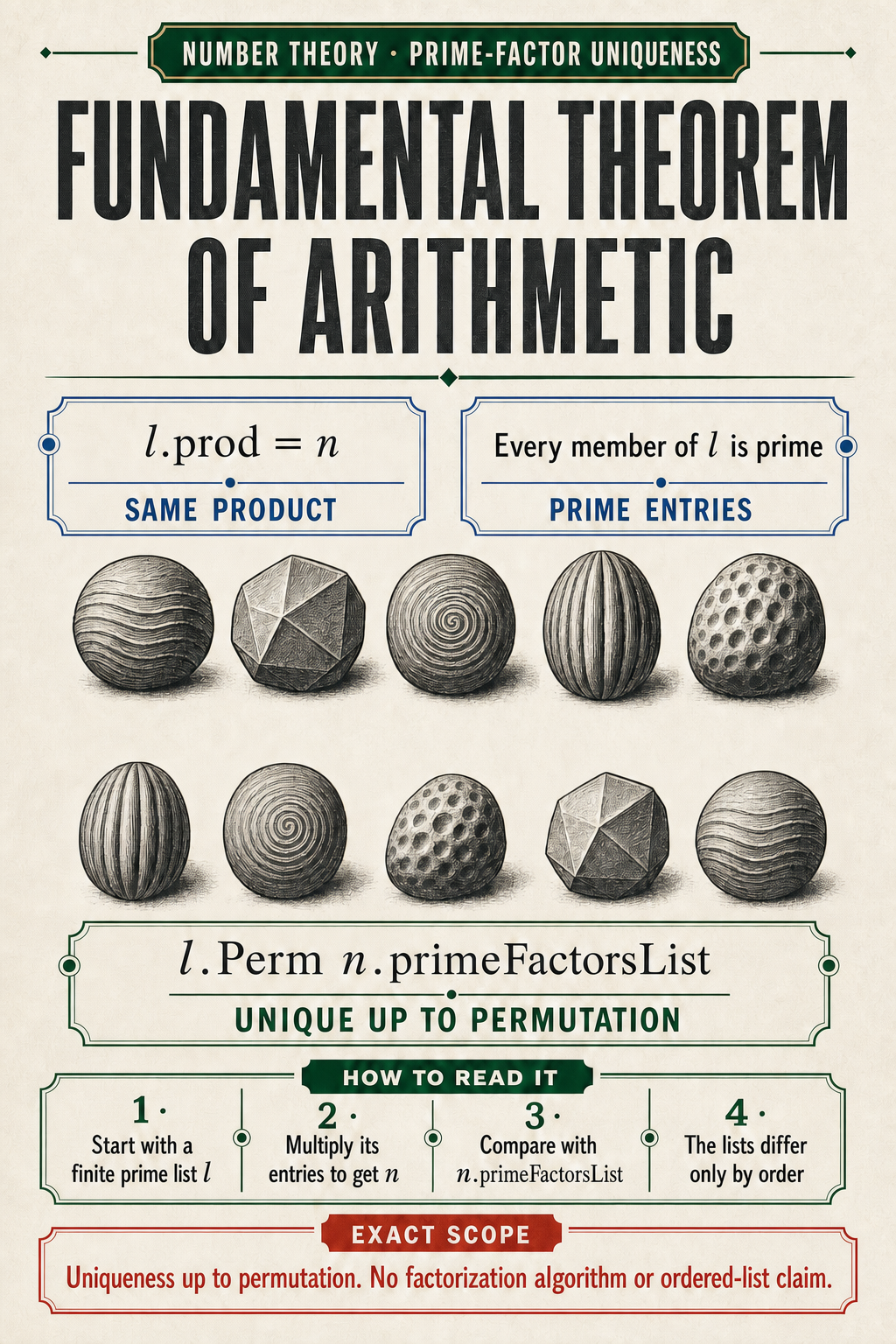
Detailed visual description
The retained poster presents the exact hypotheses, permutation conclusion, reading sequence, and boundary of Nat.primeFactorsList_unique without adding a factorization algorithm or ordered-list claim.
The same prime factors, in another order

Detailed visual description
The theorem compares any finite all-prime list with the canonical prime-factor list after establishing that both multiply to the same natural number.
Complementary intuition
A mathematical landmark
Unique prime factorization is the organizing principle behind elementary arithmetic and much of number theory. This declaration isolates its uniqueness half in an exact finite-list form.
The low-text schematic gives the theorem a visual identity; it does not replace the source-bound poster or exact statement.
Authoritative formal type
Exact Mathlib statement
theorem Nat.primeFactorsList_unique {n : ℕ} {l : List ℕ} (h₁ : l.prod = n) (h₂ : ∀ p ∈ l, Nat.Prime p) : l.Perm n.primeFactorsListSelected evidence declaration text
theorem Nat.primeFactorsList_unique {n : ℕ} {l : List ℕ} (h₁ : l.prod = n) (h₂ : ∀ p ∈ l, Nat.Prime p) : l.Perm n.primeFactorsListClaim boundary
No new theorem is claimed
This target indexes Mathlib's uniqueness theorem for prime-factor lists: any list of primes with product n is a permutation of n.primeFactorsList. It does not claim an ordered factorization, a factorization algorithm, a new proof, or a new mathematical result.
- This selected declaration does not provide a factorization algorithm.
- It proves uniqueness up to permutation, not equality of arbitrarily ordered lists.
- ProofAtlas is indexing an existing Mathlib theorem, not claiming new mathematics.
Provenance
Origin and evidence stay separate
- Existing declaration
Nat.primeFactorsList_uniquein mathlib- Relationship
- The checked artifact is the upstream declaration itself
- Preferred checked artifact
artifact.library.mathlib.fundamental-theorem-arithmetic.v001- Source handling
- Verified upstream reference; no mirrored source package