Probability and analysis · existing Mathlib theorem
Central Limit Theorem
Add more and more independent copies of the same real random variable, whose mean is zero and second moment is one, and divide the sum by the square root of the number of terms. The resulting distributions approach the standard bell curve.
Accepted Atlas resultNot recorded for the preferred artifact
These states distinguish upstream identity, local reproduction, review, and Atlas acceptance. This page is part of the public, read-only Mathlib landmark collection.
Formal orientation
Statement map
This deterministic map orients the reader from the mathematical summary to the pinned declaration and exact checked form. The HTML statement below is authoritative.
The theorem at a glance
Central Limit Theorem at a glance
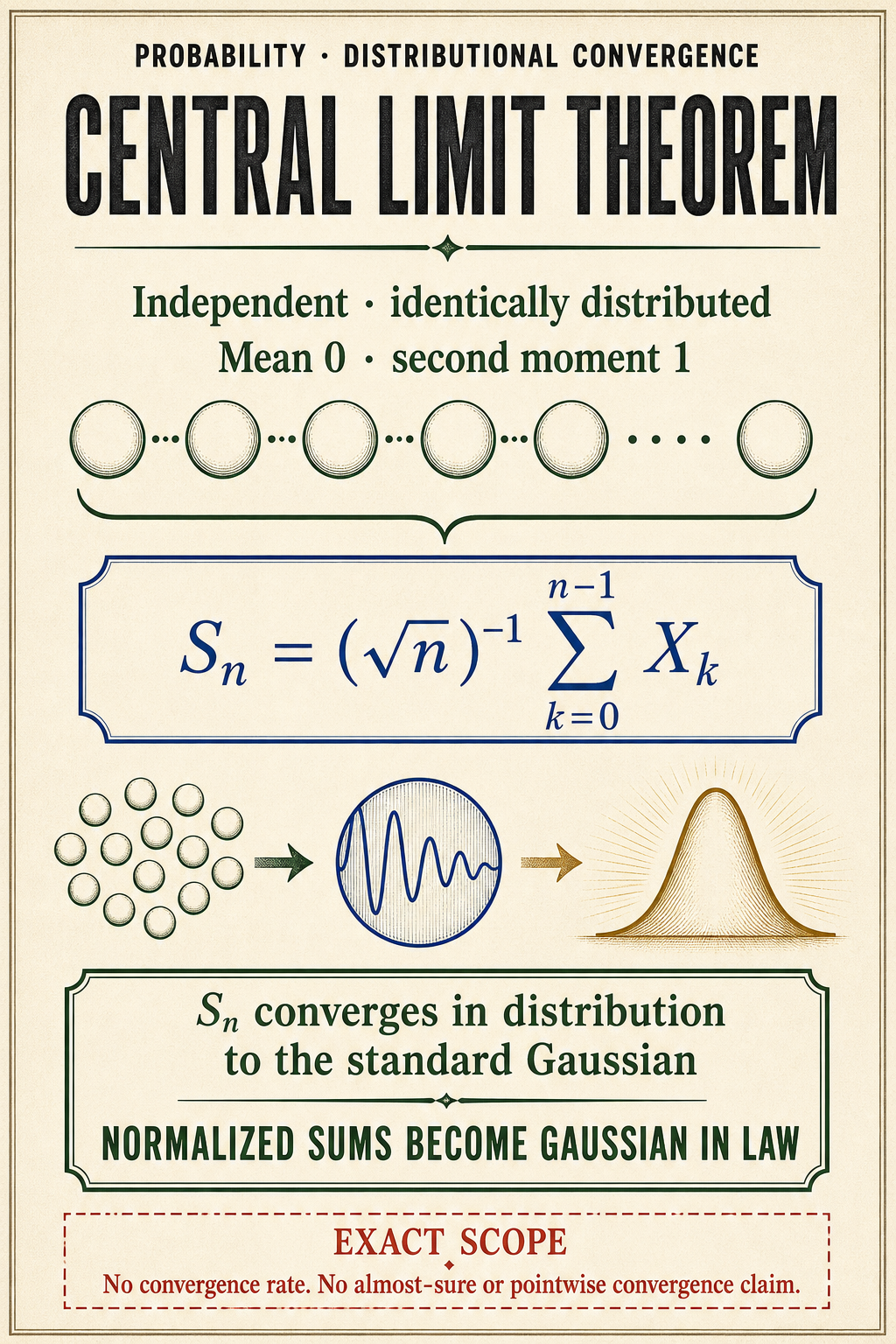
A source-bound editorial overview of the exact Mathlib formulation. The image is explanatory; the statement map, formal type, and pinned source remain authoritative.
Inverse-square-root-normalized IID sums converge in distribution to the standard Gaussian law. Generated explanation only; the exact HTML statement and pinned source are authoritative.Detailed visual description
The poster makes the independence, identical-distribution, mean-zero, second-moment-one, normalization, Gaussian endpoint, and absence of a rate or stronger convergence claim explicit.
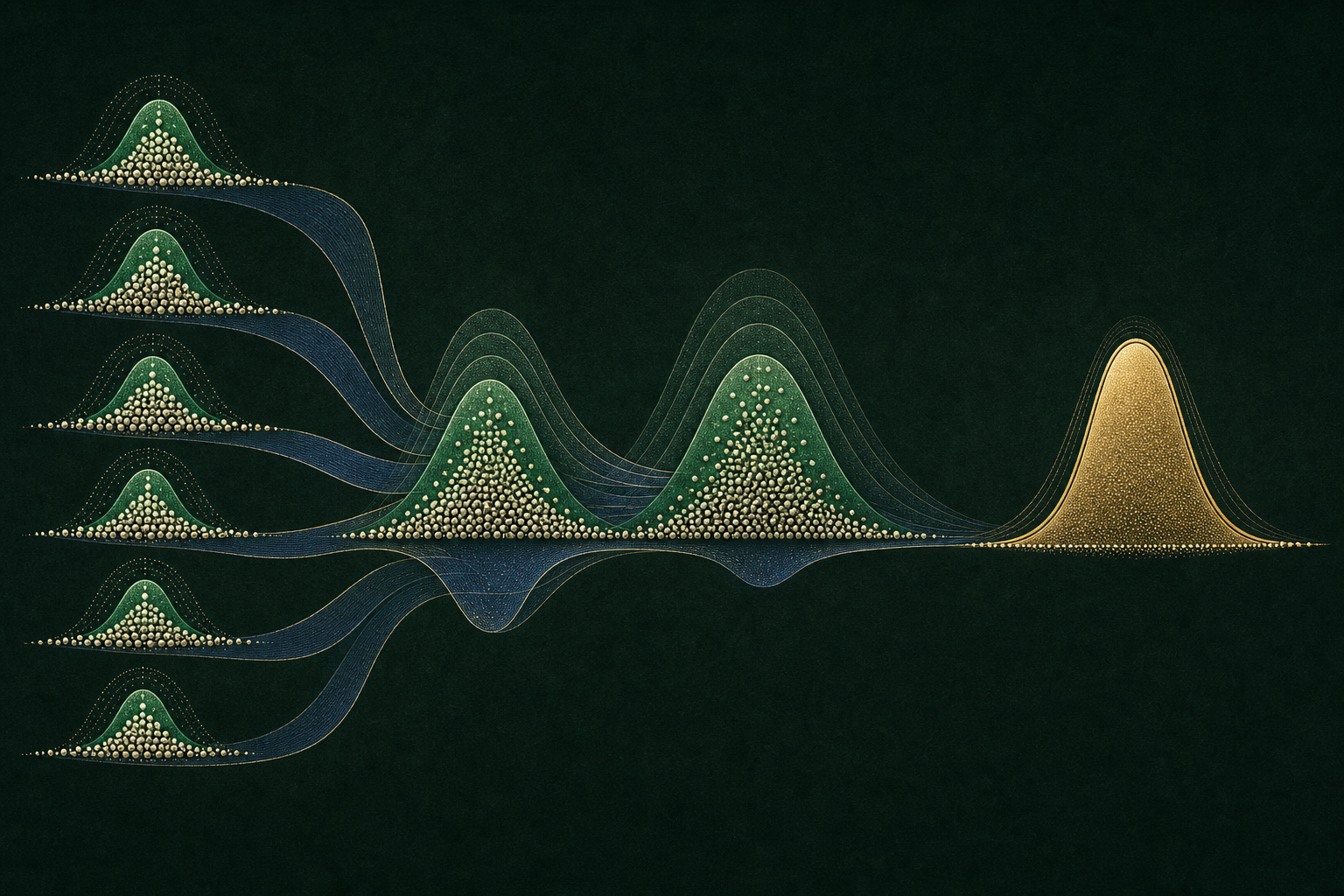
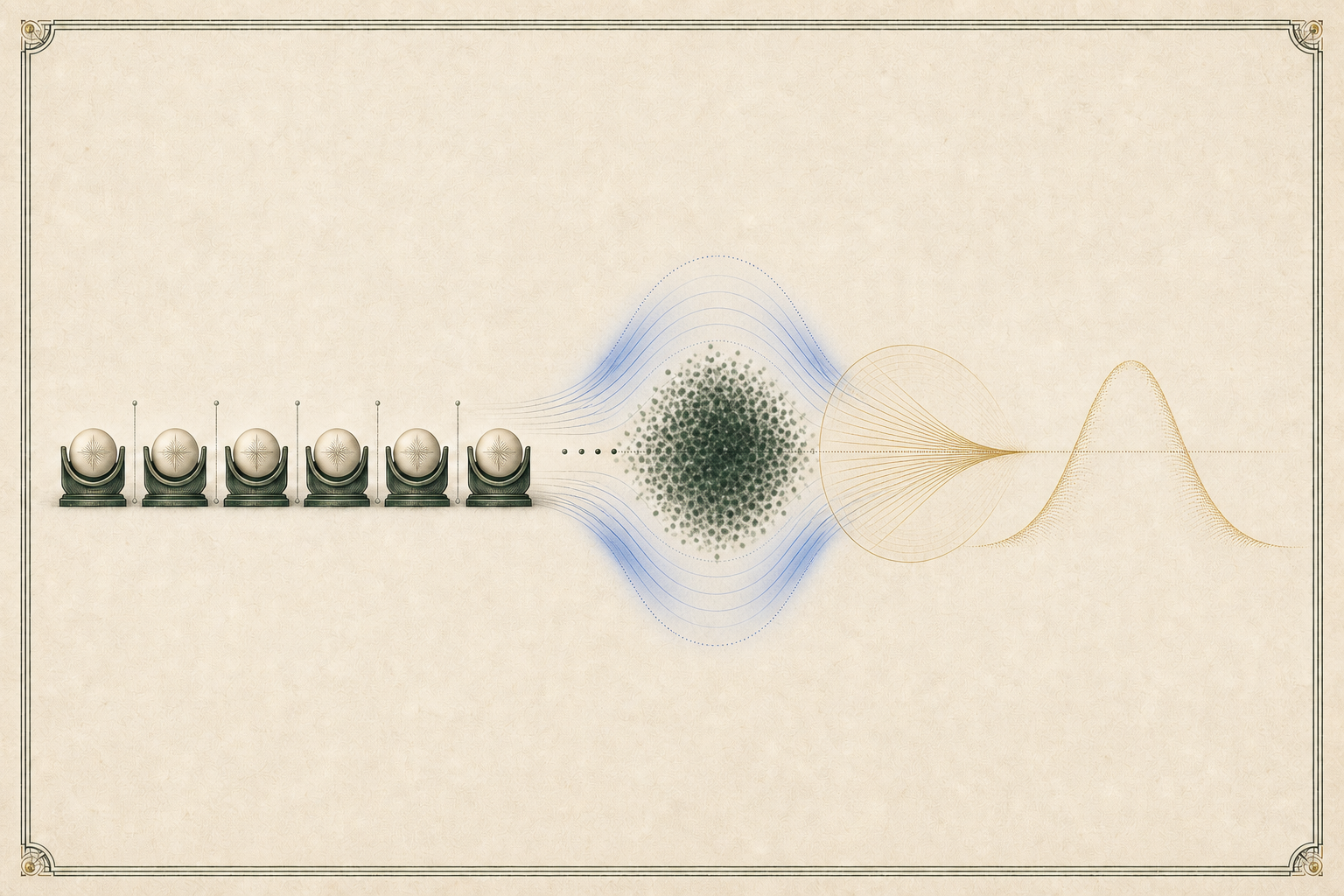
Normalized independent sums approach the standard Gaussian distribution. Generated explanation only; the exact HTML statement and pinned source are authoritative.Detailed visual description
Distinct finite input profiles flow through increasingly aggregated normalized envelopes toward a single centered bell curve, emphasizing distributional convergence rather than finite-stage equality.
Complementary intuition
A mathematical landmark
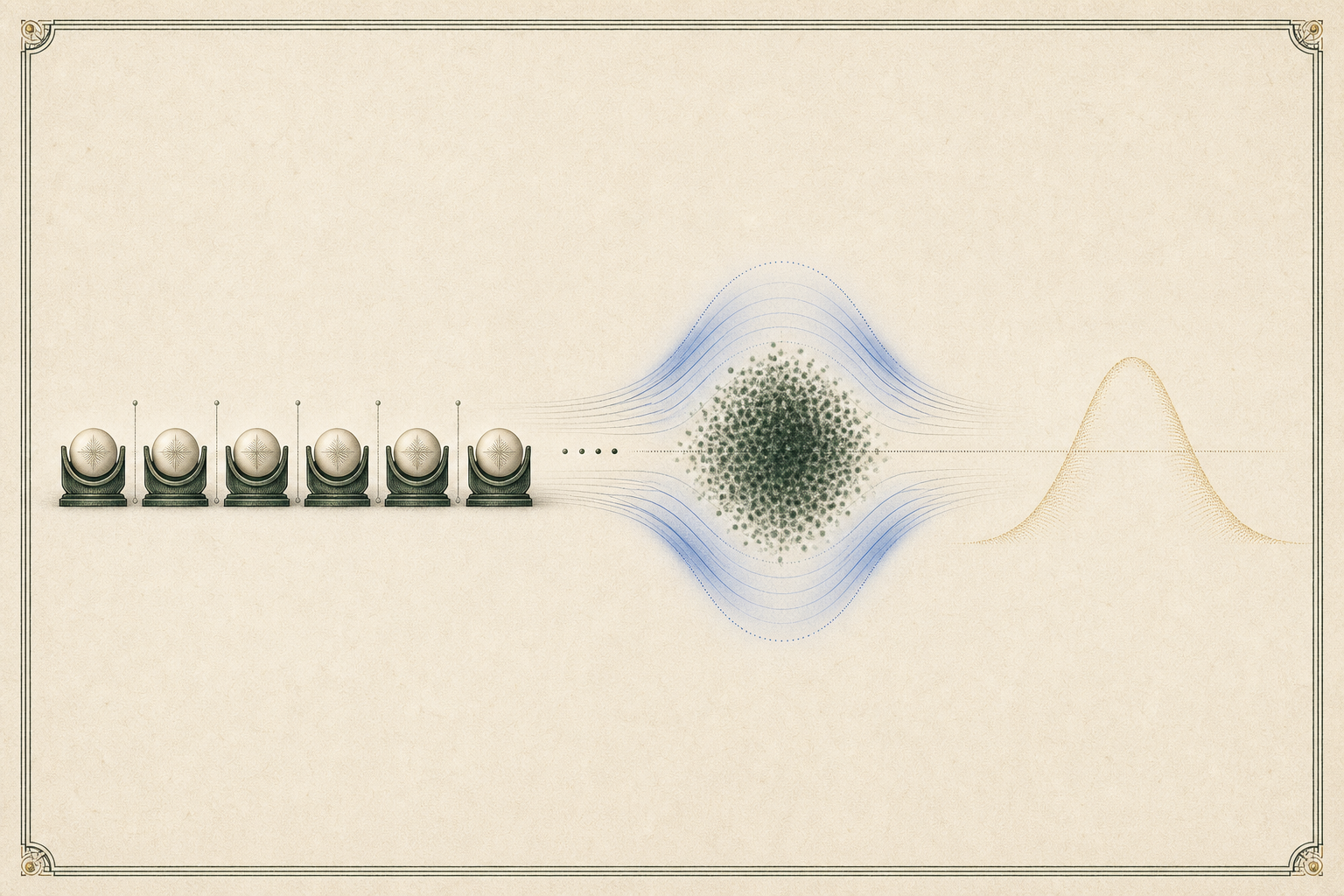
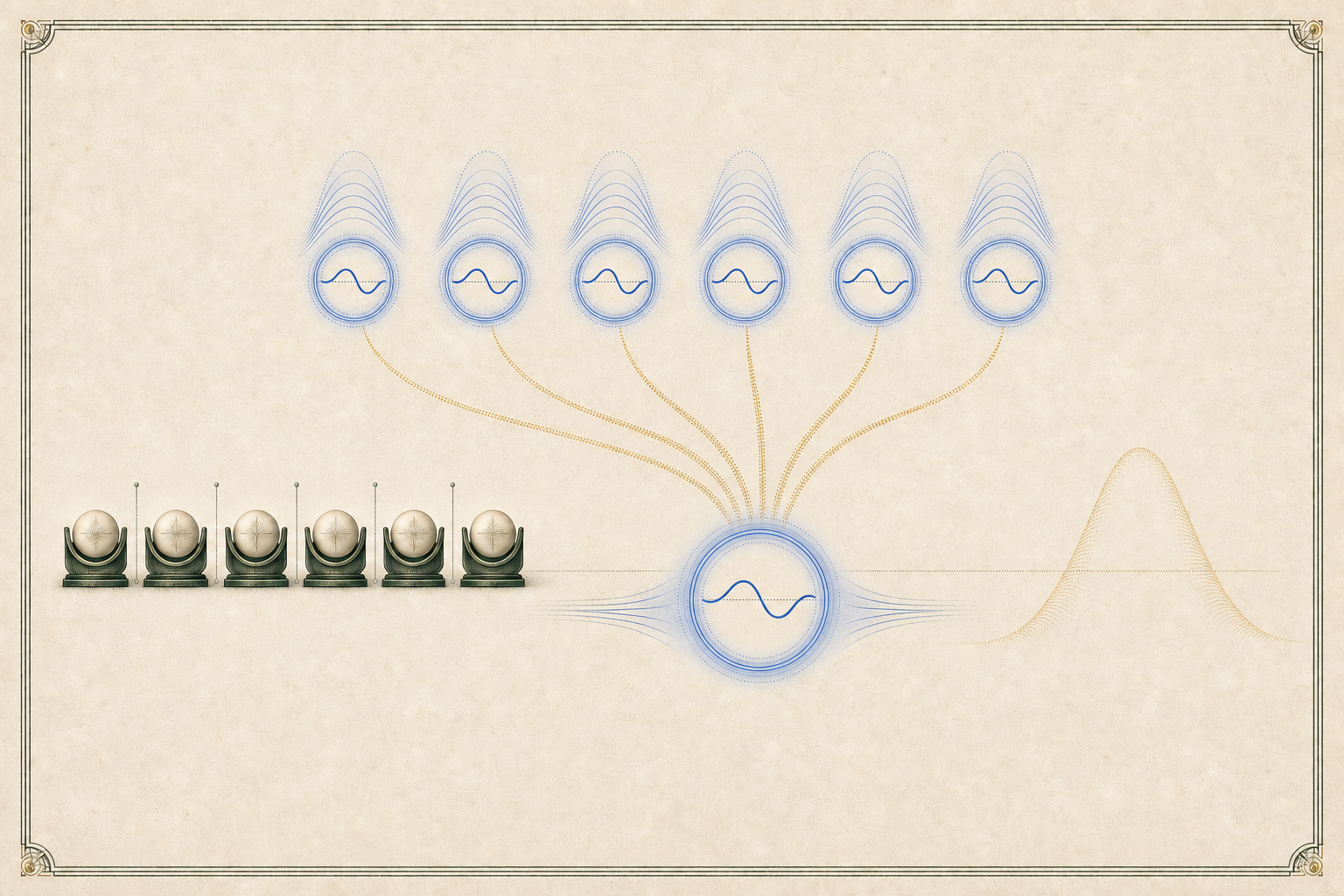
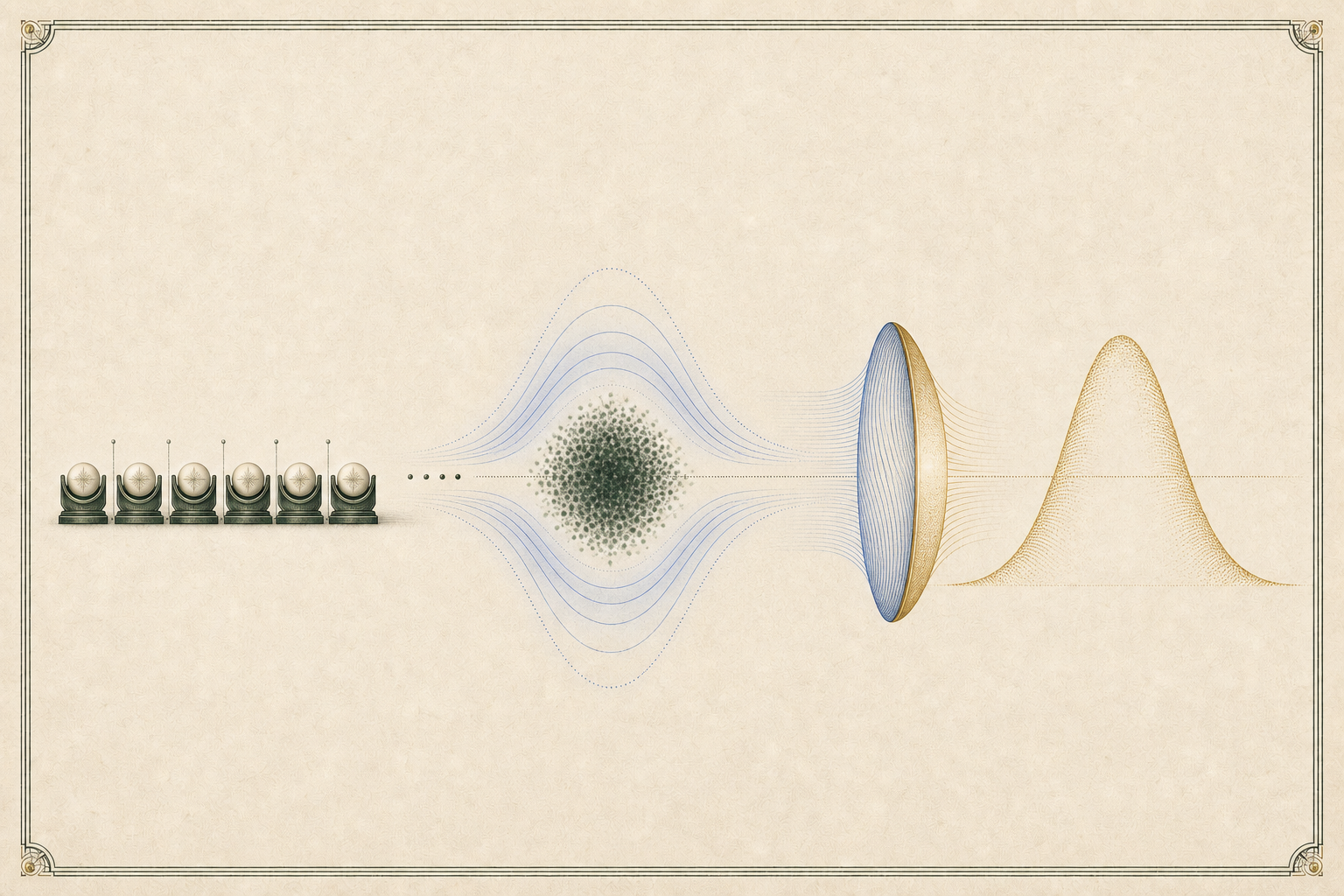
The Central Limit Theorem explains why Gaussian behavior appears throughout probability and statistics. It is a universal limit law for normalized aggregation under exact independence and moment hypotheses.
The low-text schematic gives the theorem a visual identity; it does not replace the source-bound poster or exact statement.
Authoritative formal type
Exact Mathlib statement
theorem ProbabilityTheory.tendstoInDistribution_inv_sqrt_mul_sum {Ω : Type*} {Ω' : Type*} {mΩ : MeasurableSpace Ω} {mΩ' : MeasurableSpace Ω'} {P : MeasureTheory.Measure Ω} {P' : MeasureTheory.Measure Ω'} {X : ℕ → Ω → ℝ} {Y : Ω' → ℝ} [MeasureTheory.IsProbabilityMeasure P] [MeasureTheory.IsProbabilityMeasure P'] (hY : ProbabilityTheory.HasLaw Y (ProbabilityTheory.gaussianReal 0 1) P') (h0 : ∫ x, X 0 x ∂P = 0) (h1 : ∫ x, (X 0 ^ 2) x ∂P = 1) (hindep : ProbabilityTheory.iIndepFun X P) (hident : ∀ i, ProbabilityTheory.IdentDistrib (X i) (X 0) P P) : MeasureTheory.TendstoInDistribution (fun (n : ℕ) ω ↦ (√(n : ℝ))⁻¹ * ∑ k ∈ Finset.range n, X k ω) Filter.atTop Y (fun _ ↦ P) P'
Selected evidence declaration text
theorem ProbabilityTheory.tendstoInDistribution_inv_sqrt_mul_sum {Ω : Type*} {Ω' : Type*} {mΩ : MeasurableSpace Ω} {mΩ' : MeasurableSpace Ω'} {P : MeasureTheory.Measure Ω} {P' : MeasureTheory.Measure Ω'} {X : ℕ → Ω → ℝ} {Y : Ω' → ℝ} [MeasureTheory.IsProbabilityMeasure P] [MeasureTheory.IsProbabilityMeasure P'] (hY : ProbabilityTheory.HasLaw Y (ProbabilityTheory.gaussianReal 0 1) P') (h0 : ∫ x, X 0 x ∂P = 0) (h1 : ∫ x, (X 0 ^ 2) x ∂P = 1) (hindep : ProbabilityTheory.iIndepFun X P) (hident : ∀ i, ProbabilityTheory.IdentDistrib (X i) (X 0) P P) : MeasureTheory.TendstoInDistribution (fun (n : ℕ) ω ↦ (√(n : ℝ))⁻¹ * ∑ k ∈ Finset.range n, X k ω) Filter.atTop Y (fun _ ↦ P) P'
Proof architecture
How normalized sums become Gaussian in law
4 curated stages
Mathlib proves the selected Central Limit Theorem by forming centered normalized IID sums, factoring their characteristic functions through independence, identifying the Gaussian Fourier limit from the second-order expansion, and applying Lévy convergence to return to probability laws.
These source-anchored stages explain the retained Mathlib proof route. They are generated explanations, not proof evidence or an extracted Lean proof-term dependency graph.
01
Independent copies enter one normalized sum
Independent copies enter one normalized sum
Loading full-resolution image…
Centered, second-moment-one identically distributed variables are added and compressed by the inverse square root of the sample count.Open original image in a new tab ↗
Centered, second-moment-one identically distributed variables are added and compressed by the inverse square root of the sample count.
S_n = (sqrt n)⁻¹ * sum_{k<n} X_k
The selected theorem begins with an independent identically distributed sequence of real random variables, common mean zero, and common second moment one. Its nth object is the partial sum over range n multiplied by the inverse square root of n.
02
Independence turns the sum into a power
Independence turns the sum into a power
Loading full-resolution image…
The characteristic function of the normalized sum factors into identical scaled factors, one for each summand.Open original image in a new tab ↗
The characteristic function of the normalized sum factors into identical scaled factors, one for each summand.
charFun(S_n)(t) = charFun(X_0)(t / sqrt n)^n
charFun_inv_sqrt_mul_sum maps the normalized finite sum to the Fourier side. Independence changes the sum's characteristic function into a product, identical distribution makes every factor the same, and the finite product becomes the nth power of the one-variable characteristic function at the inverse-square-root-scaled frequency.
03
The centered quadratic term reaches the Gaussian characteristic function
The centered quadratic term reaches the Gaussian characteristic function
Loading full-resolution image…
Mean zero and second moment one identify the quadratic Taylor term; the repeated scaled factors converge to the Gaussian exponential.Open original image in a new tab ↗
Mean zero and second moment one identify the quadratic Taylor term; the repeated scaled factors converge to the Gaussian exponential.
charFun(X_0)(t / sqrt n)^n → exp(-t^2/2)
taylor_charFun_two expands the characteristic function near zero. Centering removes the linear term and second moment one fixes the quadratic term. With frequencies tending to zero at the inverse-square-root scale, tendsto_pow_exp_of_isLittleO_sub_add_div sends the nth powers to the standard Gaussian characteristic function.
04
Characteristic-function convergence gives the Gaussian law
Characteristic-function convergence gives the Gaussian law
Loading full-resolution image…
Lévy's theorem converts the pointwise Fourier-side limit into convergence in distribution of the normalized sums to the standard Gaussian.Open original image in a new tab ↗
Lévy's theorem converts the pointwise Fourier-side limit into convergence in distribution of the normalized sums to the standard Gaussian.
S_n → Y in distribution, with Law(Y) = gaussianReal 0 1
The theorem uses ProbabilityMeasure.tendsto_iff_tendsto_charFun. The declared target random variable has standard Gaussian law, whose characteristic function is the page-3 exponential. Rewriting the normalized sums with the factorization and applying that limit closes the exact convergence-in-distribution statement.
Claim boundary
No new theorem is claimed
This page indexes Mathlib's distributional convergence theorem for independent identically distributed real random variables with mean zero and second moment one, normalized by the inverse square root of n, to a standard Gaussian law. It does not state a rate of convergence or cover arbitrary variance without normalization.
Proof Atlas did not originate the Central Limit Theorem or Mathlib's declaration.
The selected declaration gives neither a quantitative rate nor almost-sure or pointwise convergence.
The generated explanation and visuals are not proof evidence.