
Number theory · formal theorem

Wolstenholme’s Theorem

For every prime p > 3, the sum 1 + 1/2 + ⋯ + 1/(p − 1), with reciprocals interpreted modulo p², is 0 modulo p².

Lean proofpassed
Unfinished proof stepsNone
Formal resultAccepted
Wolstenholme modular-sum mapFor a prime greater than three, the reciprocal harmonic sum through p minus one maps to zero modulo p squared.
Exact scope: Wolstenholme's theorem in modular reciprocal-sum form: for every prime p > 3, the finite reciprocal harmonic sum through p − 1 is zero in ZMod (p²).

Line counts exclude blank lines; comments and documentation count. The total is the commit-pinned first-party Lean import closure; Mathlib and other third-party dependencies are excluded.

The theorem at a glance

Wolstenholme's theorem at a glance

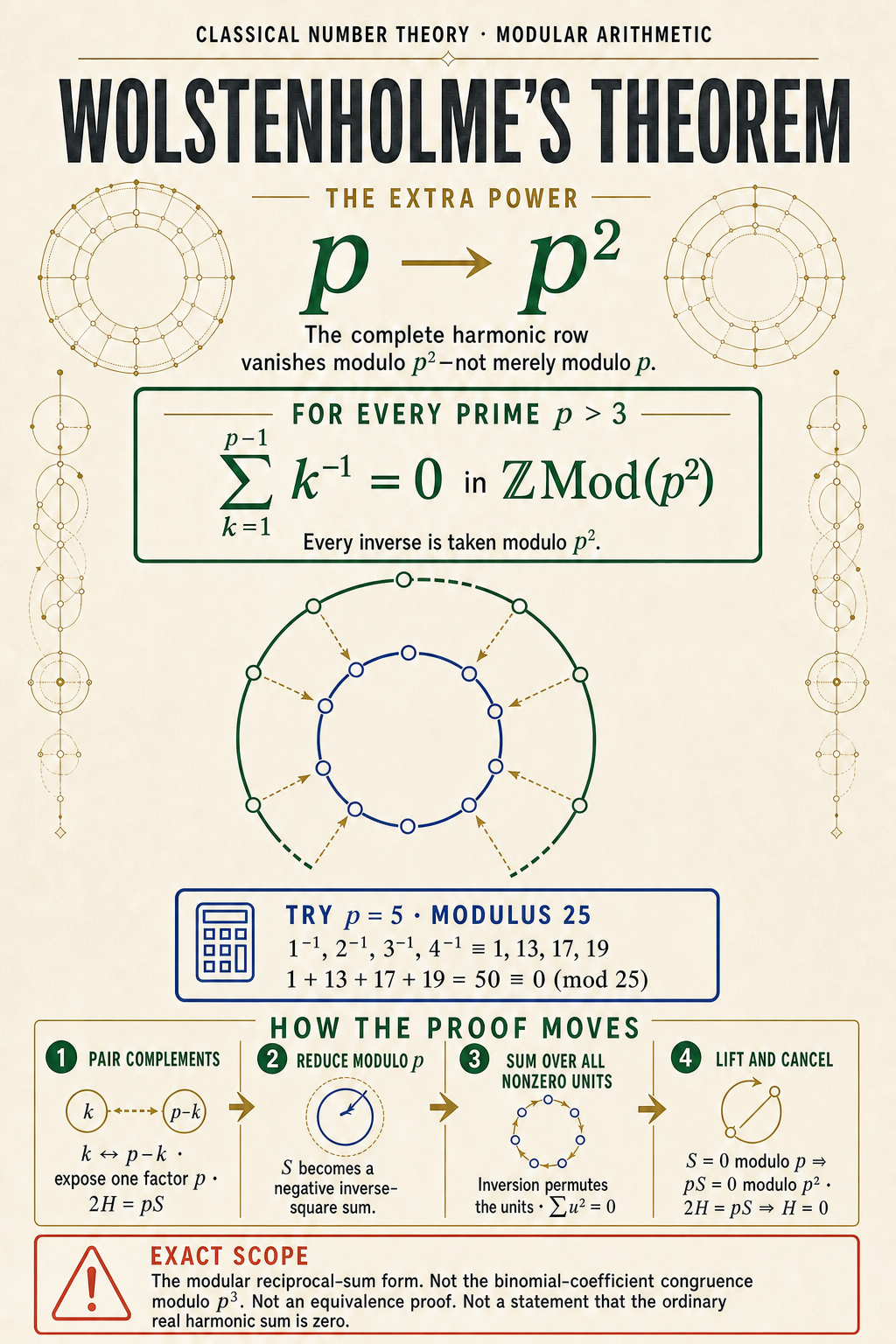
A warm-ivory editorial poster explains Wolstenholme's theorem with a large p-to-p-squared motif, the complete modular reciprocal sum, a concrete modulus-25 example, nested modular rings, four proof movements, and a red exact-scope footer.
The modular reciprocal-sum theorem, the extra power of p, a concrete p = 5 calculation, and the checked proof route in one source-bound poster.

Accessible transcript

For prime p > 3: ∑ k = 1 to p - 1 of k⁻¹ = 0 in ZMod(p²)

For every prime p > 3, the sum of the modular inverses of k from 1 through p − 1 is zero in ZMod(p²); every inverse is taken modulo p², so the complete harmonic row vanishes modulo p², not merely modulo p. For p = 5 in modulus 25, the inverses 1, 13, 17, and 19 sum to 50, hence zero modulo 25. The proof pairs k with p − k to obtain 2H = pS, reduces S modulo p to a negative inverse-square sum, uses inversion as a permutation of the nonzero units and the finite-field square power sum, then lifts S = 0 modulo p and cancels the invertible factor 2. The formal theorem proves this modular reciprocal-sum form, not the binomial-coefficient congruence modulo p³, an equivalence between those formulations, or vanishing of the ordinary real harmonic sum.

Read the complete poster transcript

CLASSICAL NUMBER THEORY · MODULAR ARITHMETIC

WOLSTENHOLME’S THEOREM

THE EXTRA POWER

p → p²

The complete harmonic row vanishes modulo p²—not merely modulo p.

FOR EVERY PRIME p > 3

∑ₖ₌₁ᵖ⁻¹ k⁻¹ = 0 in ZMod(p²)

Every inverse is taken modulo p².

TRY p = 5 · MODULUS 25

1⁻¹, 2⁻¹, 3⁻¹, 4⁻¹ ≡ 1, 13, 17, 19

1 + 13 + 17 + 19 = 50 ≡ 0 (mod 25)

HOW THE PROOF MOVES

1 · PAIR COMPLEMENTS

k ↔ p − k · expose one factor p · 2H = pS

2 · REDUCE MODULO p

S becomes a negative inverse-square sum.

3 · SUM OVER ALL NONZERO UNITS

Inversion permutes the units · ∑u² = 0

4 · LIFT AND CANCEL

S = 0 modulo p ⇒ pS = 0 modulo p² · 2H = pS ⇒ H = 0

EXACT SCOPE

The modular reciprocal-sum form. Not the binomial-coefficient congruence modulo p³. Not an equivalence proof. Not a statement that the ordinary real harmonic sum is zero.

Mathematical illustration

A finite world of modular reciprocals

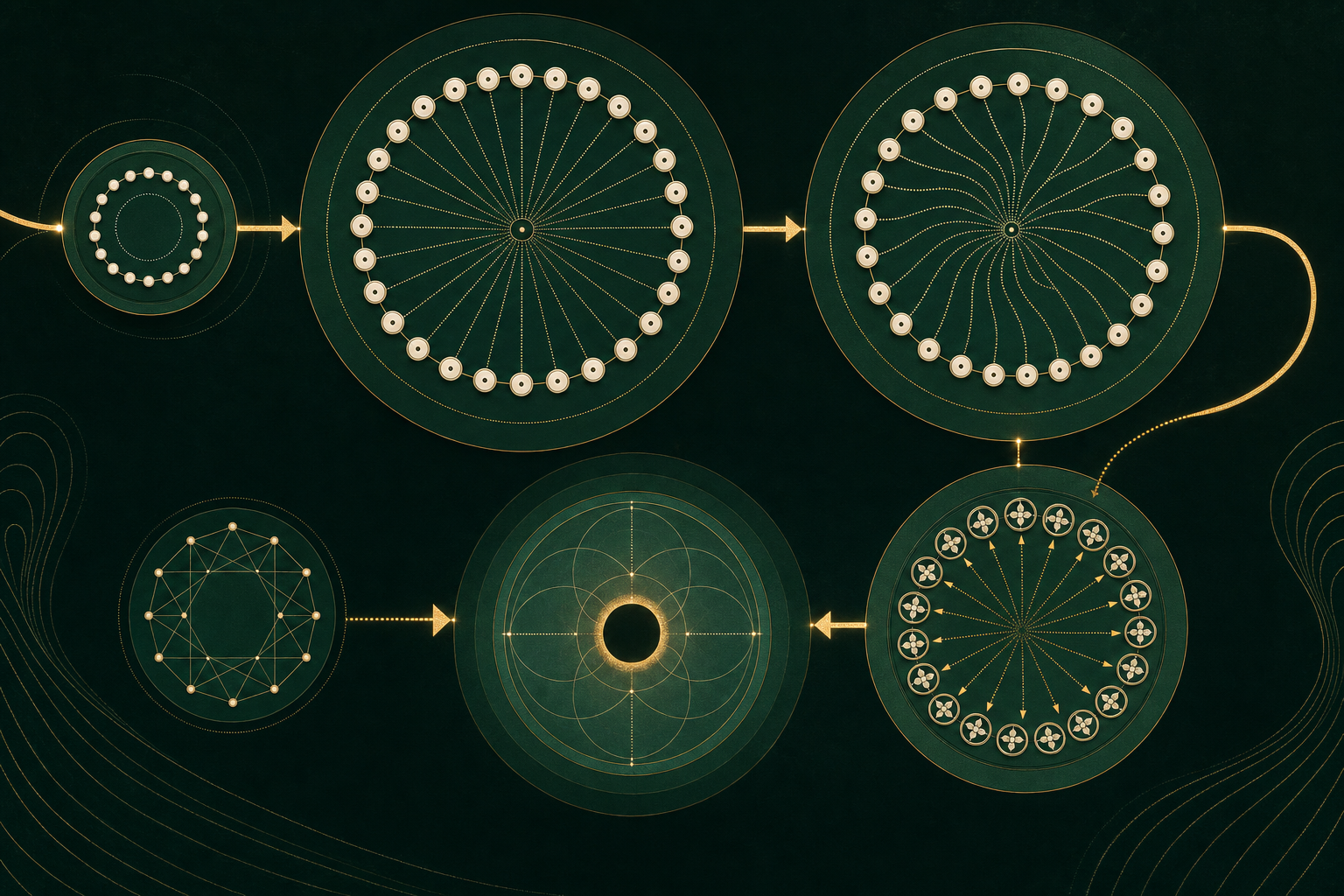
An engraved circular modular world in forest green, ivory, and gold. Repeated reciprocal-like elements sweep inward along curved paths and resolve at a calm open center.
The complete finite family of modular reciprocals lives in one ring modulo p squared and resolves to the zero residue.

For prime p > 3: 1 + 1/2 + ⋯ + 1/(p - 1) = 0 in ZMod (p²)

For a prime p > 3, every k from 1 through p − 1 is a unit modulo p². The sum of all their inverses is zero in ZMod(p²); individual inverse terms need not vanish, and the statement concerns modular arithmetic rather than an ordinary real harmonic sum.

Proof architecture

From paired reciprocals to the modular zero

4 curated stages

The proof pairs complementary residues, reduces the paired sum modulo p, uses symmetry and a finite-field power sum, then lifts the resulting zero back to modulo p squared.

These source-anchored stages explain the retained proof route. They are not an extracted Lean proof-term dependency graph.

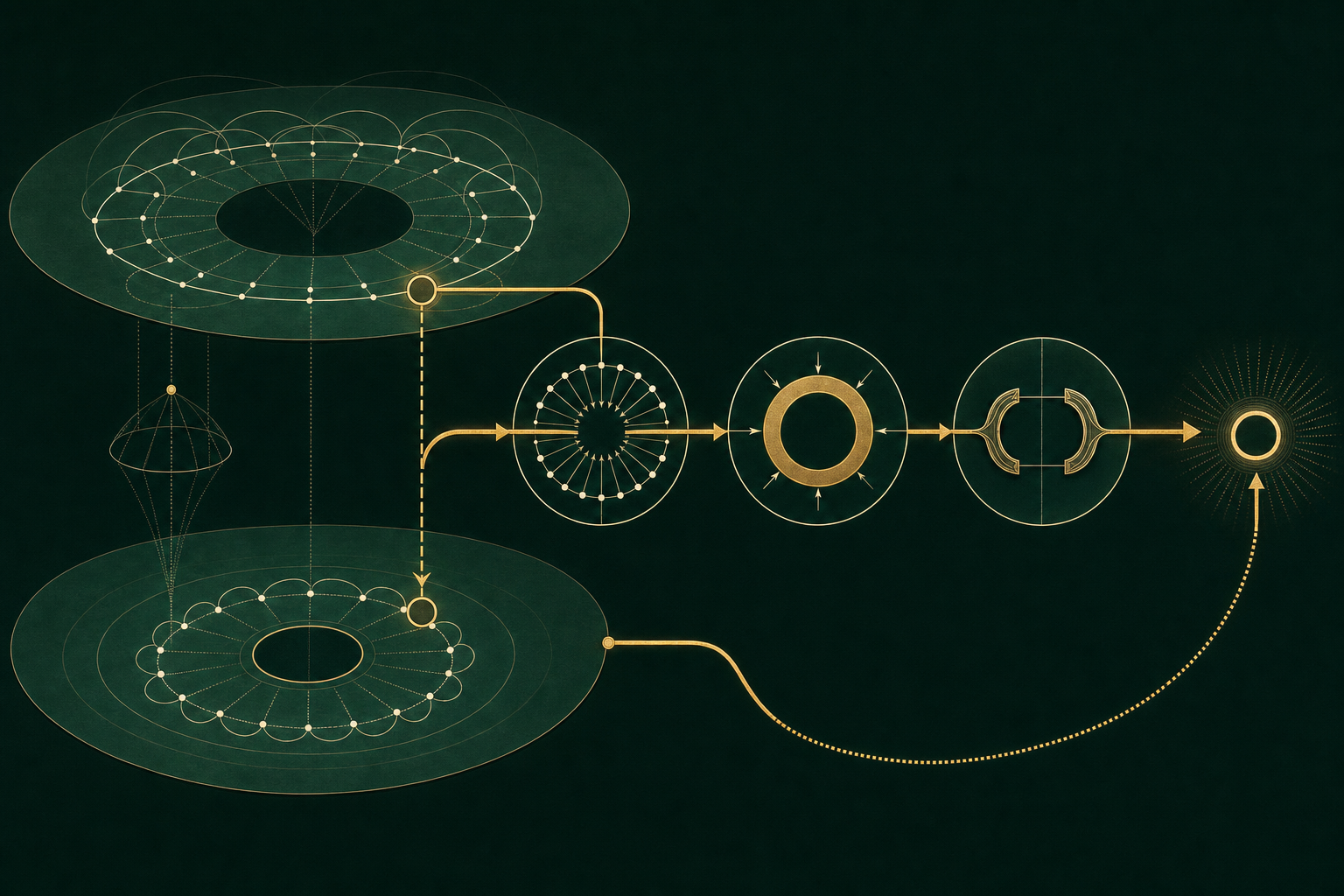
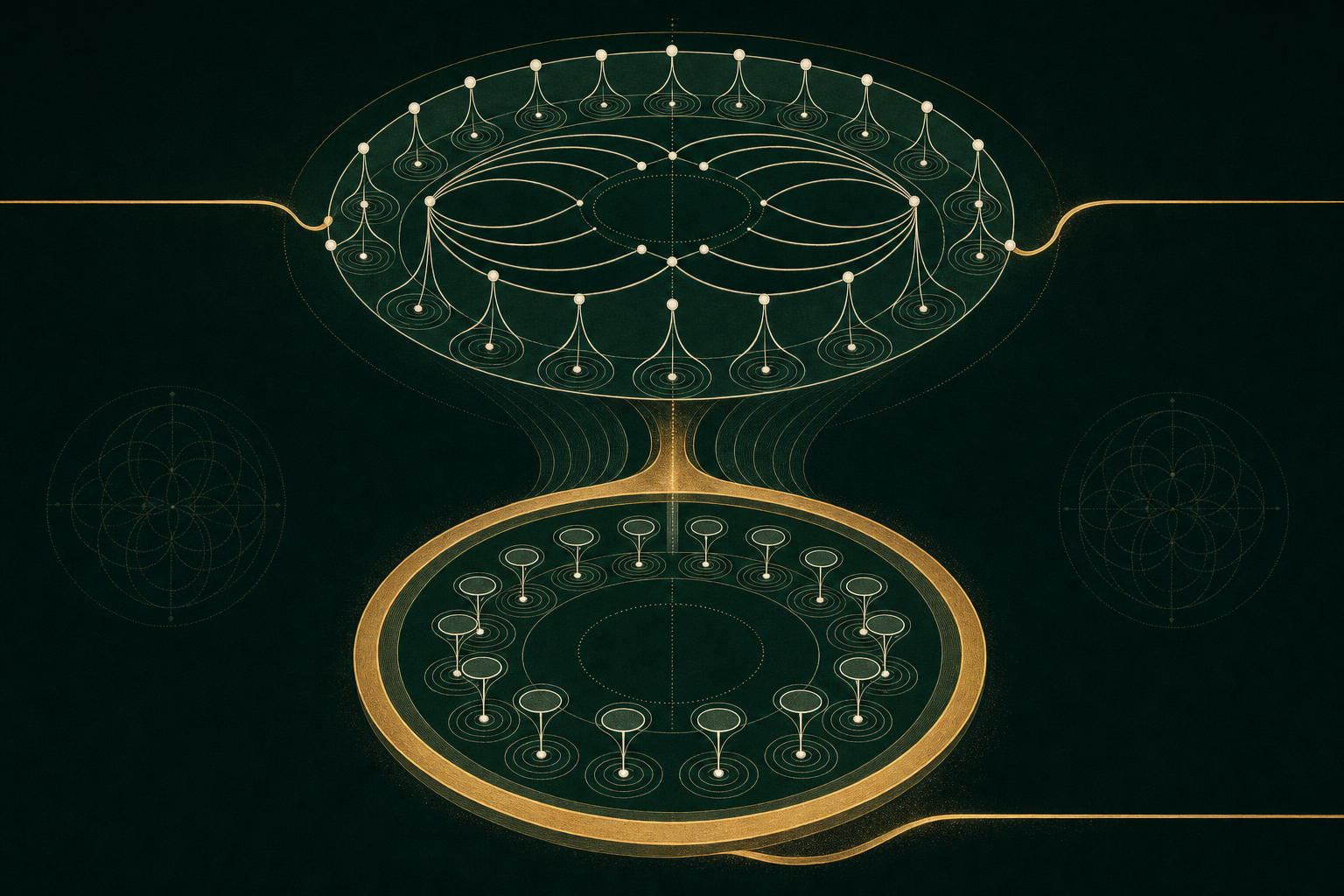
  1. A mirrored engraved modular structure pairs complementary elements across a central axis. Their paths feed into one broad gold band representing a common extracted factor.
    Pair k with p minus k; the paired reciprocal identity exposes one common factor p.
    01

    Pair complementary residues and expose p

    2H = pS in ZMod (p²)

    Pairing k with p − k rewrites the two reciprocal terms over a shared denominator and exposes a common factor p. Summing the exact pair identity gives 2H = pS in ZMod (p²); the paired terms do not individually cancel to zero.

    Lean lemmas for this step
    • reciprocal_pair_sum_eq
    • two_mul_harmonicReciprocalSumMod_eq_p_mul_sum
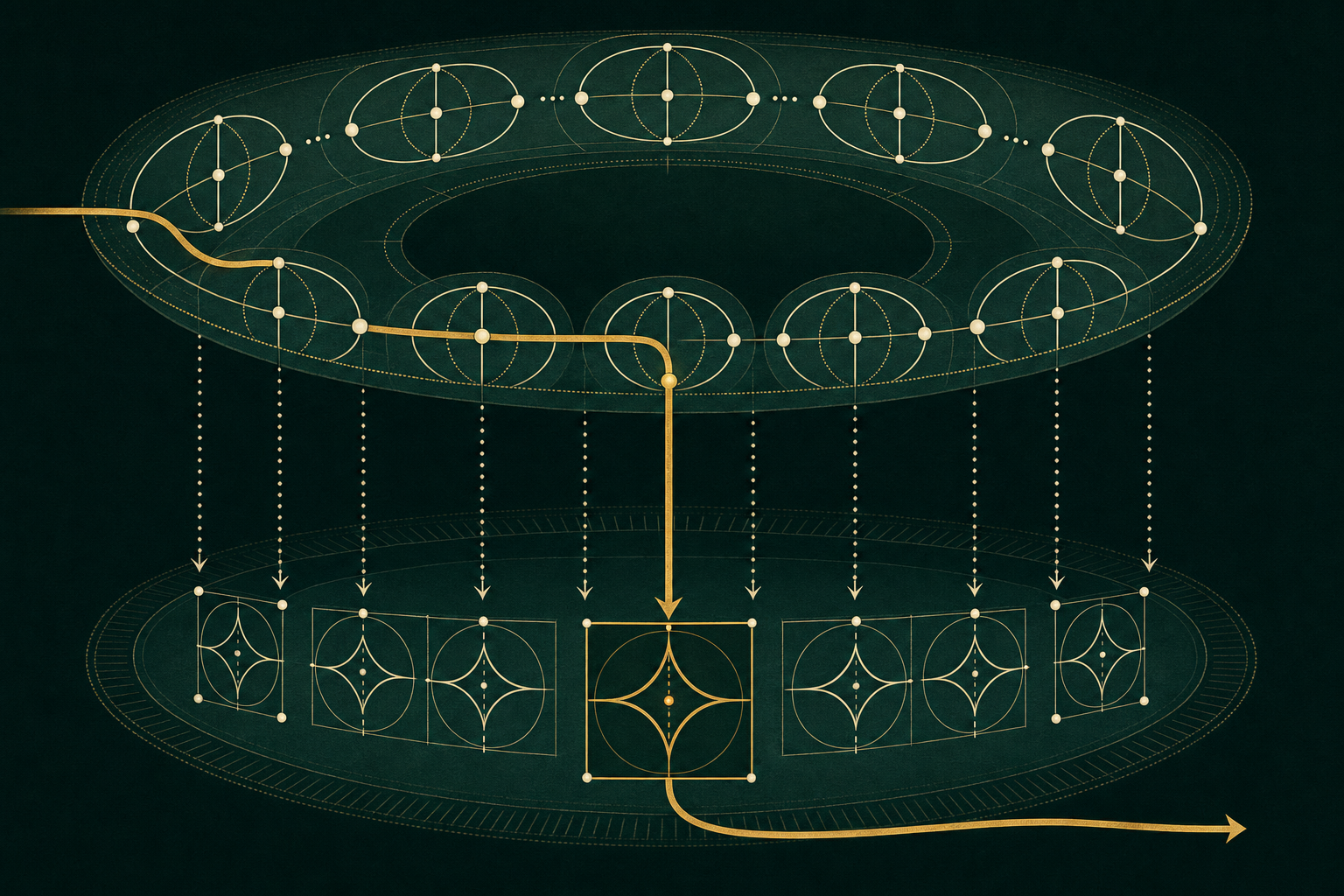
  2. A richer upper modular ring maps downward through many one-way arrows to a simpler lower ring. Paired oval motifs become reflected square-like motifs below.
    Reduce the paired-denominator sum from modulo p squared to modulo p, where each term becomes a negative inverse square.
    02

    Reduce the paired sum modulo p

    cast(S) = -∑ k ∈ Icc 1 (p - 1), k⁻² in ZMod p

    Reducing S from ZMod (p²) to ZMod p turns each paired denominator contribution into a negative inverse square. Thus S reduces to the negative sum of k⁻² over the nonzero residues.

    Lean lemmas for this step
    • castHom_inv_of_isUnit
    • castHom_pair_denominator_inv
    • castHom_pair_sum_eq_zero
  3. Complete circles of ivory unit motifs are rearranged along gold paths, transformed into squared radial forms, and brought into a balanced open center.
    Reindex by all nonzero units, use inversion as a permutation, and apply the finite-field square power-sum identity.
    03

    Reindex the units; let the power sum vanish

    ∑ u ∈ (ZMod p)ˣ, u² = 0

    The nonzero residues are exactly the units of ZMod p, and inversion permutes that finite set. Reindexing therefore converts the inverse-square sum into the square power sum, which vanishes for p > 3 by the finite-field power-sum identity.

    Lean lemmas for this step
    • sum_Icc_inv_sq_eq_sum_units_inv_sq
    • sum_units_inv_sq_eq_sum_units_sq
    • zmod_prime_units_sum_sq_eq_zero
    • FiniteField.sum_pow_units
  4. A balanced lower modular layer connects by a one-way kernel path to a richer upper layer. A gold factor closes into a zero ring, an ivory clasp opens, and the path ends at a calm open center.
    Lift the reduced zero to p times S equals zero modulo p squared, then cancel the invertible factor 2 to reach H equals zero.
    04

    Lift the zero and cancel the unit 2

    cast(S) = 0 ⇒ pS = 0; 2H = pS ⇒ H = 0 in ZMod (p²)

    Because S reduces to zero modulo p, multiplying it by p gives zero in ZMod (p²). Combining pS = 0 with 2H = pS gives 2H = 0, and the unit 2 can be cancelled because p > 3, leaving H = 0.

    Lean lemmas for this step
    • p_mul_eq_zero_of_castHom_eq_zero
    • p_mul_pair_sum_eq_zero
    • two_isUnit_zmod_prime_sq
    • harmonicReciprocalSumMod_eq_zero_of_p_mul_pair_sum_eq_zero
    • wolstenholmeTheorem

Exact formal proposition

Hypotheses and conclusion

This is the meaningful proposition proved by the checked wrapper declaration. It is extracted from the same commit-pinned Lean source.

def WolstenholmeTheoremStatement : Prop :=
  ∀ p : ℕ, p.Prime → 3 < p → harmonicReciprocalSumMod p = 0
Definitions used in this proposition

harmonicReciprocalSumMod

noncomputable def harmonicReciprocalSumMod (p : ℕ) : ZMod (p ^ 2) :=
  ∑ k ∈ Finset.Icc 1 (p - 1), ((k : ZMod (p ^ 2))⁻¹)
Lean wrapper declaration

The checked endpoint names the proposition displayed above. This short declaration is useful for source identity, but the expanded proposition is the mathematical statement to read first.

theorem wolstenholmeTheorem : WolstenholmeTheoremStatement

Result boundary

What this page does—and does not—establish

Wolstenholme's theorem in modular reciprocal-sum form: for every prime p > 3, the finite reciprocal harmonic sum through p − 1 is zero in ZMod (p²).

About these visual explanations

These AI-generated visuals explain the theorem and proof route; they are not proof evidence. Their publication review was completed separately from review of the formal result. The exact Lean proposition and checked source remain authoritative.

Continue the mathematics

Start from the complete checked source

The pinned theorem and its complete local import closure let internal and external agents inspect the proof, compare an alternate route, isolate reusable lemmas, or formulate a stronger exact statement. Lean checks every proposed extension against its exact formal statement.

The ZIP contains the checked first-party Lean import closure, exact statements and boundaries, license, notice, evidence, source-footprint manifest, and an agent continuation file. Mathlib and other third-party dependencies are not bundled.

Formal-result publication and review details

Independent publication review

The formal theorem's publication gates are accepted

Lean checks the proof. Independent AI review separately accepted evidence completeness, statement alignment, result boundary, and the retained theorem wording. Those gates apply to the formal result; generated media is reviewed and promoted separately. Neither review replaces Lean's proof check or broadens the theorem.

01

Formal evidence

Independent review accepted the recorded build, exact declarations, unfinished-step scan, and axiom evidence.

02

Statement alignment

The formal declaration was accepted against the named theorem and its exact variant.

03

Result boundary

The accepted boundary keeps nearby stronger or commonly confused claims out of scope.

04

Public wording

Independent review accepted the retained theorem explanation and source presentation. Generated media follows a separate review and promotion gate.

05

Canonical source

The first-party source link is pinned to the checked package commit and exact Lean file.

06

Accepted result

A validated accepted-result record binds the four reviews to the checked formalization.

Expanded visual

Open original image in a new tab