Formal evidence
Independent review accepted the recorded build, exact declarations, unfinished-step scan, and axiom evidence.
Diophantine approximation · formal theorem
There exists a positive constant c such that every positive integer q satisfies c · q⁻¹³³ᐟ¹⁰ ≤ ‖q log₂ 3‖, the distance to the nearest integer.
Line counts exclude blank lines; comments and documentation count. The total is the commit-pinned first-party Lean import closure; Mathlib and other third-party dependencies are excluded.
The theorem at a glance
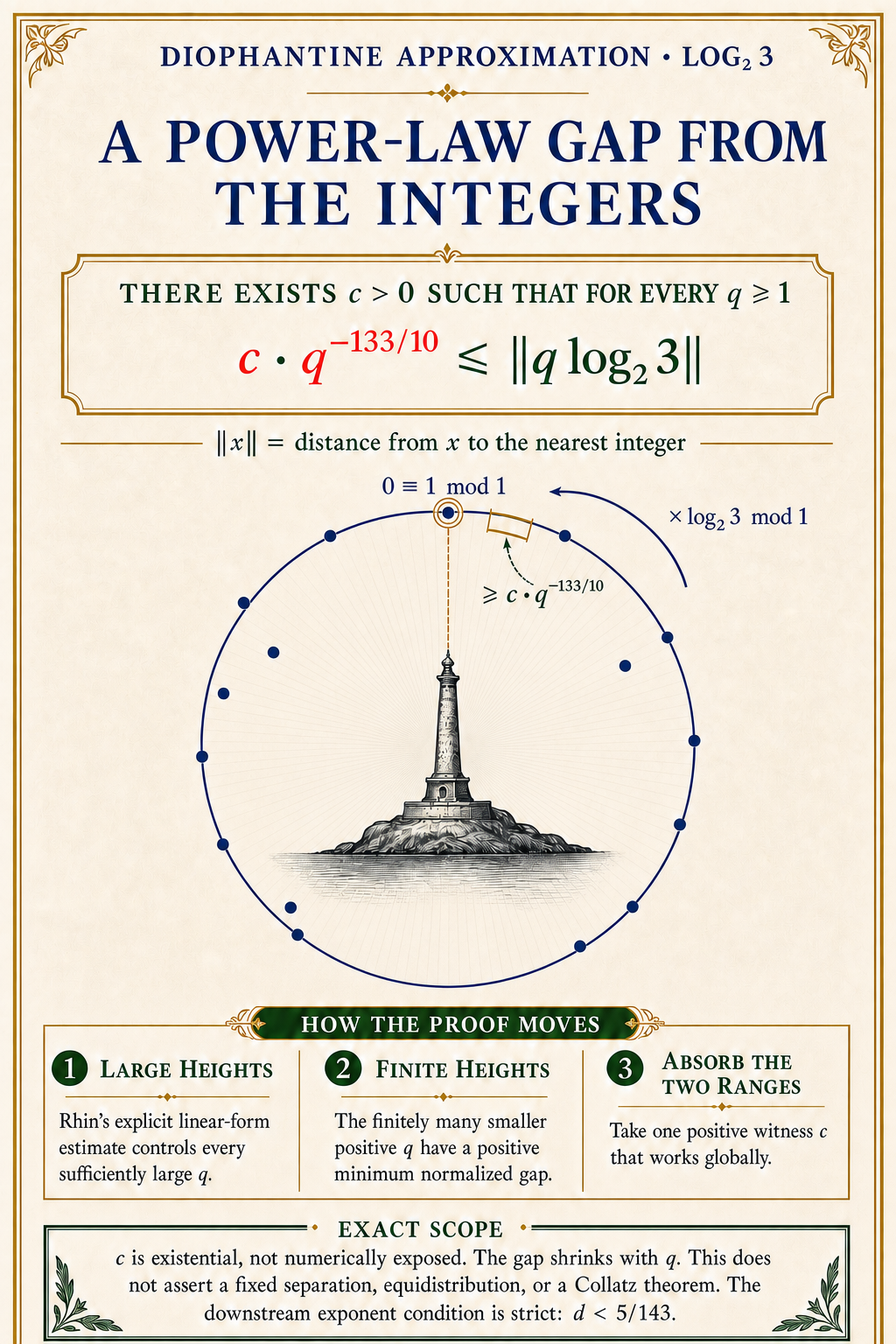
Accessible transcript
∃ c > 0, ∀ q ≥ 1, c · q^(-133/10) ≤ ‖q log₂ 3‖
The proof controls all sufficiently large q through an explicit linear-form estimate, takes a positive normalized minimum over the finitely many smaller q, and chooses one witness c valid in both ranges.
DIOPHANTINE APPROXIMATION · LOG₂ 3
A POWER-LAW GAP FROM THE INTEGERS
THERE EXISTS c > 0 SUCH THAT FOR EVERY q ≥ 1
c · q^(-133/10) ≤ ‖q log₂ 3‖
‖x‖ = distance from x to the nearest integer
0 ≡ 1 mod 1
× log₂ 3 mod 1
≥ c · q^(-133/10)
HOW THE PROOF MOVES
1 · LARGE HEIGHTS
Rhin's explicit linear-form estimate controls every sufficiently large q.
2 · FINITE HEIGHTS
The finitely many smaller positive q have a positive minimum normalized gap.
3 · ABSORB THE TWO RANGES
Take one positive witness c that works globally.
EXACT SCOPE
c is existential, not numerically exposed. The gap shrinks with q. This does not assert a fixed separation, equidistribution, or a Collatz theorem. The downstream exponent condition is strict: d < 5/143.
Theorem schematic
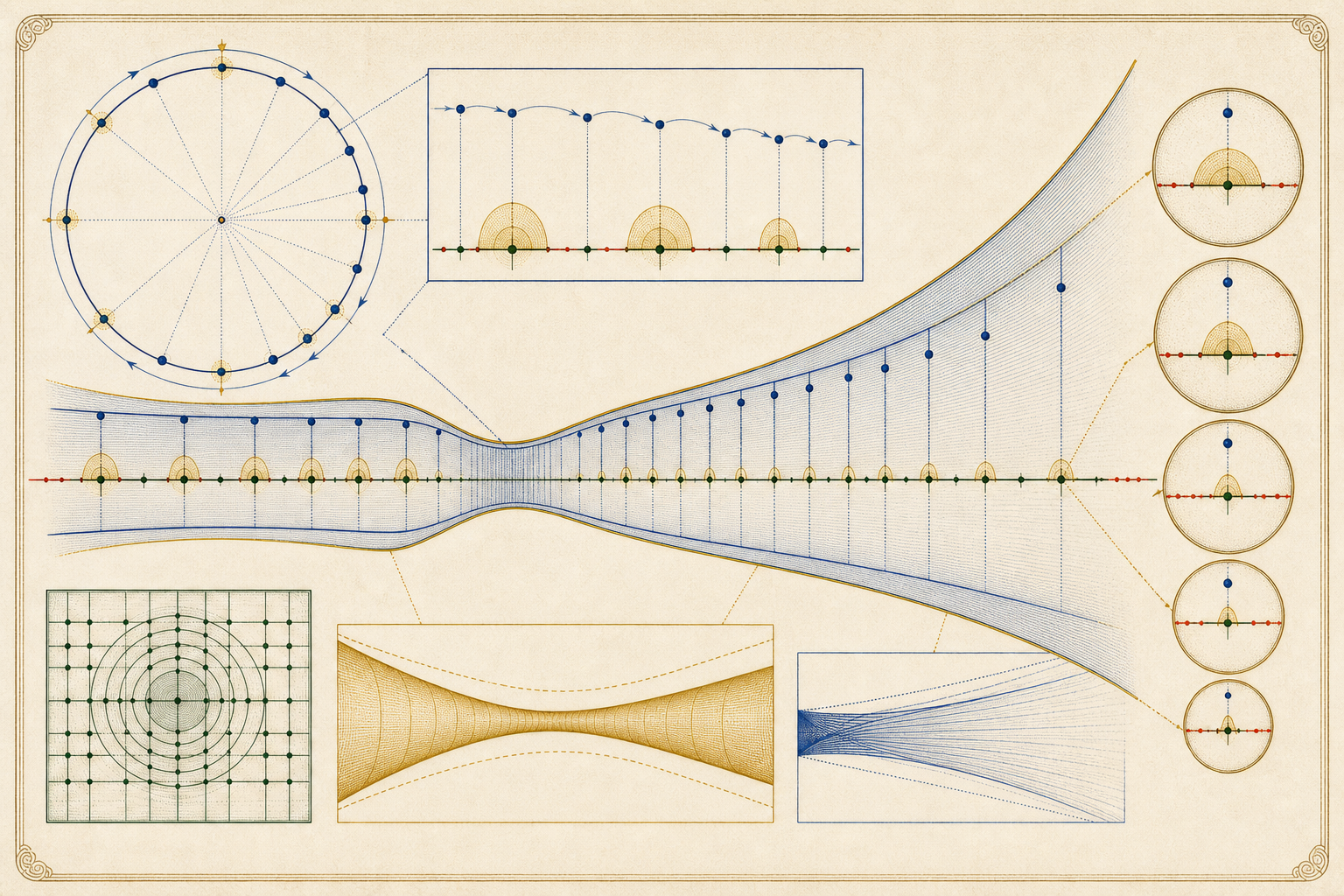
∃ c > 0, ∀ q ≥ 1, c · q^(-133/10) ≤ ‖q log₂ 3‖
There exists c > 0 such that c · q^(-133/10) is no greater than the nearest-integer distance of q log₂ 3 for every q ≥ 1. The witness is existential and the separation shrinks with q.
Exact formal proposition
This is the exact recorded theorem statement, followed by the source definitions that give its named predicates and quantities their full meaning.
theorem existsPhaseGapRhin : ∃ c : ℝ, PhaseGap c (143 / 10 : ℝ)PhaseGap structure PhaseGap (c kappa : ℝ) : Prop where
c_pos : 0 < c
c_le_one : c ≤ 1
two_lt_kappa : 2 < kappa
gap : ∀ q : ℕ, 0 < q →
c * Real.rpow (q : ℝ) (1 - kappa) ≤
nearestIntegerNorm ((q : ℝ) * logTwoThree)Result boundary
The checked theorem supplies a positive constant c for which c · q⁻¹³³ᐟ¹⁰ ≤ ‖q log₂ 3‖ for every positive integer q.
These AI-generated visuals explain the theorem and proof route; they are not proof evidence. Their publication review was completed separately from review of the formal result. The exact Lean proposition and checked source remain authoritative.
Continue the mathematics
The pinned theorem and its complete local import closure let internal and external agents inspect the proof, compare an alternate route, isolate reusable lemmas, or formulate a stronger exact statement. Lean checks every proposed extension against its exact formal statement.
The ZIP contains the checked first-party Lean import closure, exact statements and boundaries, license, notice, evidence, source-footprint manifest, and an agent continuation file. Mathlib and other third-party dependencies are not bundled.
Independent publication review
Lean checks the proof. Independent AI review separately accepted evidence completeness, statement alignment, result boundary, and the retained theorem wording. Those gates apply to the formal result; generated media is reviewed and promoted separately. Neither review replaces Lean's proof check or broadens the theorem.
Independent review accepted the recorded build, exact declarations, unfinished-step scan, and axiom evidence.
The formal declaration was accepted against the named theorem and its exact variant.
The accepted boundary keeps nearby stronger or commonly confused claims out of scope.
Independent review accepted the retained theorem explanation and source presentation. Generated media follows a separate review and promotion gate.
The first-party source link is pinned to the checked package commit and exact Lean file.
A validated accepted-result record binds the four reviews to the checked formalization.