For every finite Young diagram, multiplying all hook lengths by the number of standard Young tableaux gives the factorial of the number of cells.
Lean proofpassed
Unfinished proof stepsNone
Formal resultAccepted
Starting pointFinite Young diagram μ
→
RelationCorner erasure and branching
→
Conclusionhook product · tableaux = |μ|!
Exact scope: For every finite Young diagram μ, hookProduct μ · standardTableauCount μ = (μ.card)!.
Line counts exclude blank lines; comments and documentation count. The total is the commit-pinned first-party Lean import closure; Mathlib and other third-party dependencies are excluded.
The theorem at a glance
Hook-Length Formula at a glance
EnlargeLocal hook sizes determine the number of all standard tableaux of a finite Young diagram.
Accessible transcript
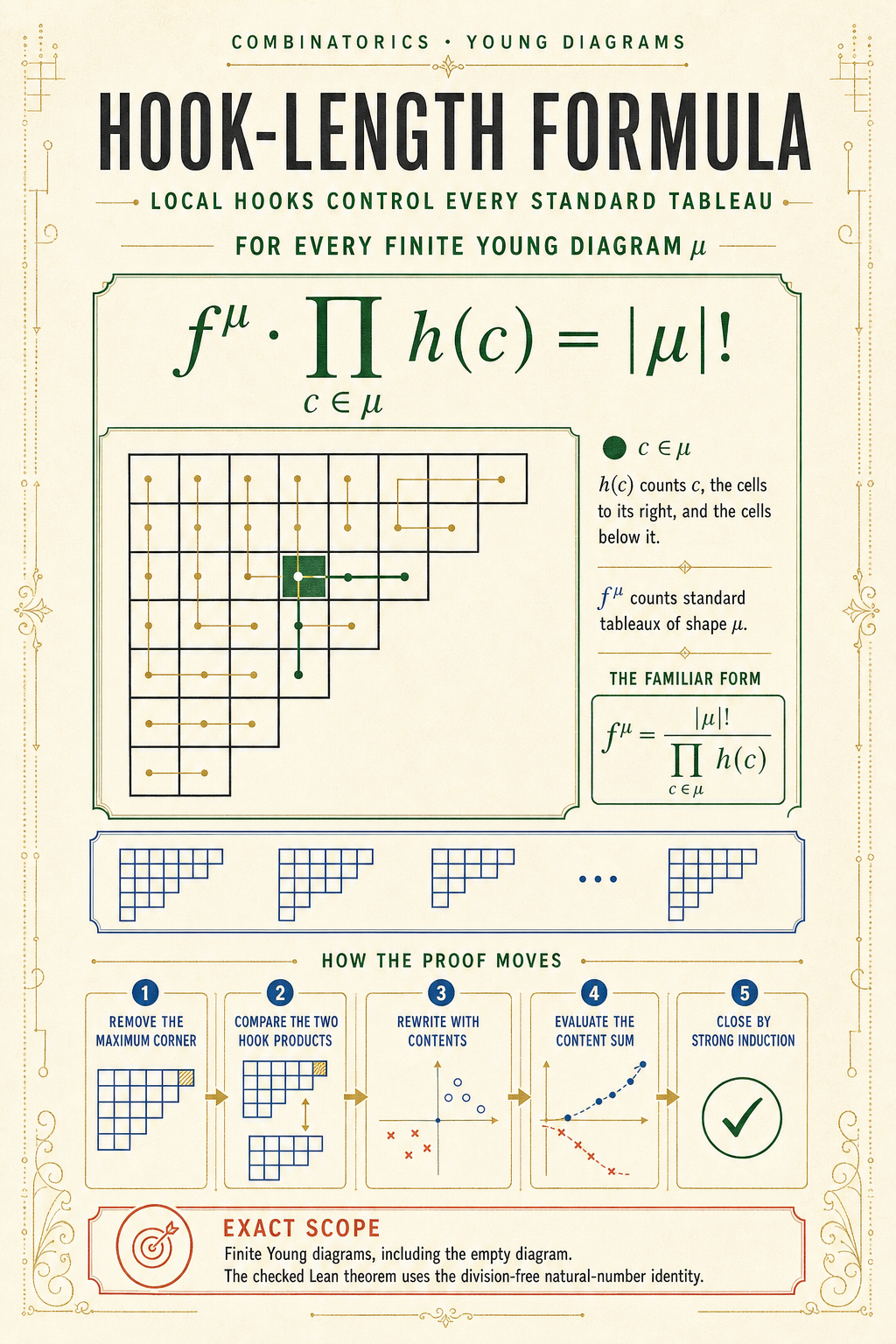
f^μ · ∏ h(c) = |μ|!
The exact multiplicative Hook-Length Formula, its local hook statistic, tableau count, and induction architecture are gathered in one reference.
Read the complete poster transcript
COMBINATORICS · YOUNG DIAGRAMS
HOOK-LENGTH FORMULA
LOCAL HOOKS CONTROL EVERY STANDARD TABLEAU
FOR EVERY FINITE YOUNG DIAGRAM μ
f^μ · ∏ h(c) = |μ|!
h(c) counts c, the cells to its right, and the cells below it.
f^μ counts standard tableaux of shape μ.
THE FAMILIAR FORM
f^μ = |μ|! / ∏ h(c)
HOW THE PROOF MOVES
REMOVE THE MAXIMUM CORNER · COMPARE HOOK PRODUCTS · REWRITE WITH CONTENTS · EVALUATE THE CONTENT SUM · CLOSE BY STRONG INDUCTION
EXACT SCOPE
Finite Young diagrams, including the empty diagram.
Theorem schematic
Hooks turn local geometry into a global count
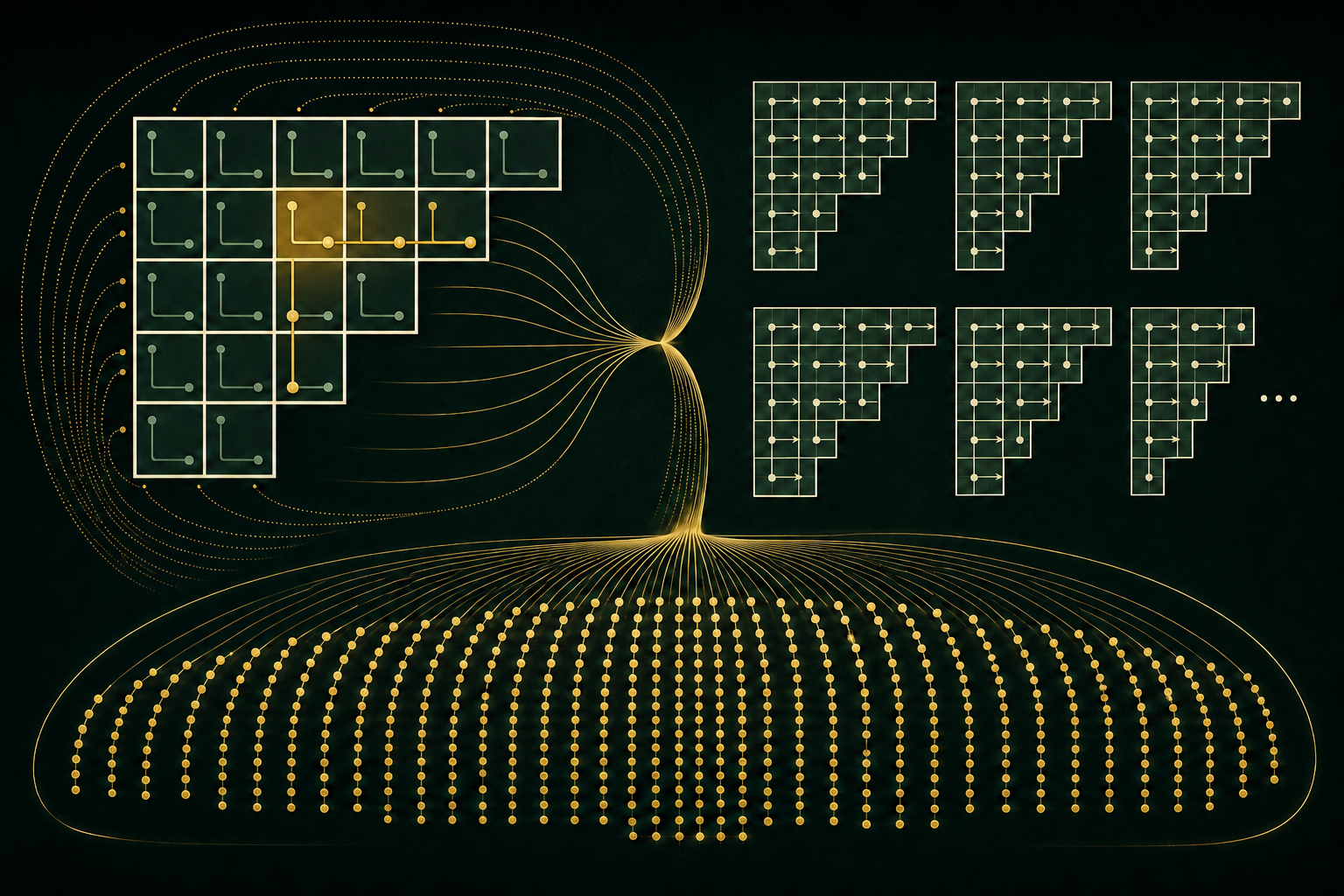
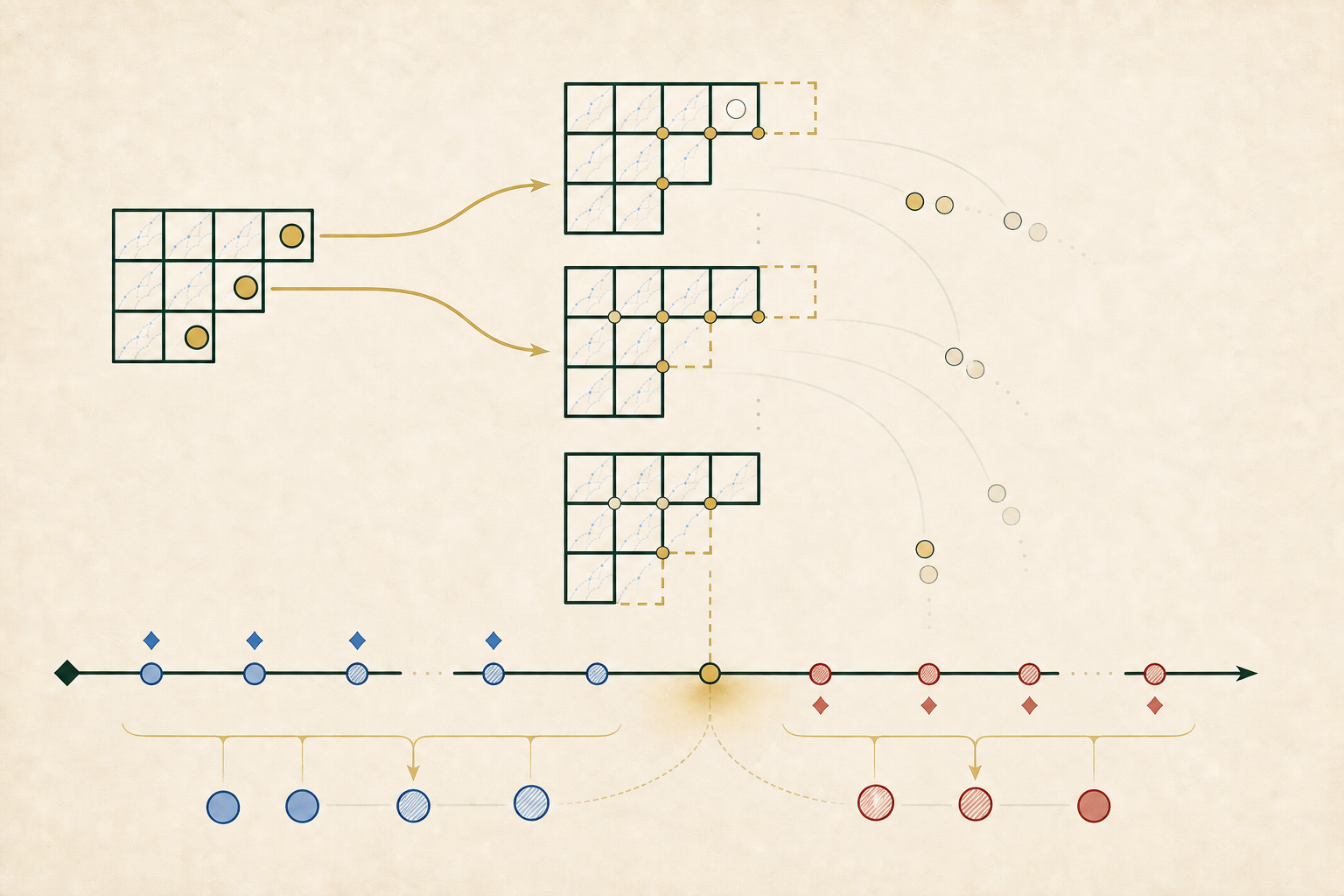
EnlargeA Young diagram links one local hook to the global tableau-count identity.
f^μ · ∏ h(c) = |μ|!
A finite Young diagram assigns each cell a hook extending rightward and downward; multiplying those local hook lengths controls the total number of standard tableaux.
Proof architecture
How the Hook-Length Formula is proved
6 curated stages
Follow the retained proof from removable corners through hook-product ratios and finite interpolation to the strong-induction close.
These source-anchored stages explain the retained proof route. They are not an extracted Lean proof-term dependency graph.
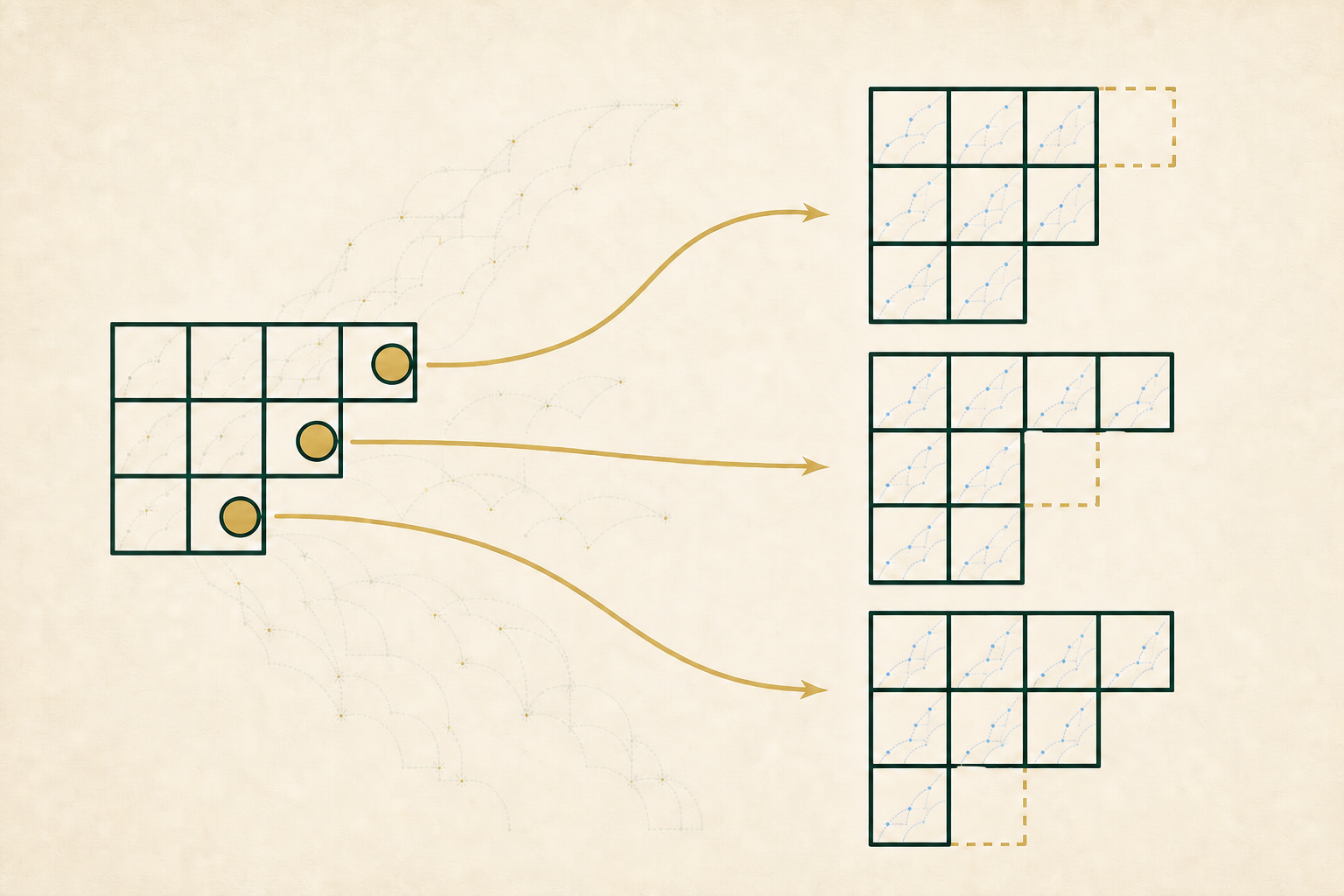
EnlargeEach removable corner produces one smaller tableau-count branch.
01
Tableaux branch at the maximum corner
f^μ = ∑ f^(μ\c)
The largest tableau entry must occupy a removable corner, so every standard tableau belongs to exactly one smaller-shape branch.
Lean lemmas for this step
Cell
hookCells
hookLength
IsStandardTableau
standardTableauCount
hookProduct
hookLengthFormula
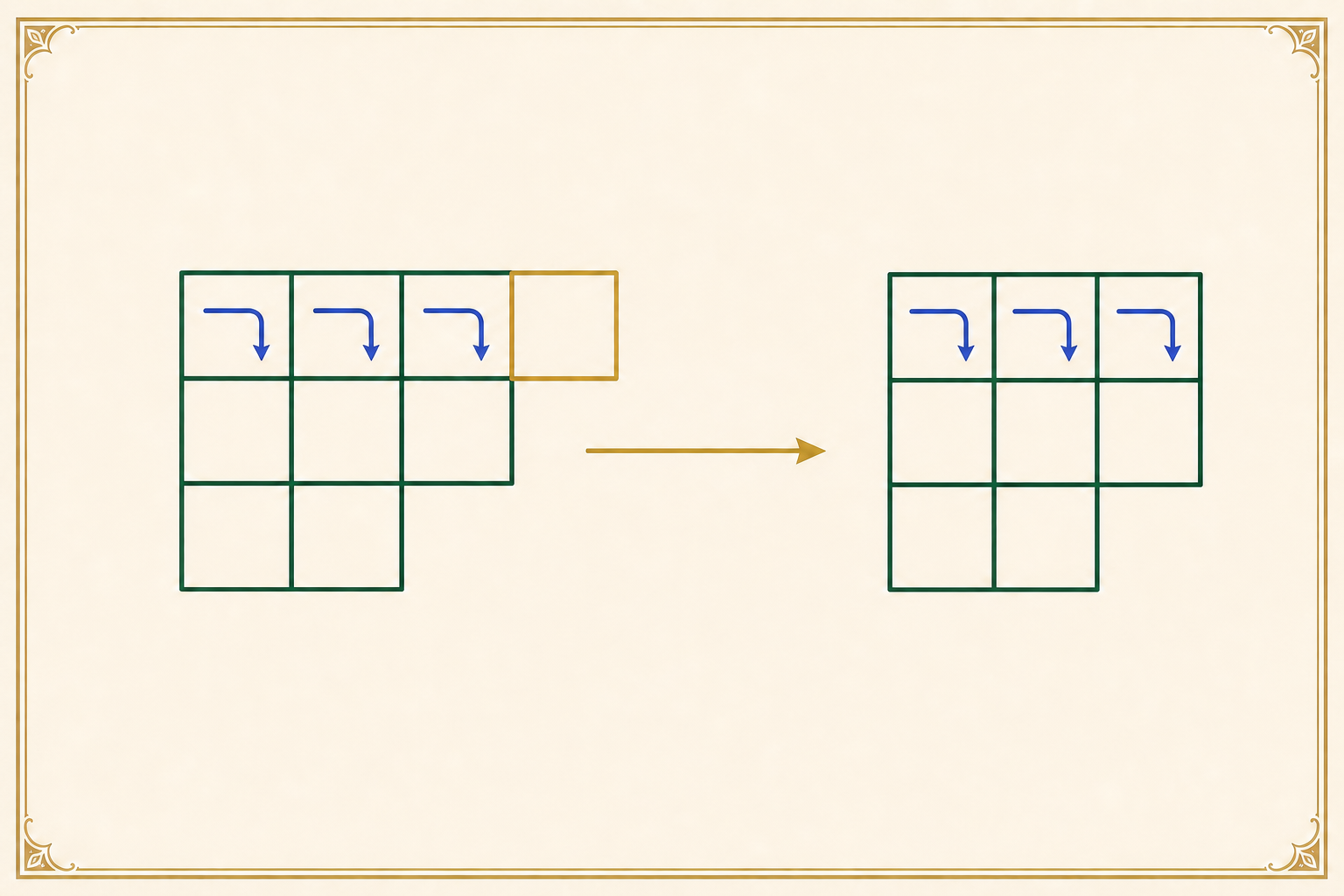
EnlargeA single corner deletion isolates the hooks that lose one cell.
02
Only crossing hooks change
(4,3,2) → (3,3,2)
Deleting the top-right corner of the (4,3,2) example leaves (3,3,2); only hooks whose arms crossed that corner change.
Lean lemmas for this step
Cell
hookCells
hookLength
IsStandardTableau
standardTableauCount
hookProduct
hookLengthFormula
EnlargeRow and column hook changes telescope into content factors.
03
Hook ratios become content intervals
The ratio between the original and corner-deleted hook products factors along one row and one column, then telescopes into addable and removable contents.
Lean lemmas for this step
Cell
hookCells
hookLength
IsStandardTableau
standardTableauCount
hookProduct
hookLengthFormula
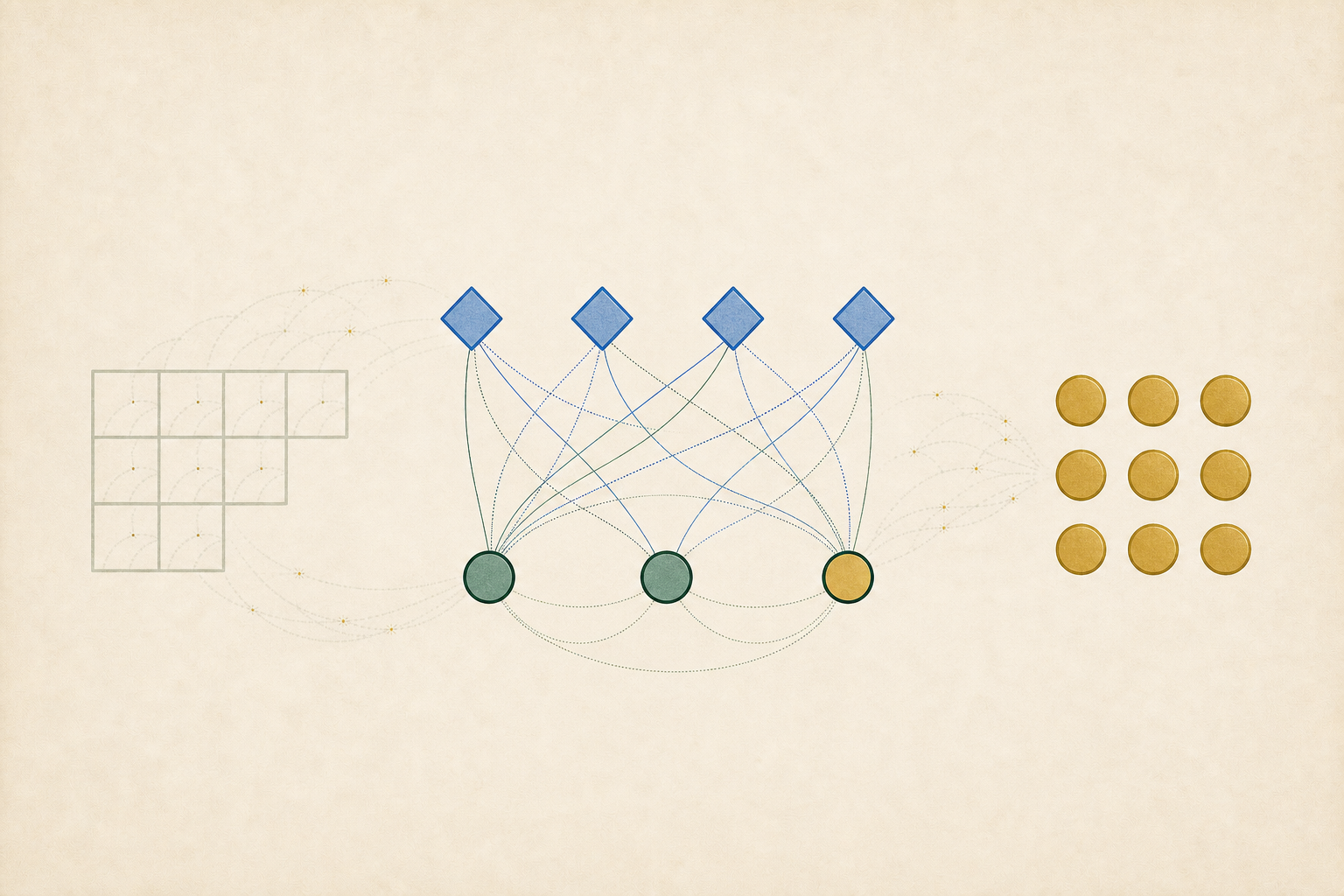
EnlargeAll erased-corner branches gather into one content identity.
04
The branching identity becomes one finite sum
After rewriting every corner branch by contents, the required hook-product identity reduces to a finite rational sum over removable corners.
Lean lemmas for this step
Cell
hookCells
hookLength
IsStandardTableau
standardTableauCount
hookProduct
hookLengthFormula
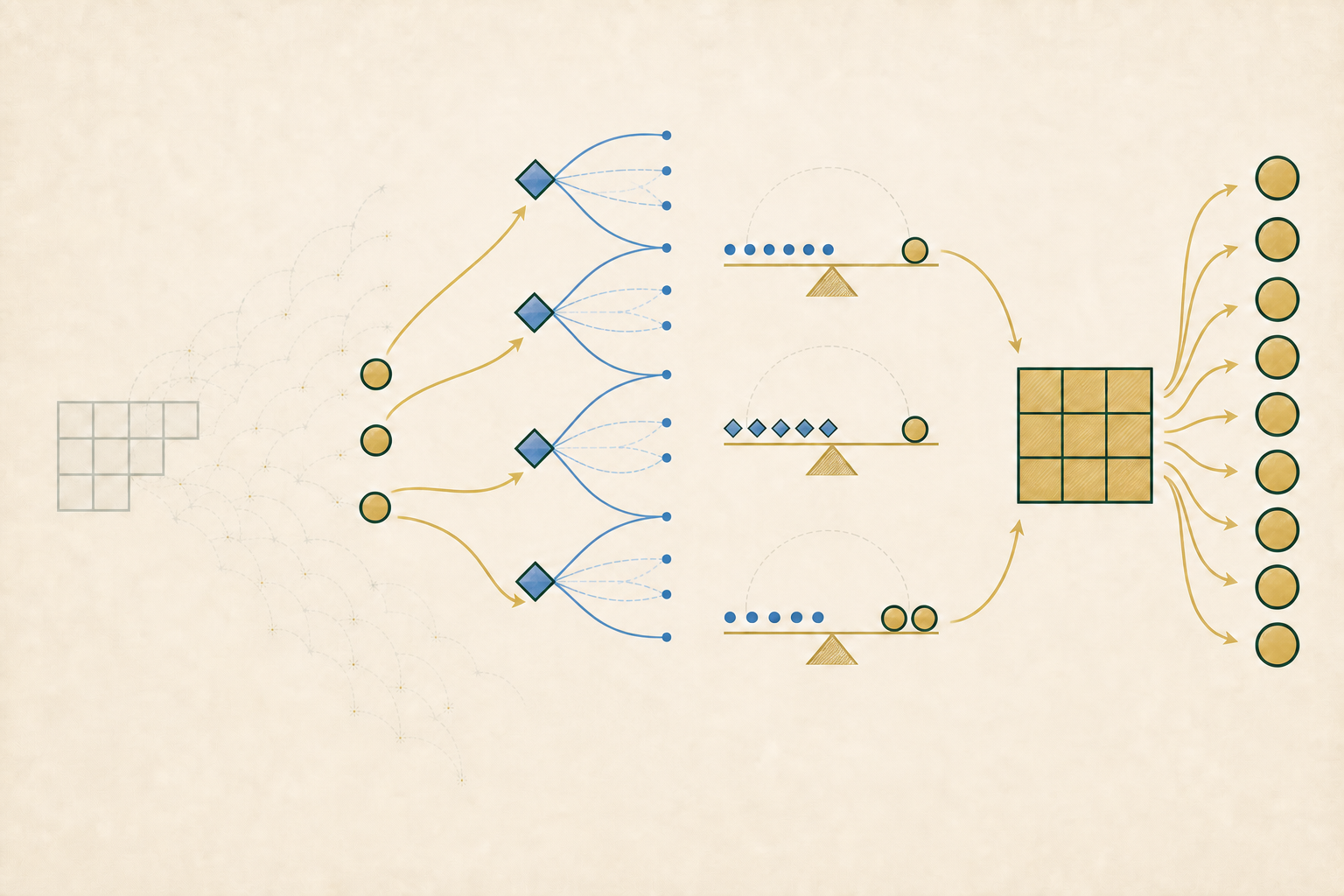
EnlargeInterpolation converts the content factors into the missing branching multiplier.
05
Finite interpolation evaluates the sum
A finite interpolation identity evaluates the content sum, supplying exactly the scalar needed to balance the branching recurrence.
Lean lemmas for this step
Cell
hookCells
hookLength
IsStandardTableau
standardTableauCount
hookProduct
hookLengthFormula
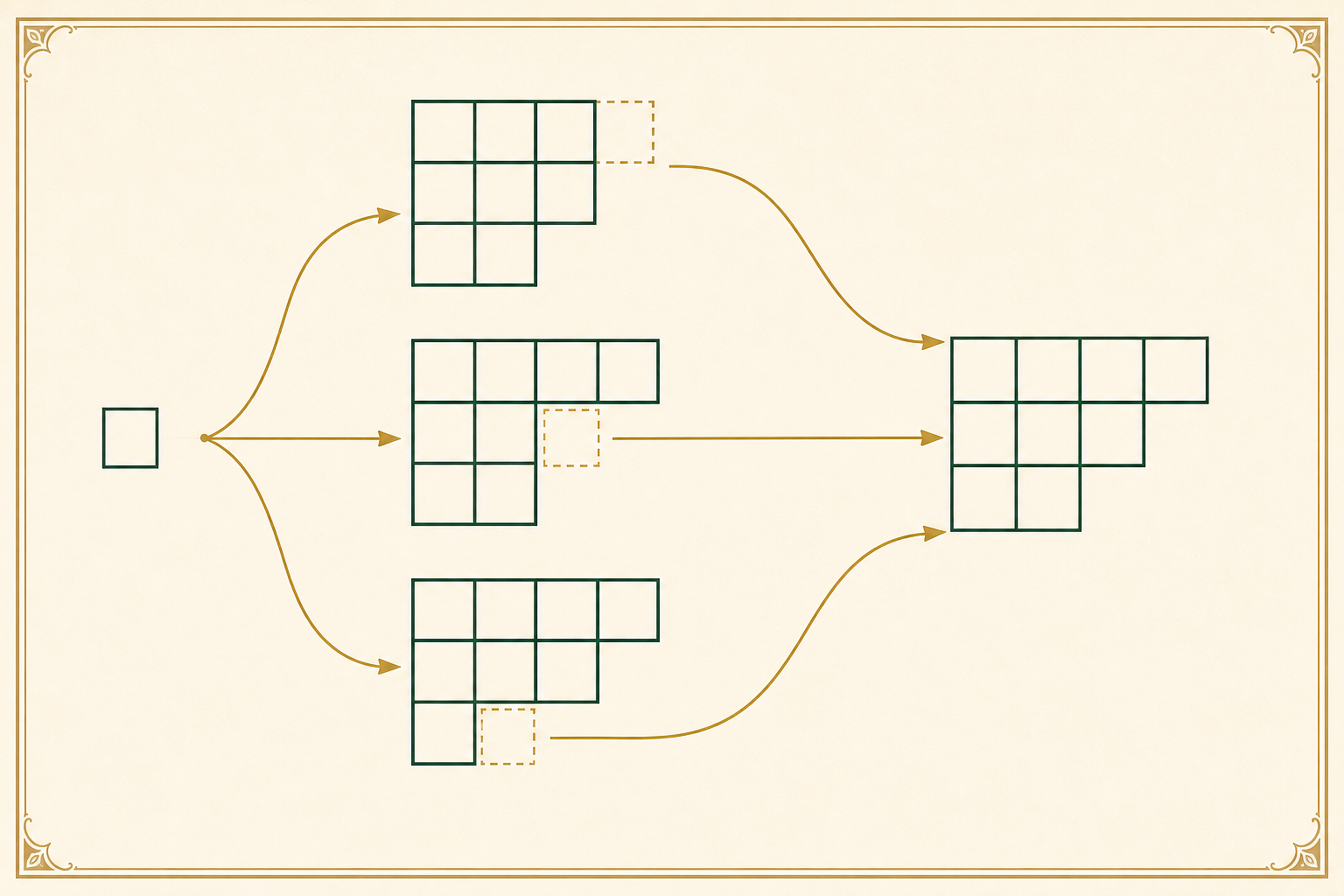
EnlargeEvery valid smaller shape converges into the factorial identity for the original shape.
06
Strong induction closes the formula
Strong induction substitutes the formula for every erased-corner child. In the (4,3,2) example there are three such children. The branching identity supplies the missing factor, and the empty diagram anchors the base case.
For every finite Young diagram μ, hookProduct μ · standardTableauCount μ = (μ.card)!.
The Lean endpoint is the multiplication identity; the familiar factorial-divided-by-hooks expression is an interpretation rather than the literal statement.
The theorem does not cover skew or shifted tableaux.
About these visual explanations
These AI-generated visuals explain the theorem and proof route; they are not proof evidence. Their publication review was completed separately from review of the formal result. The exact Lean proposition and checked source remain authoritative.
Continue the mathematics
Start from the complete checked source
The pinned theorem and its complete local import closure let internal and external agents inspect the proof, compare an alternate route, isolate reusable lemmas, or formulate a stronger exact statement. Lean checks every proposed extension against its exact formal statement.
The ZIP contains the checked first-party Lean import closure, exact statements and boundaries, license, notice, evidence, source-footprint manifest, and an agent continuation file. Mathlib and other third-party dependencies are not bundled.
The formal theorem's publication gates are accepted
Lean checks the proof. Independent AI review separately accepted evidence completeness, statement alignment, result boundary, and the retained theorem wording. Those gates apply to the formal result; generated media is reviewed and promoted separately. Neither review replaces Lean's proof check or broadens the theorem.
01
Formal evidence
Independent review accepted the recorded build, exact declarations, unfinished-step scan, and axiom evidence.
02
Statement alignment
The formal declaration was accepted against the named theorem and its exact variant.
03
Result boundary
The accepted boundary keeps nearby stronger or commonly confused claims out of scope.
04
Public wording
Independent review accepted the retained theorem explanation and source presentation. Generated media follows a separate review and promotion gate.
05
Canonical source
The first-party source link is pinned to the checked package commit and exact Lean file.
06
Accepted result
A validated accepted-result record binds the four reviews to the checked formalization.