In a finite graph with at least two vertices, exactly one common neighbor for every distinct pair forces a universal hub; every other vertex has exactly one neighbor other than the hub.
Lean proofpassed
Unfinished proof stepsNone
Formal resultAccepted
Starting pointFinite nontrivial simple graph
→
RelationOne common neighbor per distinct pair
→
ConclusionUniversal hub + local pairing
Exact scope: For finite simple graphs with at least two vertices, exactly one common neighbor for every distinct pair forces a universal hub; every other vertex has exactly one neighbor other than the hub.
Line counts exclude blank lines; comments and documentation count. The total is the commit-pinned first-party Lean import closure; Mathlib and other third-party dependencies are excluded.
The theorem at a glance
Friendship Theorem at a glance
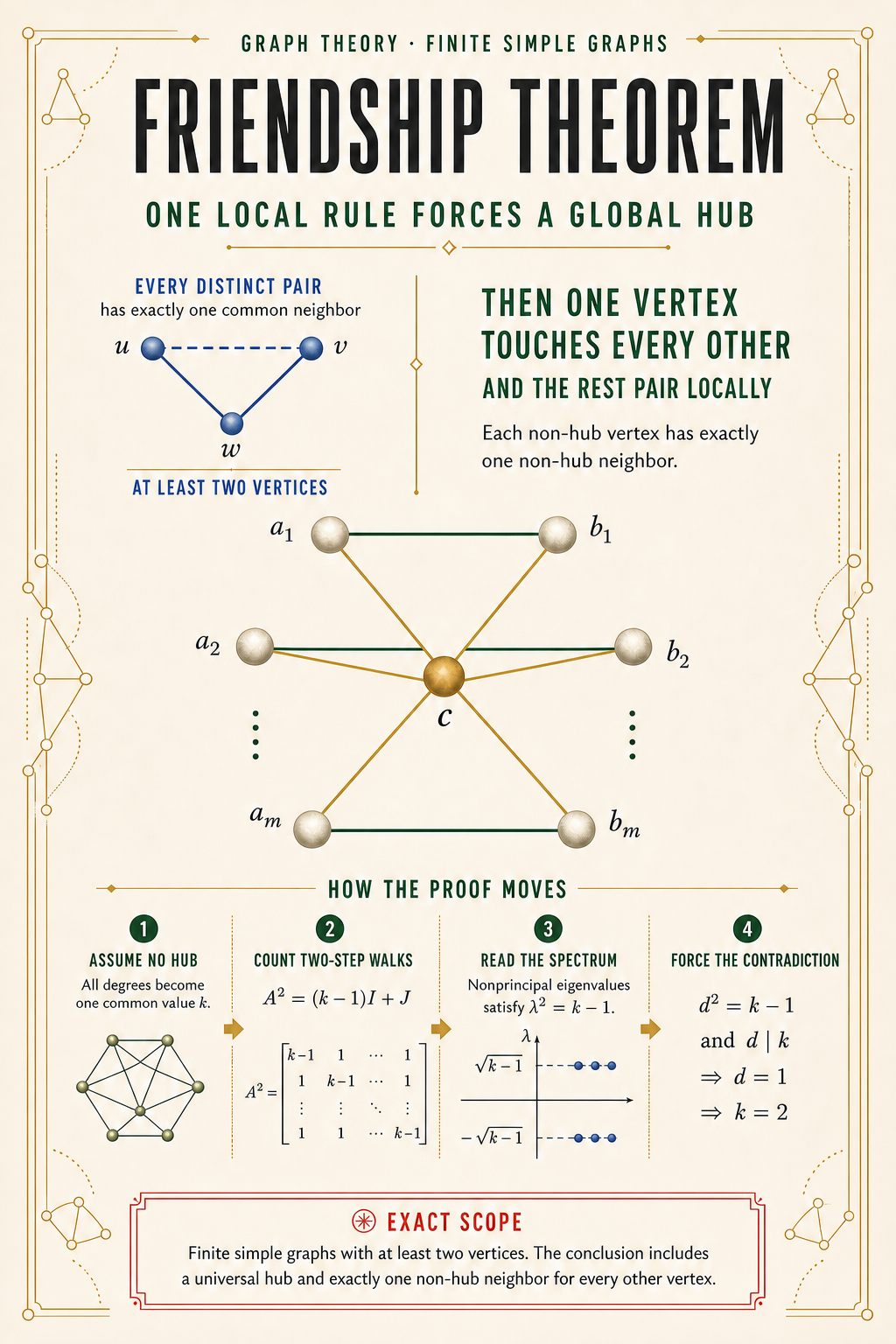
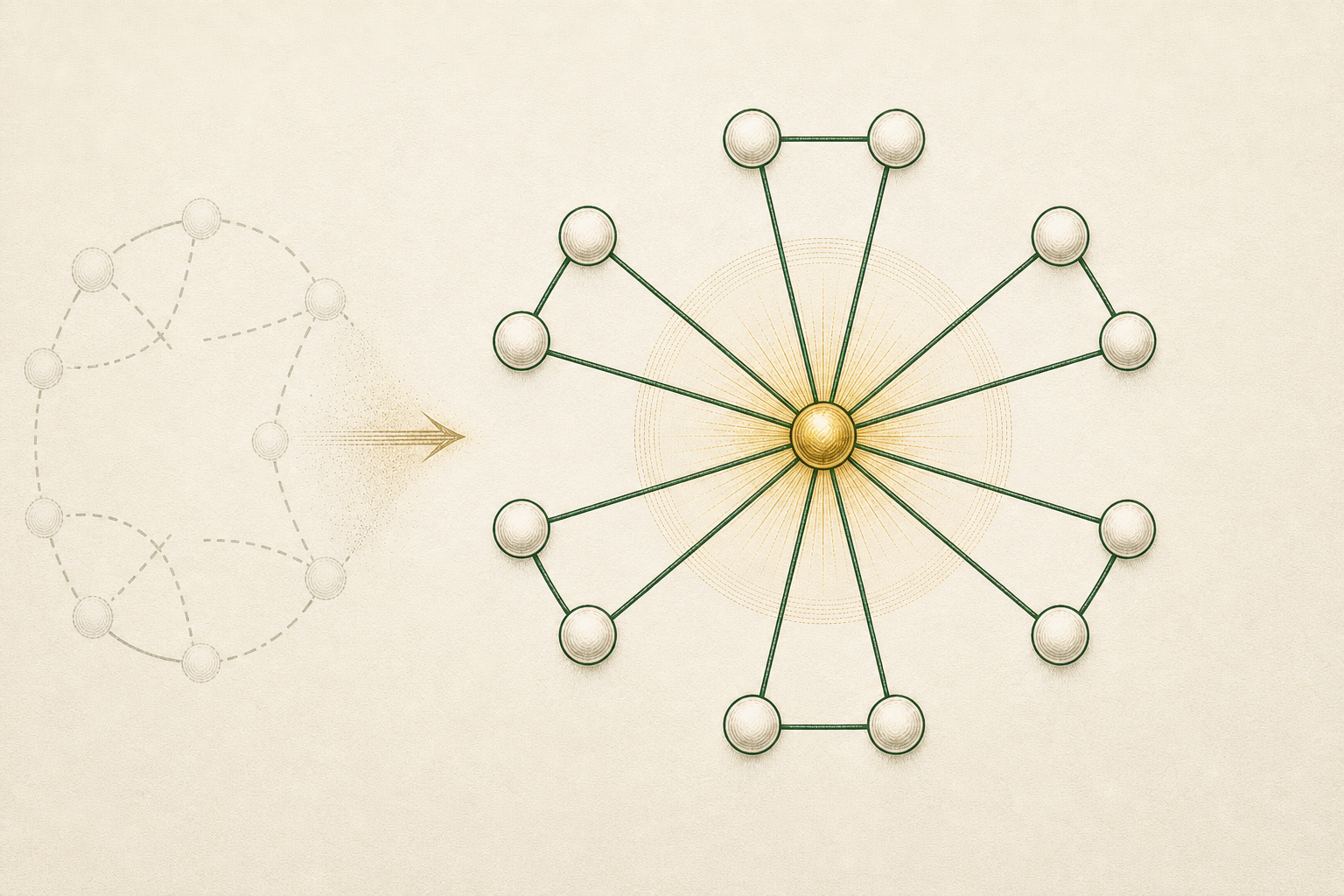
EnlargeThe Friendship Theorem turns one local common-neighbor rule into a universal hub and a precise pairing of every other vertex.
Accessible transcript
Every distinct pair has exactly one common neighbor ⇒ ∃ a universal hub c, and each v ≠ c has exactly one non-hub neighbor
Assuming no universal hub first forces regularity and the matrix identity A² = (k − 1)I + J. Its spectrum and trace relations produce an arithmetic contradiction, so a hub exists; the original common-neighbor rule then gives exactly one non-hub neighbor for every other vertex.
Read the complete poster transcript
GRAPH THEORY · FINITE SIMPLE GRAPHS
FRIENDSHIP THEOREM
ONE LOCAL RULE FORCES A GLOBAL HUB
EVERY DISTINCT PAIR
has exactly one common neighbor
u · v · w
AT LEAST TWO VERTICES
THEN ONE VERTEX TOUCHES EVERY OTHER
AND THE REST PAIR LOCALLY
Each non-hub vertex has exactly one non-hub neighbor.
a₁ · b₁ · a₂ · b₂ · ⋮ · c · ⋮ · aₘ · bₘ
HOW THE PROOF MOVES
1 · ASSUME NO HUB
All degrees become one common value k.
2 · COUNT TWO-STEP WALKS
A² = (k − 1)I + J
A² = [k−1 1 … 1; 1 k−1 … 1; ⋮ ⋮ ⋱ ⋮; 1 1 … k−1]
3 · READ THE SPECTRUM
Nonprincipal eigenvalues satisfy λ² = k − 1.
λ · √(k − 1) · −√(k − 1)
4 · FORCE THE CONTRADICTION
d² = k − 1 and d ∣ k ⇒ d = 1 ⇒ k = 2
EXACT SCOPE
Finite simple graphs with at least two vertices. The conclusion includes a universal hub and exactly one non-hub neighbor for every other vertex.
Theorem schematic
A local rule forces a universal hub
EnlargeA unique common neighbor for every distinct pair forces one universal hub, with every other vertex having exactly one non-hub neighbor.
Every distinct pair has exactly one common neighbor ⇒ a universal hub exists and each non-hub vertex has exactly one non-hub neighbor
The unique-common-neighbor hypothesis forces a vertex adjacent to every other vertex. Once that hub is fixed, every remaining vertex has exactly one neighbor outside the hub, so the non-hub vertices split into disjoint adjacent pairs.
Proof architecture
Why one shared neighbor forces a universal hub
5 curated stages
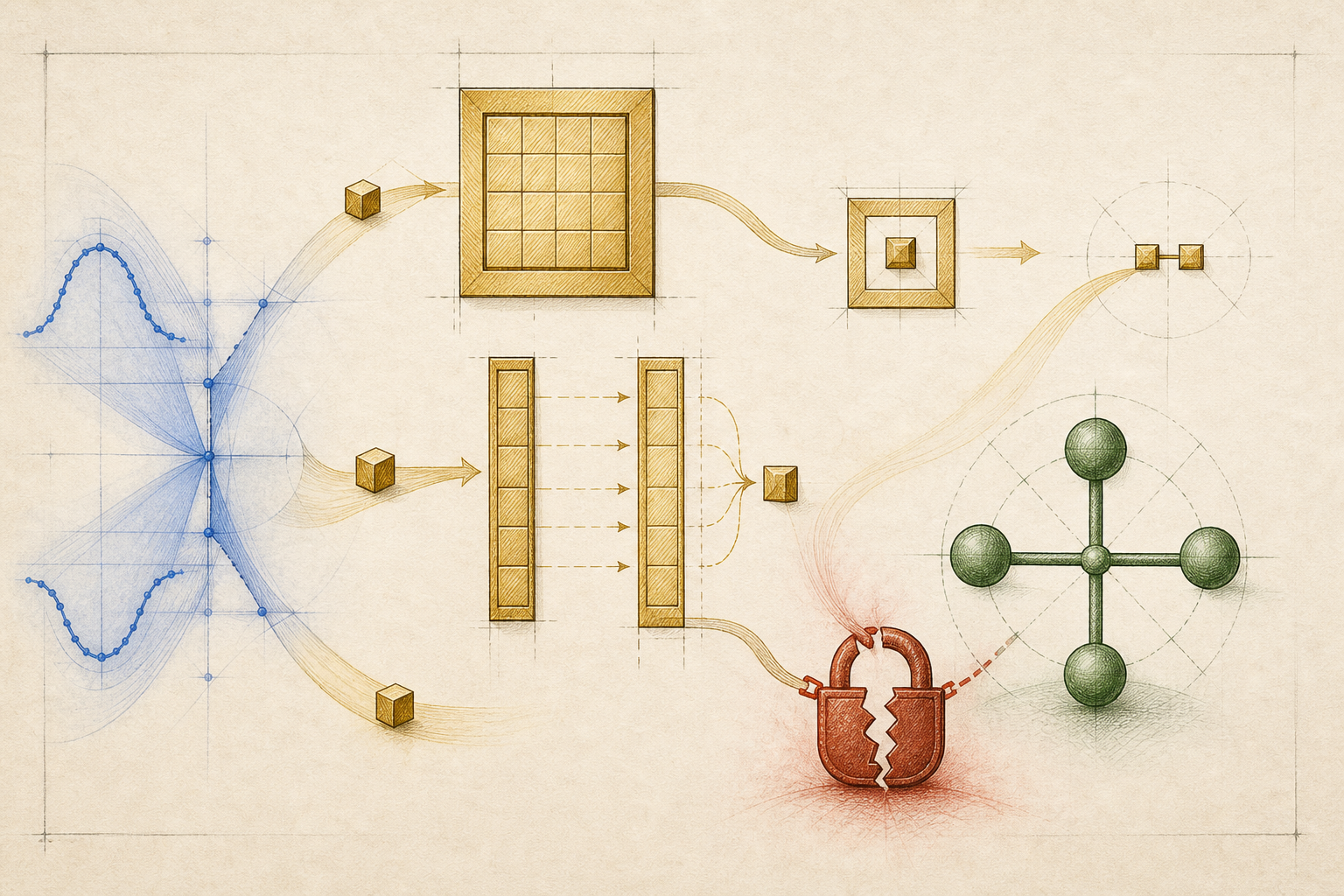
The checked proof first assumes that no hub exists. It turns the graph into a strongly regular matrix problem, uses the Hermitian spectrum to force impossible degree arithmetic, and then returns to the graph to obtain the hub and exact pairing of every non-hub vertex.
These source-anchored stages explain the retained proof route. They are not an extracted Lean proof-term dependency graph.
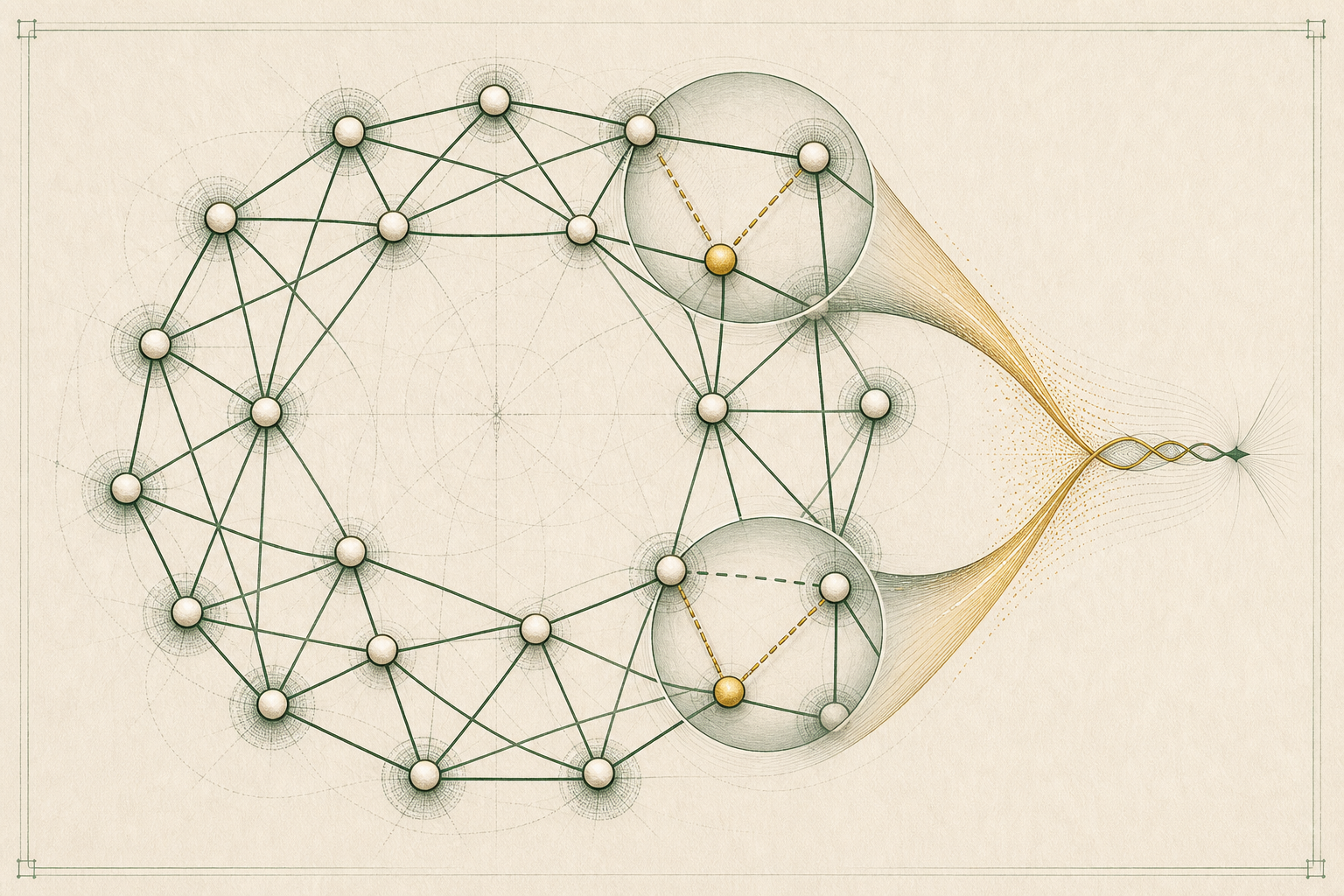
EnlargeUnder the temporary no-hub assumption, the common-neighbor rule forces one common degree and strongly regular parameters with both common-neighbor counts equal to one.
01
No hub forces strong regularity
No hub ⇒ G is k-regular and IsSRGWith |V| k 1 1
Assuming there is no universal vertex, the unique-common-neighbor rule forces every vertex to have the same degree. Adjacent and nonadjacent pairs each have exactly one common neighbor, giving the strongly regular parameters used in the rest of the proof.
Lean lemmas for this step
degree_eq_of_no_hub
isRegularOfDegree_of_no_hub
isSRGWith_of_no_hub
card_commonNeighbors_eq_one_of_unique
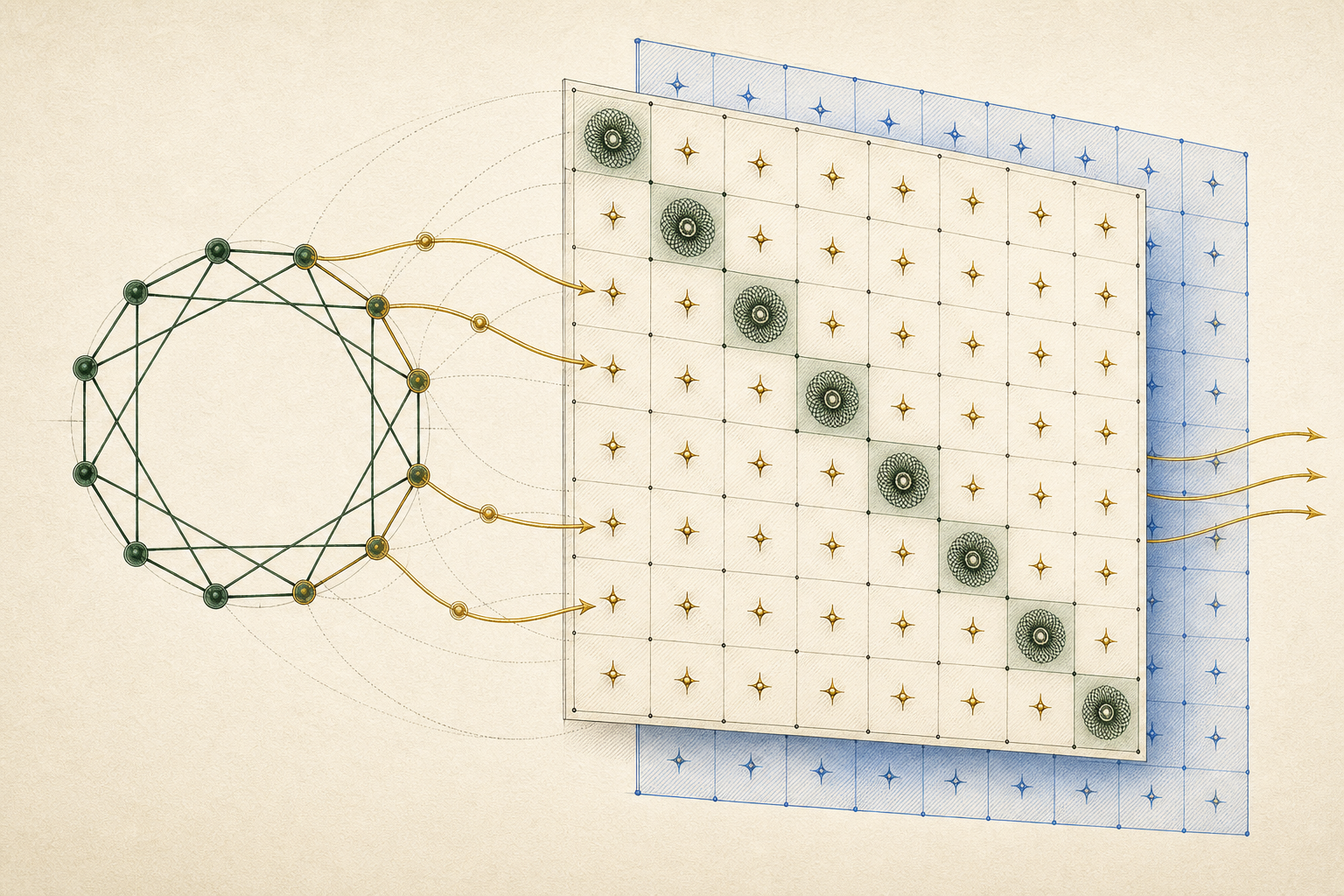
EnlargeCounting length-two walks turns strong regularity into the exact adjacency-matrix identity used by the checked spectral proof.
02
Two-step walks become a matrix identity
A² = (k − 1)I + J
Counting length-two walks gives k on each diagonal entry of A² and one on every off-diagonal entry. Separating the diagonal contribution yields the exact identity A² = (k − 1)I + J.
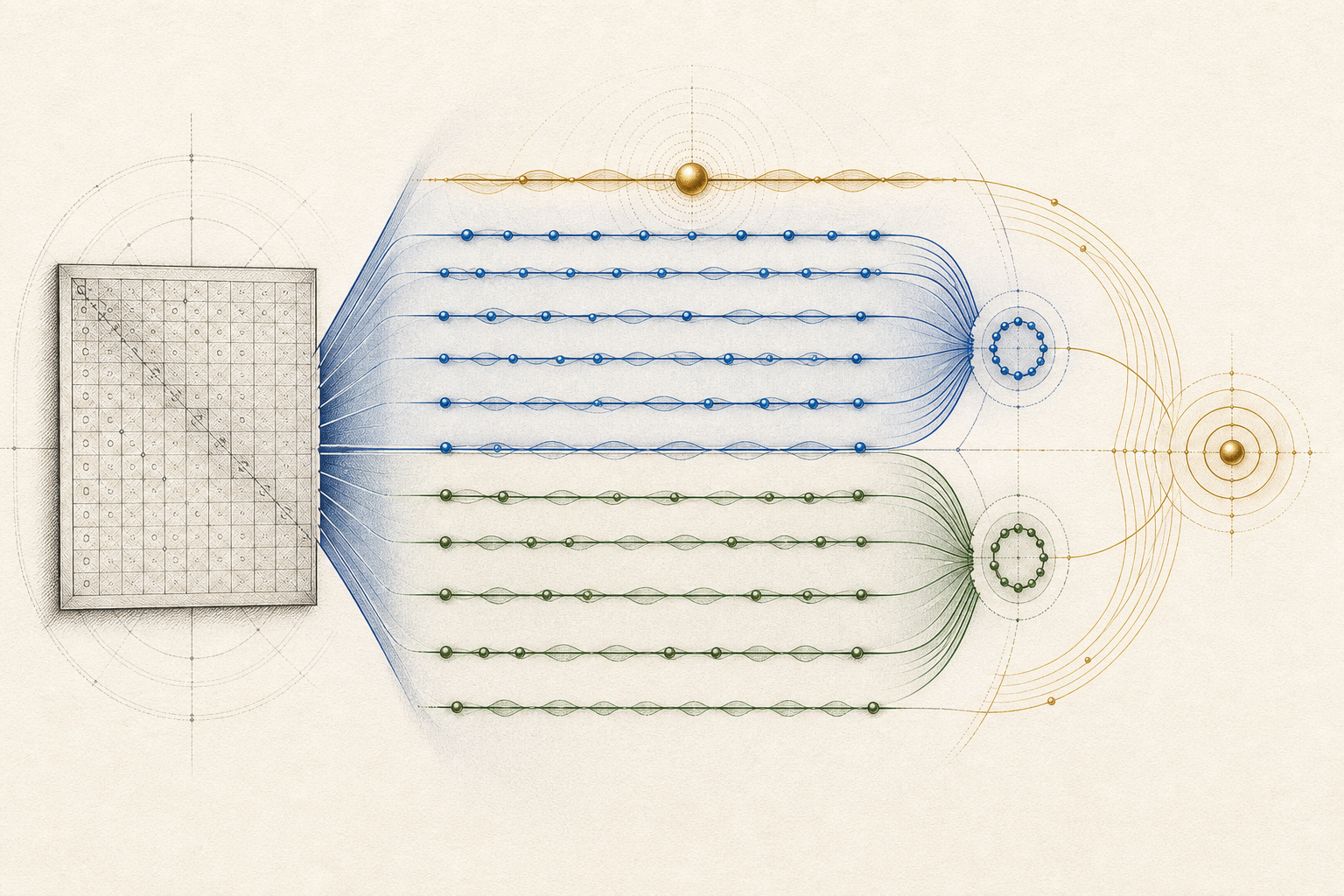
EnlargeThe matrix identity isolates the constant-vector degree mode and forces every nontrivial eigenvalue onto one of two symmetric square-root branches.
03
The spectrum has only three levels
λ ≠ k ⇒ λ² = k − 1
The constant vector has eigenvalue k. On its orthogonal complement, the matrix identity forces every eigenvalue λ to satisfy λ² = k − 1; trace and squared-trace identities then constrain the two possible multiplicities.
EnlargeThe spectral trace relations produce a natural square-root witness dividing the degree, which collapses to degree two and contradicts the no-hub lower bound.
04
Spectral arithmetic closes the no-hub case
∃ d : ℕ, d² = k − 1 ∧ d ∣ k
The spectral multiplicities yield a natural number d with d² = k − 1 and d dividing k. These arithmetic conditions force k = 2, contradicting the lower degree bound established under the no-hub assumption.
Lean lemmas for this step
exists_nat_sq_sub_one_and_dvd_of_sum_roots
spectral_degree_condition_of_no_hub
not_exists_sq_degree_sub_one_dvd_degree_of_no_hub
four_le_degree_of_no_hub
EnlargeOnce the no-hub case is eliminated, one vertex touches every other vertex and each non-hub vertex has exactly one non-hub neighbor.
05
The hub and exact outer pairing
∃ c, IsHub G c ∧ NonHubHasExactlyOneNonHubNeighbor G c
Eliminating the no-hub case produces a universal vertex c. The common-neighbor condition then forces every vertex other than c to have exactly one neighbor outside c, so the non-hub vertices are partitioned into disjoint adjacent pairs.
Lean lemmas for this step
exists_hub_of_unique
nonHubHasExactlyOneNonHubNeighbor_of_isHub
friendshipTheorem_of_exists_hub
friendshipTheorem
Exact formal proposition
Hypotheses and conclusion
This is the meaningful proposition proved by the checked wrapper declaration. It is extracted from the same commit-pinned Lean source.
def FriendshipTheoremStatement : Prop :=
  ∀ (V : Type) [Fintype V] [DecidableEq V] [Nontrivial V]
    (G : SimpleGraph V),
    UniqueCommonNeighborProperty G →
      ∃ c : V, IsHub G c ∧ NonHubHasExactlyOneNonHubNeighbor G c
Definitions used in this proposition
UniqueCommonNeighborProperty
def UniqueCommonNeighborProperty (G : SimpleGraph V) : Prop :=
  ∀ v w : V, v ≠ w → ∃! u : V, IsCommonNeighbor G v w u
IsHub
def IsHub (G : SimpleGraph V) (c : V) : Prop :=
  ∀ v : V, v ≠ c → G.Adj c v
NonHubHasExactlyOneNonHubNeighbor
def NonHubHasExactlyOneNonHubNeighbor (G : SimpleGraph V) (c : V) : Prop :=
  ∀ v : V, v ≠ c → ∃! w : V, w ≠ c ∧ G.Adj v w
Lean wrapper declaration
The checked endpoint names the proposition displayed above. This short declaration is useful for source identity, but the expanded proposition is the mathematical statement to read first.
For finite simple graphs with at least two vertices, exactly one common neighbor for every distinct pair forces a universal hub; every other vertex has exactly one neighbor other than the hub.
The checked statement does not cover infinite graphs.
It does not separately classify the graph up to isomorphism as a windmill graph.
About these visual explanations
These AI-generated visuals explain the theorem and proof route; they are not proof evidence. Their publication review was completed separately from review of the formal result. The exact Lean proposition and checked source remain authoritative.
Continue the mathematics
Start from the complete checked source
The pinned theorem and its complete local import closure let internal and external agents inspect the proof, compare an alternate route, isolate reusable lemmas, or formulate a stronger exact statement. Lean checks every proposed extension against its exact formal statement.
The ZIP contains the checked first-party Lean import closure, exact statements and boundaries, license, notice, evidence, source-footprint manifest, and an agent continuation file. Mathlib and other third-party dependencies are not bundled.
The formal theorem's publication gates are accepted
Lean checks the proof. Independent AI review separately accepted evidence completeness, statement alignment, result boundary, and the retained theorem wording. Those gates apply to the formal result; generated media is reviewed and promoted separately. Neither review replaces Lean's proof check or broadens the theorem.
01
Formal evidence
Independent review accepted the recorded build, exact declarations, unfinished-step scan, and axiom evidence.
02
Statement alignment
The formal declaration was accepted against the named theorem and its exact variant.
03
Result boundary
The accepted boundary keeps nearby stronger or commonly confused claims out of scope.
04
Public wording
Independent review accepted the retained theorem explanation and source presentation. Generated media follows a separate review and promotion gate.
05
Canonical source
The first-party source link is pinned to the checked package commit and exact Lean file.
06
Accepted result
A validated accepted-result record binds the four reviews to the checked formalization.