Formal evidence
Independent review accepted the recorded build, exact declarations, unfinished-step scan, and axiom evidence.
Combinatorics · formal theorem
Any injective sequence of r · s + 1 values in a linear order contains either a strictly increasing subsequence of length r + 1 or a strictly decreasing one of length s + 1.
Line counts exclude blank lines; comments and documentation count. The total is the commit-pinned first-party Lean import closure; Mathlib and other third-party dependencies are excluded.
The theorem at a glance
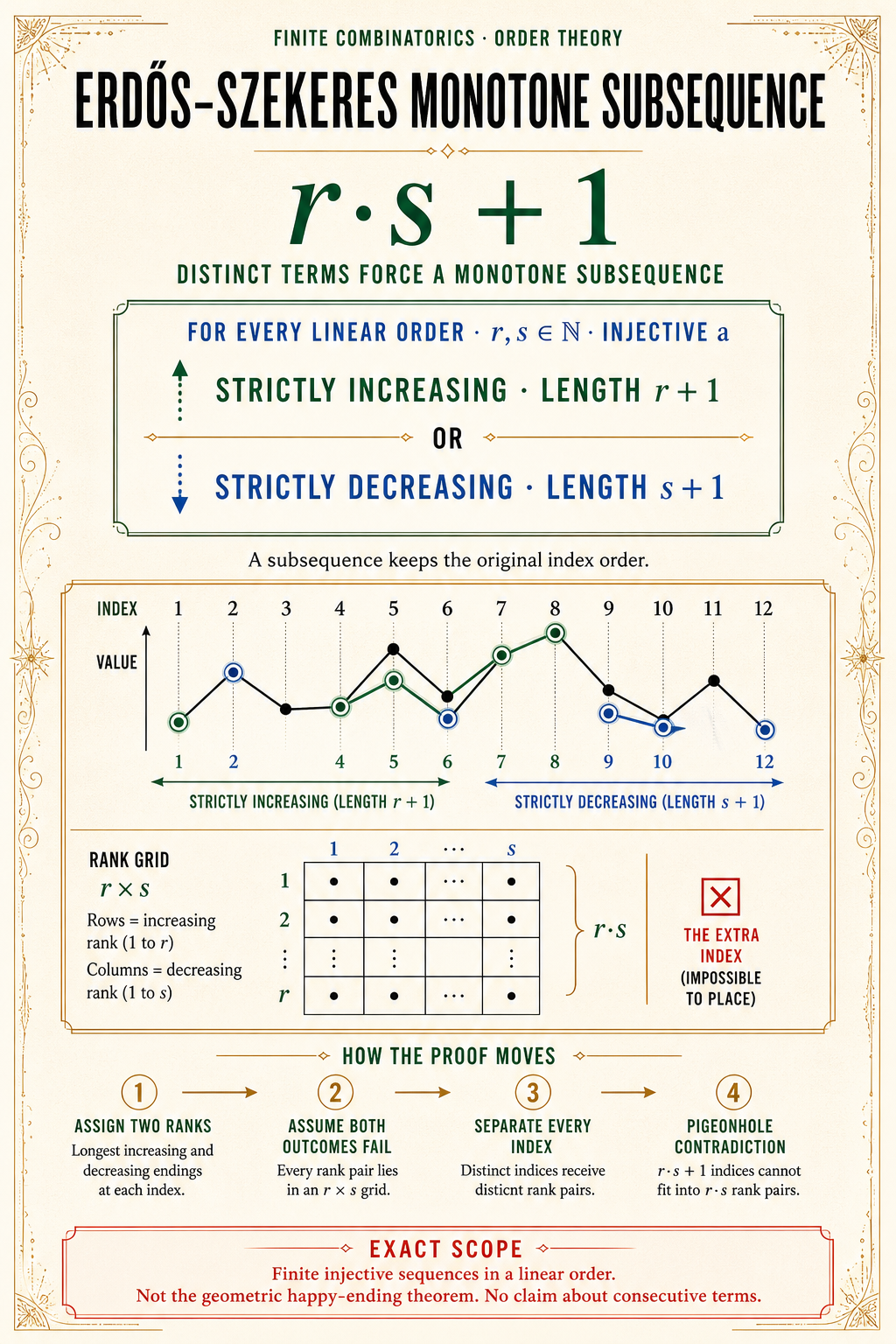
Accessible transcript
Injective a : Fin (r*s+1) → α ⇒ increasing length r+1 ∨ decreasing length s+1
Assign each index the lengths of the longest increasing and decreasing subsequences ending there. If both desired outcomes failed, r·s + 1 indices would have to occupy only r·s distinct rank pairs, giving the pigeonhole contradiction. This is the finite monotone-subsequence theorem, not the geometric happy-ending theorem.
FINITE COMBINATORICS · ORDER THEORY
ERDŐS–SZEKERES MONOTONE SUBSEQUENCE
r·s + 1
DISTINCT TERMS FORCE A MONOTONE SUBSEQUENCE
FOR EVERY LINEAR ORDER · r,s ∈ N · INJECTIVE a
STRICTLY INCREASING · LENGTH r + 1
OR
STRICTLY DECREASING · LENGTH s + 1
A subsequence keeps the original index order.
INDEX · VALUE
STRICTLY INCREASING (LENGTH r + 1)
STRICTLY DECREASING (LENGTH s + 1)
RANK GRID · r × s
Rows = increasing rank (1 to r)
Columns = decreasing rank (1 to s)
THE EXTRA INDEX (IMPOSSIBLE TO PLACE)
HOW THE PROOF MOVES
1 · ASSIGN TWO RANKS
Longest increasing and decreasing endings at each index.
2 · ASSUME BOTH OUTCOMES FAIL
Every rank pair lies in an r × s grid.
3 · SEPARATE EVERY INDEX
Distinct indices receive distinct rank pairs.
4 · PIGEONHOLE CONTRADICTION
r·s + 1 indices cannot fit into r·s rank pairs.
EXACT SCOPE
Finite injective sequences in a linear order.
Not the geometric happy-ending theorem. No claim about consecutive terms.
Theorem schematic
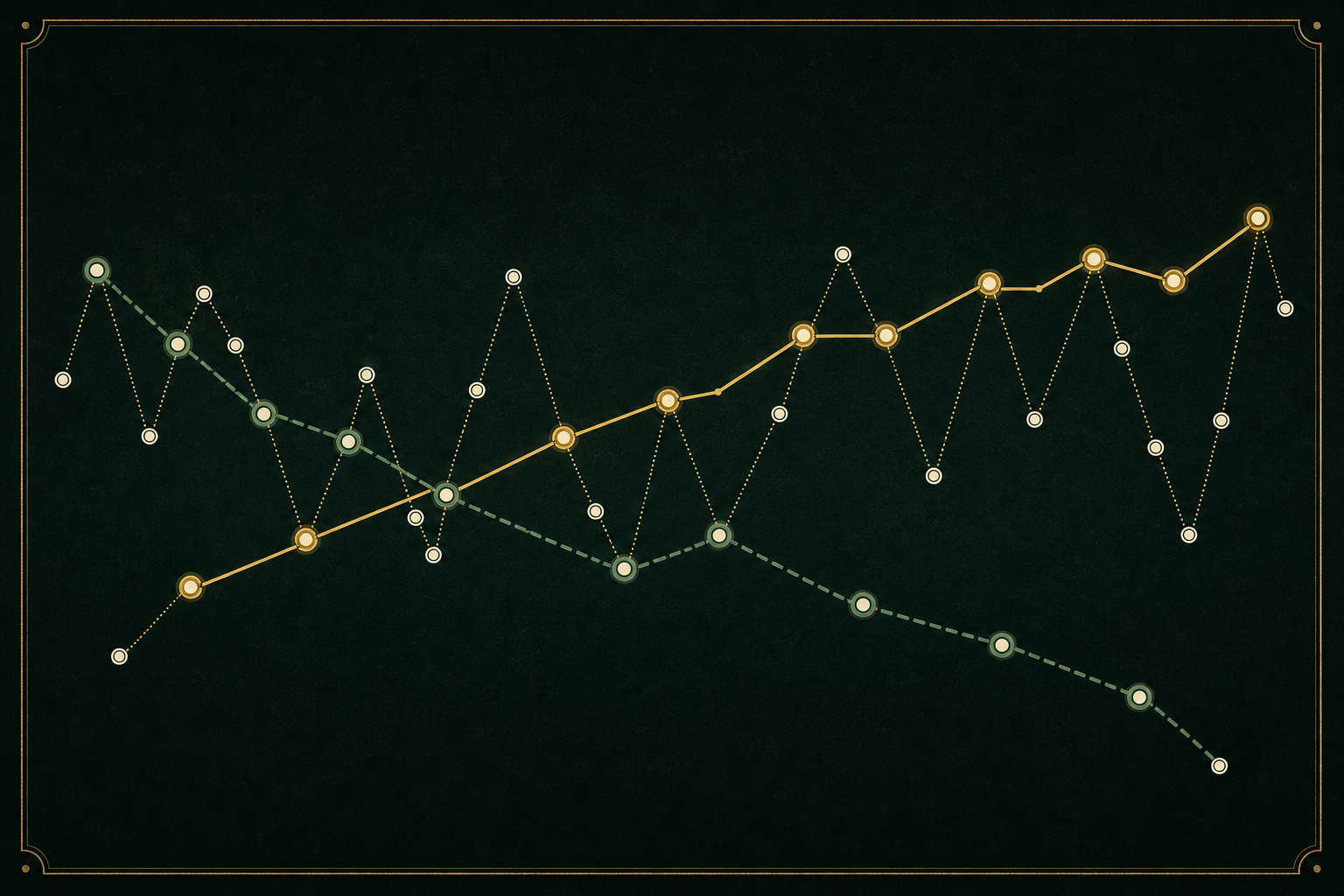
r·s + 1 terms ⇒ increasing length r + 1 ∨ decreasing length s + 1
One injective sequence in a linear order is the only input. The rank-pair argument selects indices in their original order and forces either r + 1 strictly increasing values or s + 1 strictly decreasing values; it does not require consecutive terms.
Exact formal proposition
This is the meaningful proposition proved by the checked wrapper declaration. It is extracted from the same commit-pinned Lean source.
def ErdosSzekeresMonotoneStatement : Prop :=
  ∀ (α : Type) [LinearOrder α] (r s : Nat)
    (a : Fin (r * s + 1) → α),
    Function.Injective a →
      HasStrictIncreasingSubsequence a (r + 1) ∨
HasStrictDecreasingSubsequence a (s + 1)HasStrictIncreasingSubsequence def HasStrictIncreasingSubsequence {α : Type} [Preorder α] {n : Nat}
(a : Fin n → α) (k : Nat) : Prop :=
∃ idx : Fin k → Fin n, StrictMono idx ∧ StrictMono (fun i => a (idx i))HasStrictDecreasingSubsequence def HasStrictDecreasingSubsequence {α : Type} [Preorder α] {n : Nat}
(a : Fin n → α) (k : Nat) : Prop :=
∃ idx : Fin k → Fin n, StrictMono idx ∧ StrictAnti (fun i => a (idx i))The checked endpoint names the proposition displayed above. This short declaration is useful for source identity, but the expanded proposition is the mathematical statement to read first.
theorem erdosSzekeresMonotone :
ErdosSzekeresMonotoneStatementResult boundary
The finite monotone-subsequence theorem for injective finite sequences over a linear order.
These AI-generated visuals explain the theorem and proof route; they are not proof evidence. Their publication review was completed separately from review of the formal result. The exact Lean proposition and checked source remain authoritative.
Continue the mathematics
The pinned theorem and its complete local import closure let internal and external agents inspect the proof, compare an alternate route, isolate reusable lemmas, or formulate a stronger exact statement. Lean checks every proposed extension against its exact formal statement.
The ZIP contains the checked first-party Lean import closure, exact statements and boundaries, license, notice, evidence, source-footprint manifest, and an agent continuation file. Mathlib and other third-party dependencies are not bundled.
Independent publication review
Lean checks the proof. Independent AI review separately accepted evidence completeness, statement alignment, result boundary, and the retained theorem wording. Those gates apply to the formal result; generated media is reviewed and promoted separately. Neither review replaces Lean's proof check or broadens the theorem.
Independent review accepted the recorded build, exact declarations, unfinished-step scan, and axiom evidence.
The formal declaration was accepted against the named theorem and its exact variant.
The accepted boundary keeps nearby stronger or commonly confused claims out of scope.
Independent review accepted the retained theorem explanation and source presentation. Generated media follows a separate review and promotion gate.
The first-party source link is pinned to the checked package commit and exact Lean file.
A validated accepted-result record binds the four reviews to the checked formalization.