Order theory · formal theorem

Dilworth’s Theorem

Every finite poset in which each antichain has at most k elements admits a cover of all elements by k chains.

Scope: For every finite partially ordered type, width at most k implies that k chains cover all elements.

Lean checkedBuild passed
Unfinished proof stepsNone
PublicationAccepted formal theorem
Dilworth theorem statement mapA finite poset whose antichains have size at most k can be covered by k chains.
Exact scope: For every finite partially ordered type, width at most k implies that k chains cover all elements.

Exact formal proposition

Hypotheses and conclusion

theorem dilworthTheorem : DilworthTheoremStatement

Proof route

How bounded width becomes a chain cover

5 proof stages

The checked proof inducts on the finite poset. A maximum antichain either splits the order into proper lower and upper closures whose recursive chain covers can be joined through common anchors, or forces a fallback that removes a comparable minimal–maximal pair and lowers the width.

These stages follow the checked source and explain the mathematical route. They summarize the argument; they are not a visualization of Lean's internal proof term.

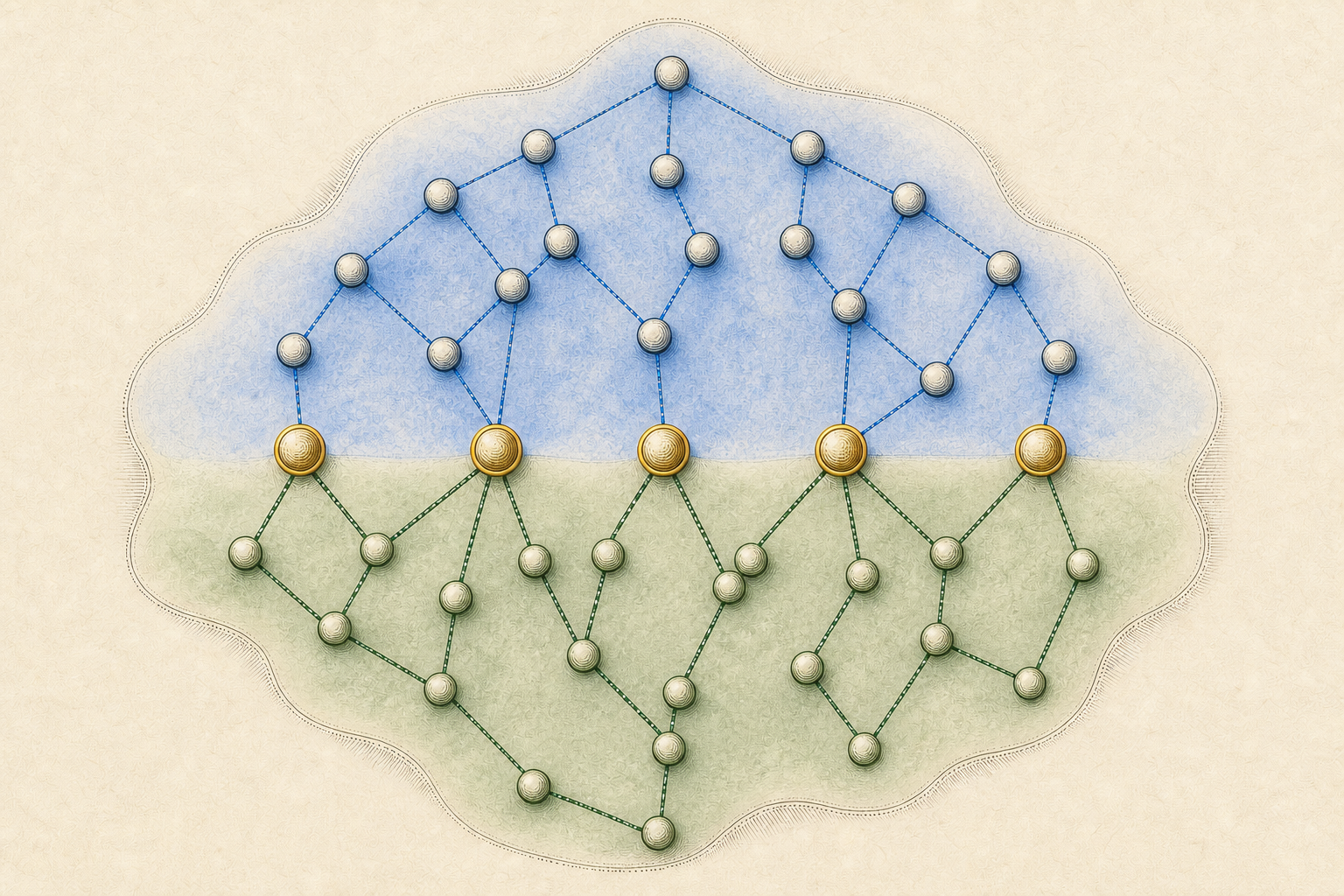
  1. Scientific figure illustrating: Choose an antichain of maximum cardinality; the width hypothesis bounds its size by k.
    Choose an antichain of maximum cardinality; the width hypothesis bounds its size by k.
    01

    Choose a maximum antichain

    |A| = width(P) ≤ k

    Finiteness supplies a maximum antichain A. Its cardinality records the poset width and is at most k, so A can index the chains that will be assembled recursively.

    Lean lemmas for this step
    • exists_max_card_antichain_of_widthAtMost
    • WidthAtMost
    • widthAtMost_max_card_antichain
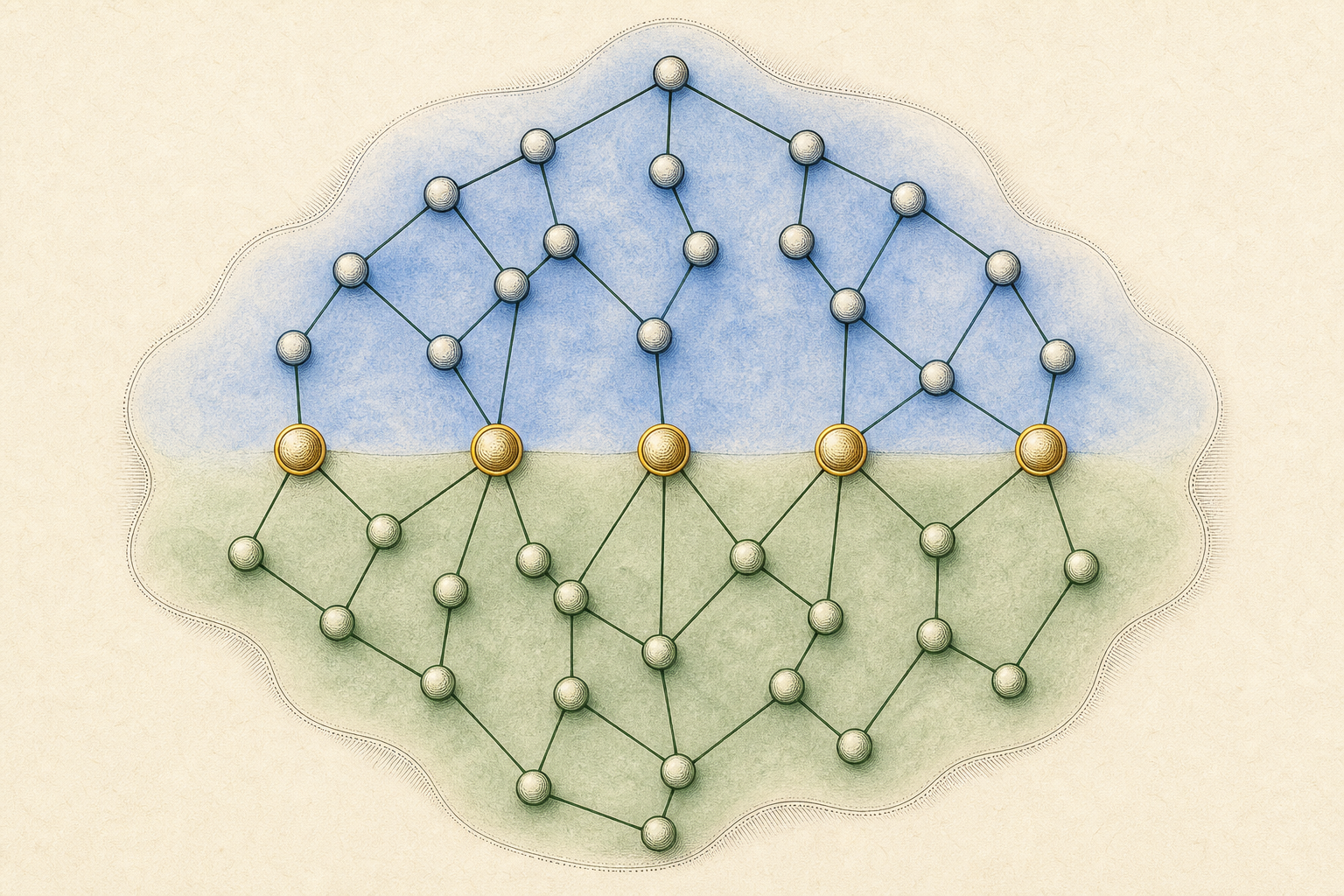
  2. A text-free finite poset splits into emerald lower and cobalt upper closures that overlap at exactly four gold anchors; four patterned chains in each closure meet their corresponding anchor.
    The two proper recursive closures share the same four antichain anchors and carry four anchor-indexed chains apiece.
    02

    Split below and above the four anchors

    P = ↓A ∪ ↑A

    A concrete width-four poset is shown as the disjoint union of four finite chains. Its lower closure contains the lower three vertices of each chain plus the shared anchor, and its upper closure contains the upper three vertices plus that same anchor. Each closure is a proper subset, their intersection is exactly the four-element maximum antichain, and their union is the whole displayed poset.

    Lean lemmas for this step
    • lowerClosure
    • upperClosure
    • widthAtMost_lowerClosure_of_max_card_antichain
    • widthAtMost_upperClosure_of_max_card_antichain
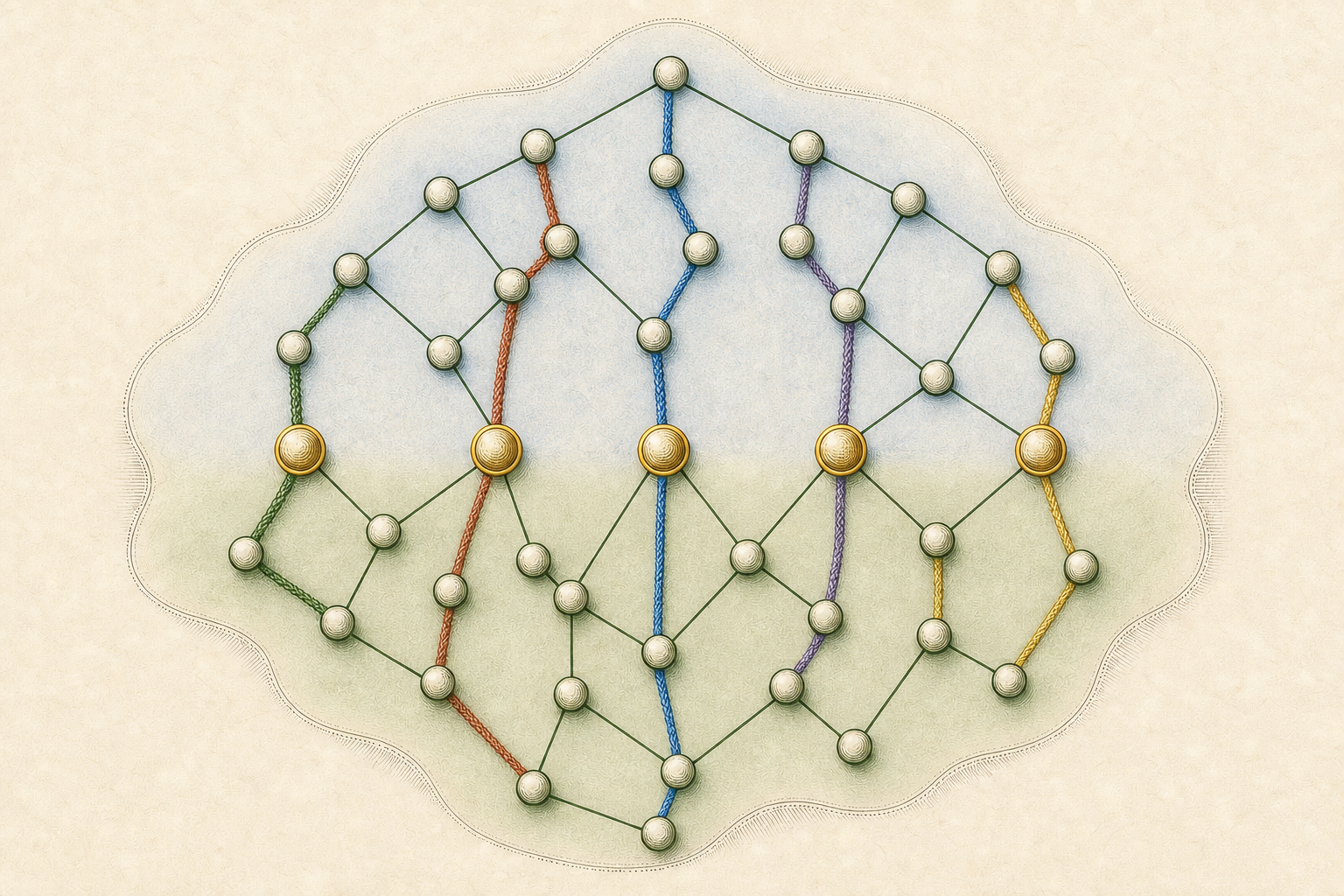
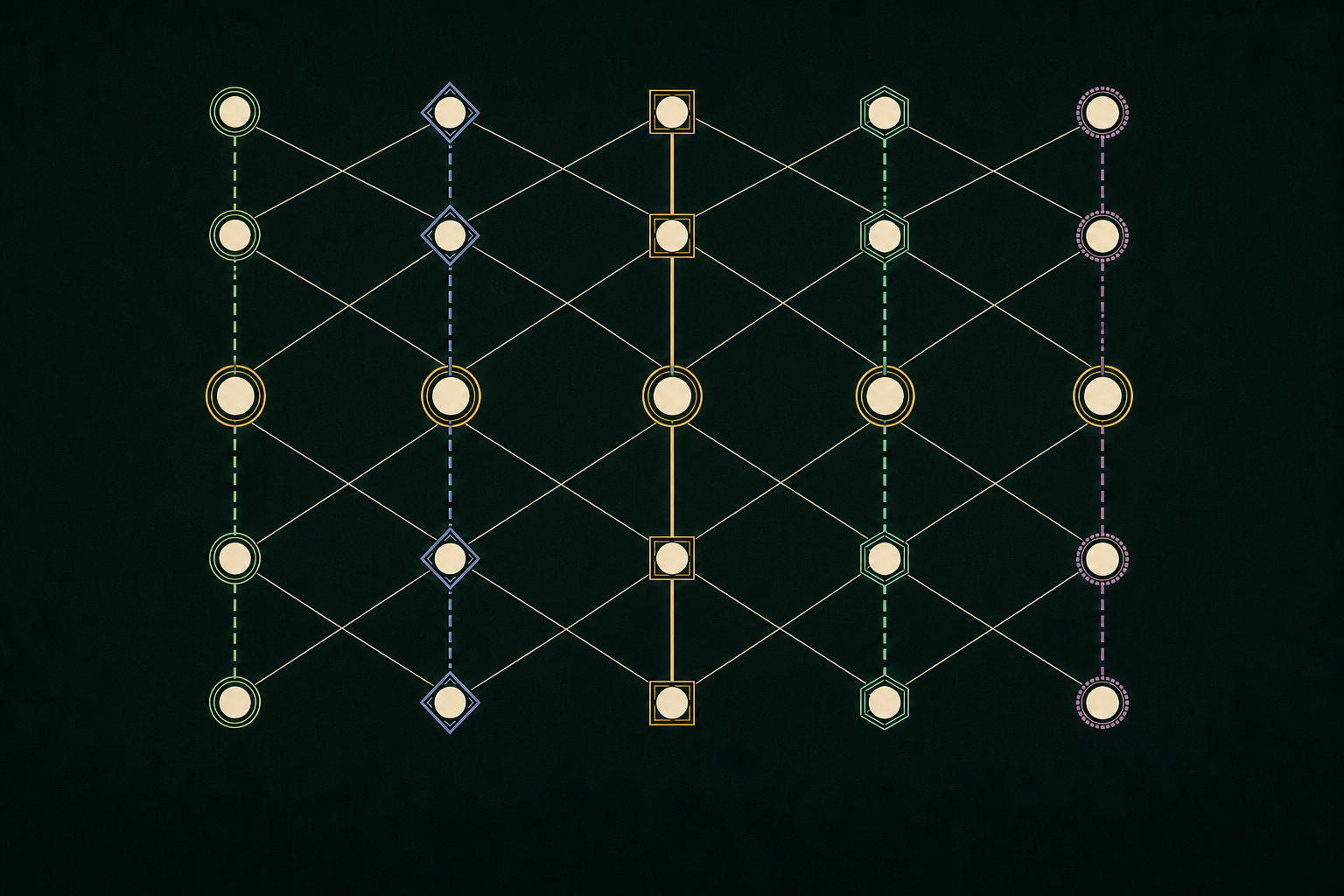
  3. Four text-free patterned chain threads run continuously through four gold anchors, each joining the corresponding lower and upper chain of the same finite poset.
    Reindex the two recursive covers by the same four anchors and unite each corresponding lower and upper pair into one chain.
    03

    Join four recursive chain pairs through their anchors

    Cₐ = Cₐ⁻ ∪ Cₐ⁺

    The exact four anchor identities, twenty-four non-anchor vertices, and within-chain incidences from the preceding closure stage are preserved. Each gold anchor belongs to one lower and one upper recursive chain; their union becomes one seven-vertex chain. The four resulting chains cover all twenty-eight displayed vertices, with no cross-anchor or cross-chain incidence.

    Lean lemmas for this step
    • exists_anchorIndexed_split_cover
    • IsChain.union_of_lower_upper_anchor
    • exists_strongCoversByChains_card_of_split
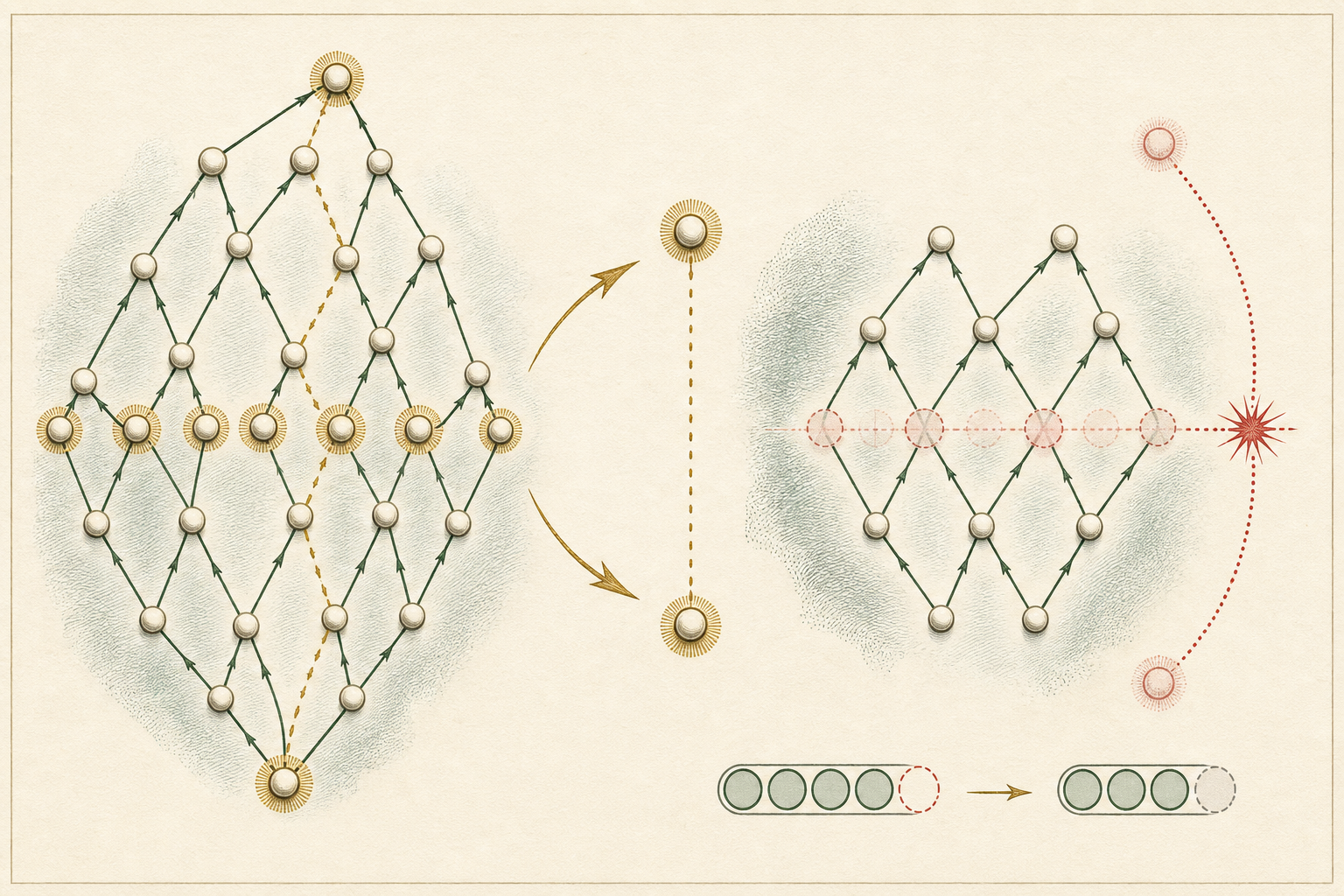
  4. Scientific figure illustrating: If the proper-closure split fails, choose a comparable minimal x and maximal y.
    If the proper-closure split fails, choose a comparable minimal x and maximal y.
    04

    Enter the no-split fallback

    x minimal, y maximal, x ≤ y

    The failed split yields a minimal element x and a maximal element y with x ≤ y. Removing the pair leaves a smaller poset whose antichains are strictly smaller than the original maximum.

    Lean lemmas for this step
    • exists_minimal_le_maximal
    • widthAtMost_erase_pair_of_no_proper_max_antichain
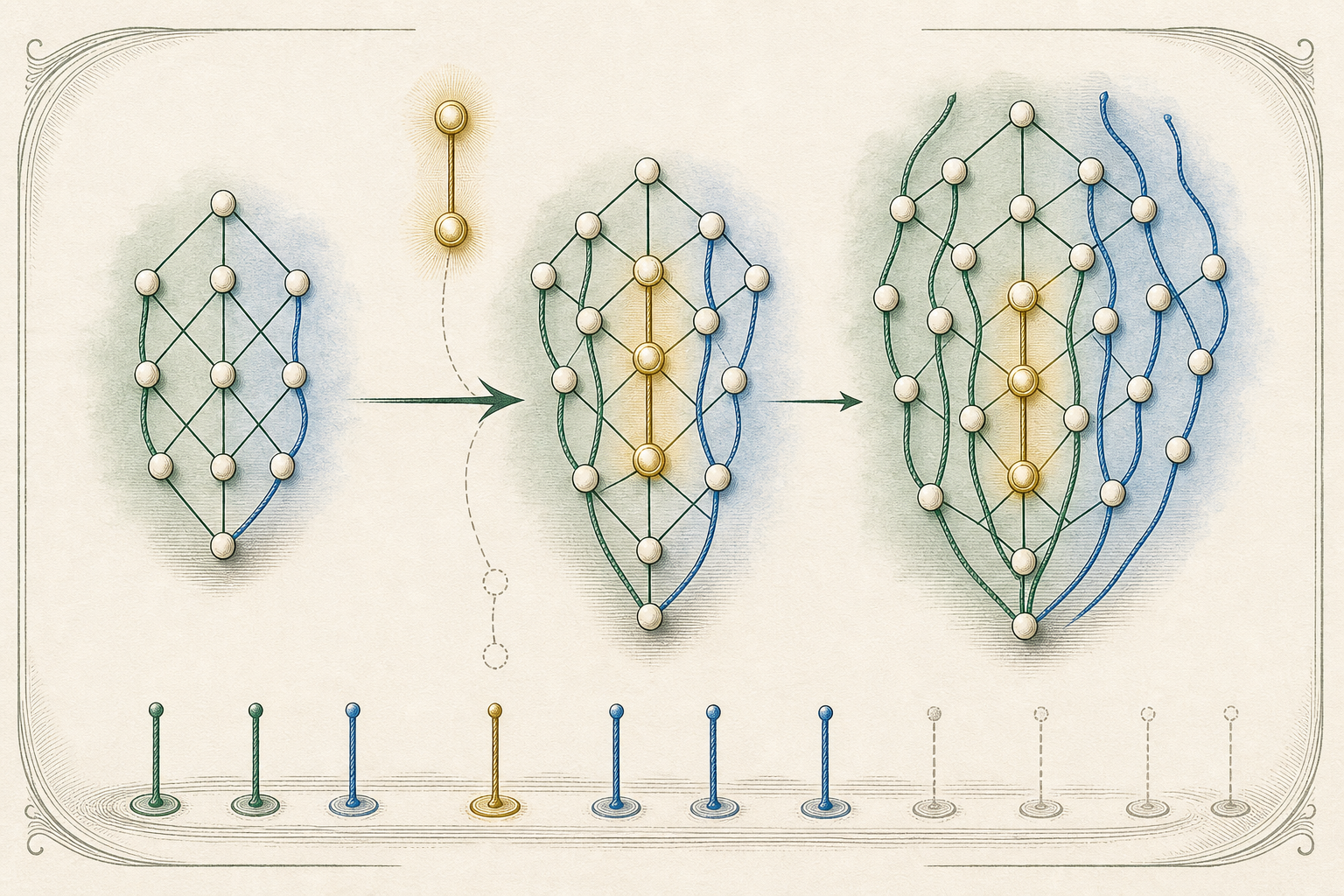
  5. Scientific figure illustrating: Cover the remainder by k−1 chains, add {x,y}, and pad if the original bound k is larger.
    Cover the remainder by k−1 chains, add {x,y}, and pad if the original bound k is larger.
    05

    Recurse at width k−1 and add one chain

    (k−1)-cover of P∖{x,y} + chain {x,y}

    The width drop gives a cover of the remaining elements by k−1 chains. Since x≤y, the removed pair is itself a chain; adjoining it and padding empty chains when necessary completes the k-chain cover.

    Lean lemmas for this step
    • exists_strongCoversByChains_of_widthAtMost
    • isChain_pair_of_le
    • StrongCoversByChains.extend
    • dilworthTheorem

The theorem at a glance

Dilworth’s theorem at a glance

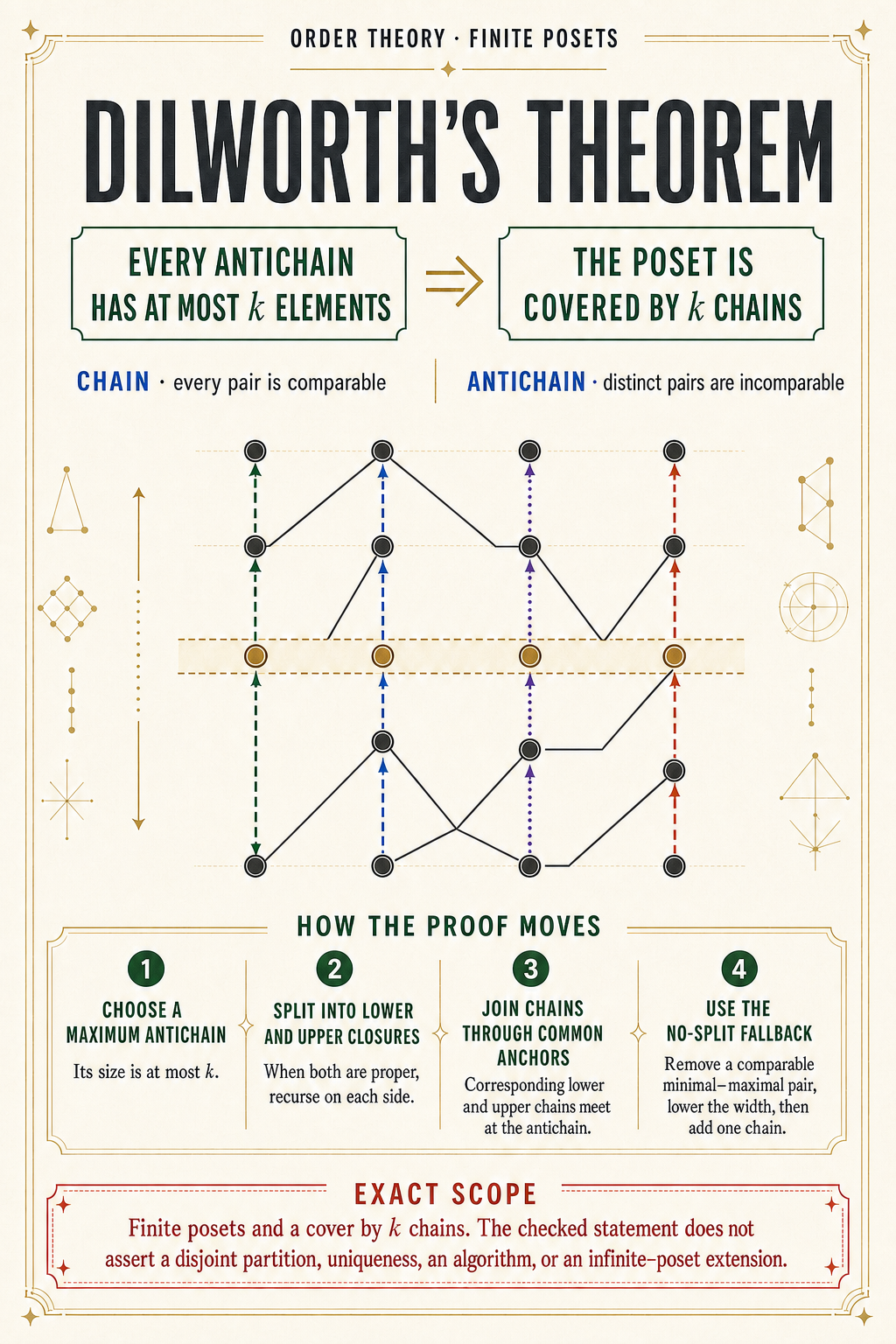
Editorial order-theory poster explaining how a finite poset of width at most k is covered by k chains and summarizing the inductive proof.
A finite poset whose antichains have size at most k admits a cover by k chains.

Accessible transcript

antichain size ≤ k ⇒ k-chain cover

The proof uses a maximum antichain to split and rejoin recursive chain covers when possible. In the remaining case it removes a comparable minimal–maximal pair, lowers the width, recurses, and adds the pair as one chain.

Read the complete poster transcript

ORDER THEORY · FINITE POSETS

DILWORTH’S THEOREM

EVERY ANTICHAIN HAS AT MOST k ELEMENTS

THE POSET IS COVERED BY k CHAINS

CHAIN · every pair is comparable

ANTICHAIN · distinct pairs are incomparable

HOW THE PROOF MOVES

1 CHOOSE A MAXIMUM ANTICHAIN

Its size is at most k.

2 SPLIT INTO LOWER AND UPPER CLOSURES

When both are proper, recurse on each side.

3 JOIN CHAINS THROUGH COMMON ANCHORS

Corresponding lower and upper chains meet at the antichain.

4 USE THE NO-SPLIT FALLBACK

Remove a comparable minimal–maximal pair, lower the width, then add one chain.

EXACT SCOPE

Finite posets and a cover by k chains. The checked statement does not assert a disjoint partition, uniqueness, an algorithm, or an infinite-poset extension.

Theorem schematic

Width at most k, covered by k chains

Scientific figure illustrating: If every antichain has at most k elements, the finite poset can be covered by k chains.
If every antichain has at most k elements, the finite poset can be covered by k chains.

width(P) ≤ k ⇒ P is covered by k chains

The width bound limits every pairwise-incomparable family to k elements. Dilworth’s theorem converts that obstruction into a cover of the whole finite poset by k chains.

Result boundary

What this theorem does—and does not—establish

For every finite partially ordered type, width at most k implies that k chains cover all elements.

About these visual explanations

These AI-generated visuals explain the theorem and proof route; they are not proof evidence. Their publication review was completed separately from review of the formal result. The exact Lean proposition and checked source remain authoritative.

Line counts exclude blank lines; comments and documentation count. The total is the commit-pinned first-party Lean import closure; Mathlib and other third-party dependencies are excluded.

Continue the mathematics

Open questions and extensions

The pinned theorem and its complete local import closure let people and AI agents inspect the proof, compare another route, isolate reusable lemmas, or formulate a stronger exact statement. Lean checks each proposed extension against its own exact statement.

What the source ZIP contains

The ZIP contains the checked first-party Lean import closure, exact statements and boundaries, license, notice, evidence, source-footprint manifest, and continuation data. Mathlib and other third-party dependencies are not bundled.

Publication review

Review record

Publication reviews accepted

Lean checks the exact proof. Accepted review records cover evidence completeness, statement alignment, scope, and public wording; the visual review covers explanation only.

01

Formal evidence

The formal-evidence review accepted the recorded build, exact declarations, unfinished-step scan, and axiom evidence.

02

Statement alignment

The formal declaration was accepted against the named theorem and its exact variant.

03

Result boundary

The accepted boundary keeps nearby stronger or commonly confused claims out of scope.

04

Public wording

The public-wording review accepted the retained theorem explanation and source presentation. Generated media follows a separate review and promotion gate.

05

Canonical source

The first-party source link is pinned to the checked package commit and exact Lean file.

06

Accepted result

A validated accepted-result record binds the four reviews to the checked formalization.

Expanded visual

Open original image