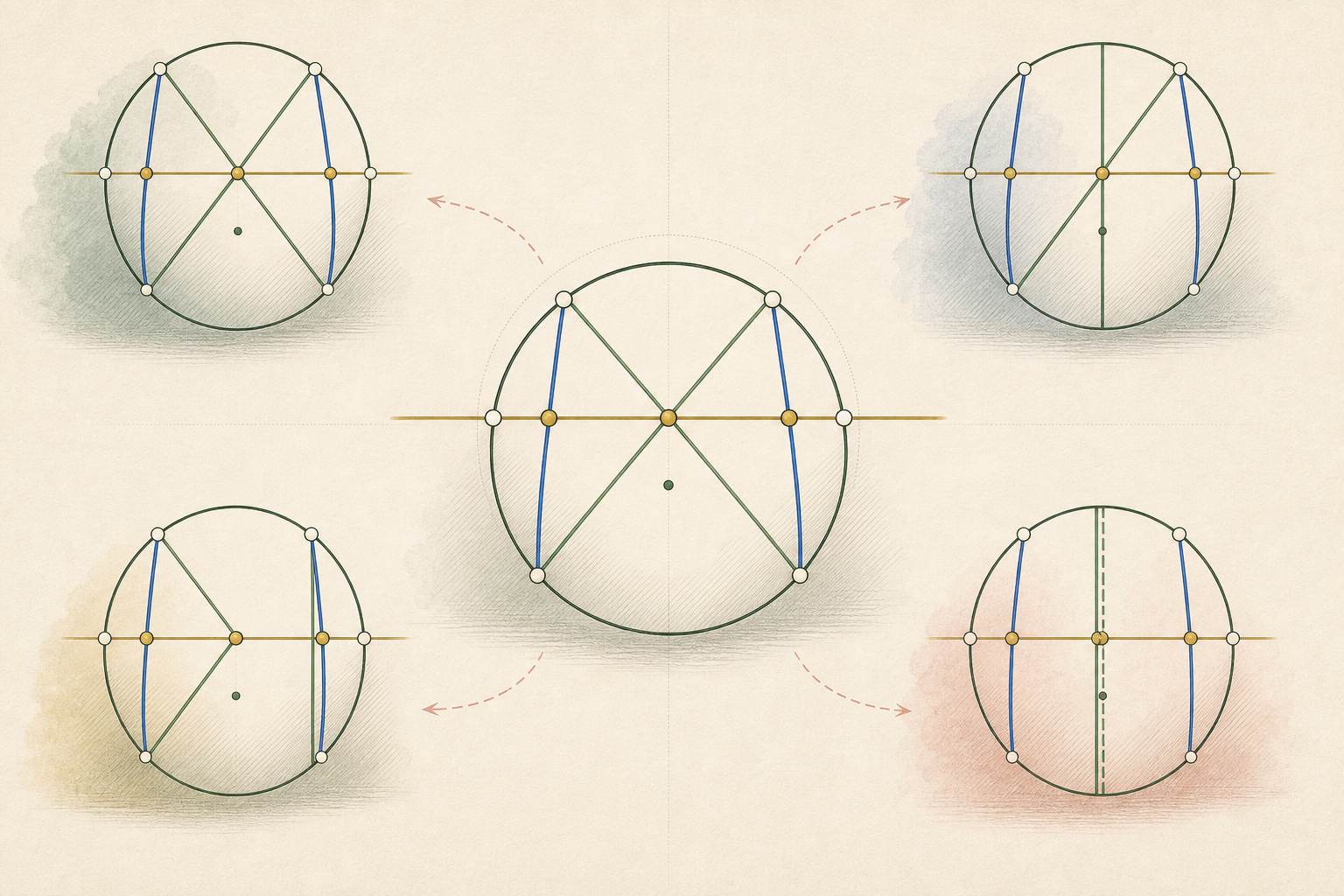
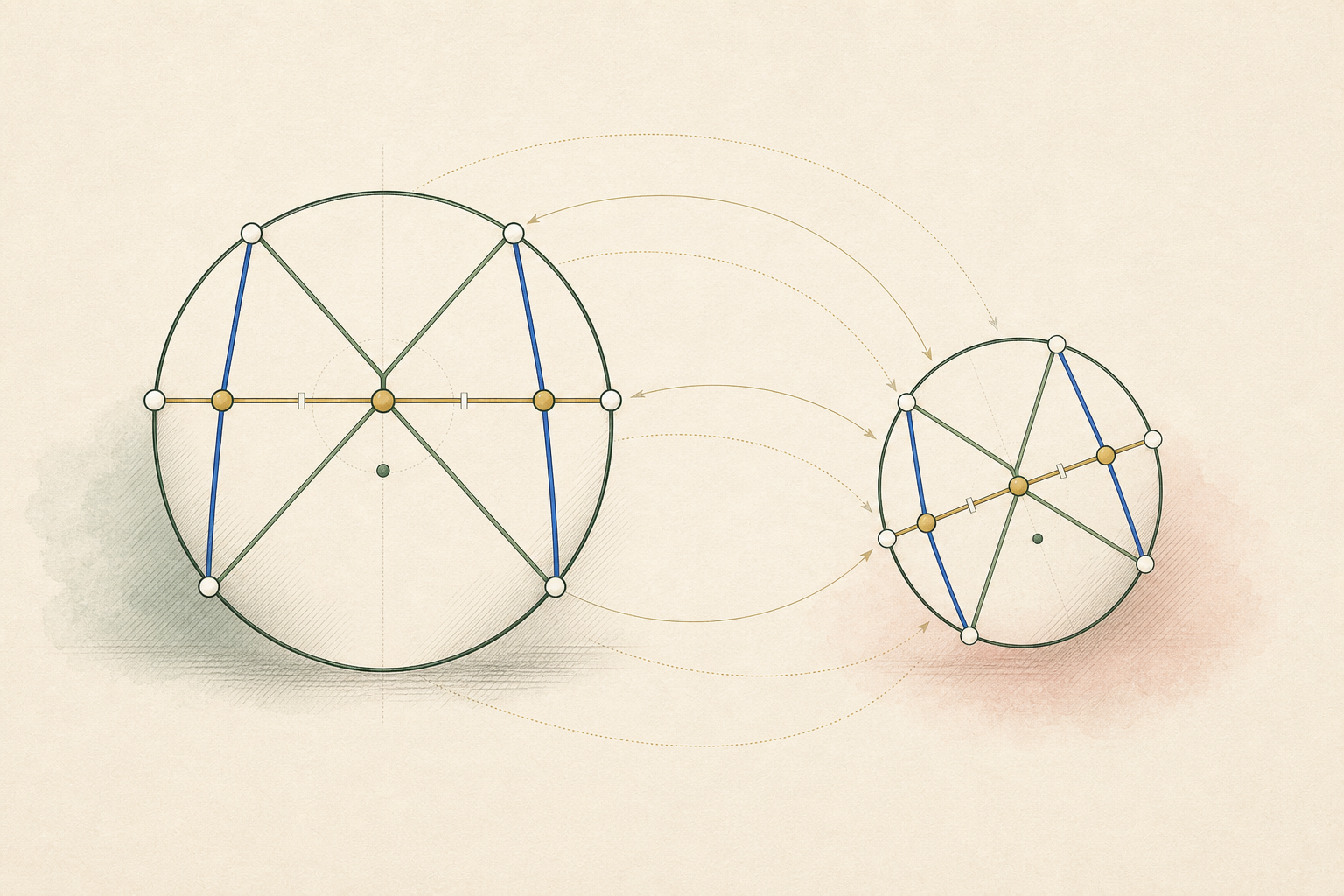
In the checked nondegenerate butterfly configuration, the opposite-chord intersections X and Y have the original chord midpoint M as their midpoint.
Lean proofpassed
Unfinished proof stepsNone
Formal resultAccepted
Starting pointCircle, chord midpoint M, two chords through M
→
RelationOpposite-chord intersections
→
ConclusionM is the midpoint of X and Y
Exact scope: For the recorded nondegenerate coordinate-circle butterfly configuration, M is the midpoint of the two uniquely specified opposite-chord intersections X and Y.
Line counts exclude blank lines; comments and documentation count. The total is the commit-pinned first-party Lean import closure; Mathlib and other third-party dependencies are excluded.
The theorem at a glance
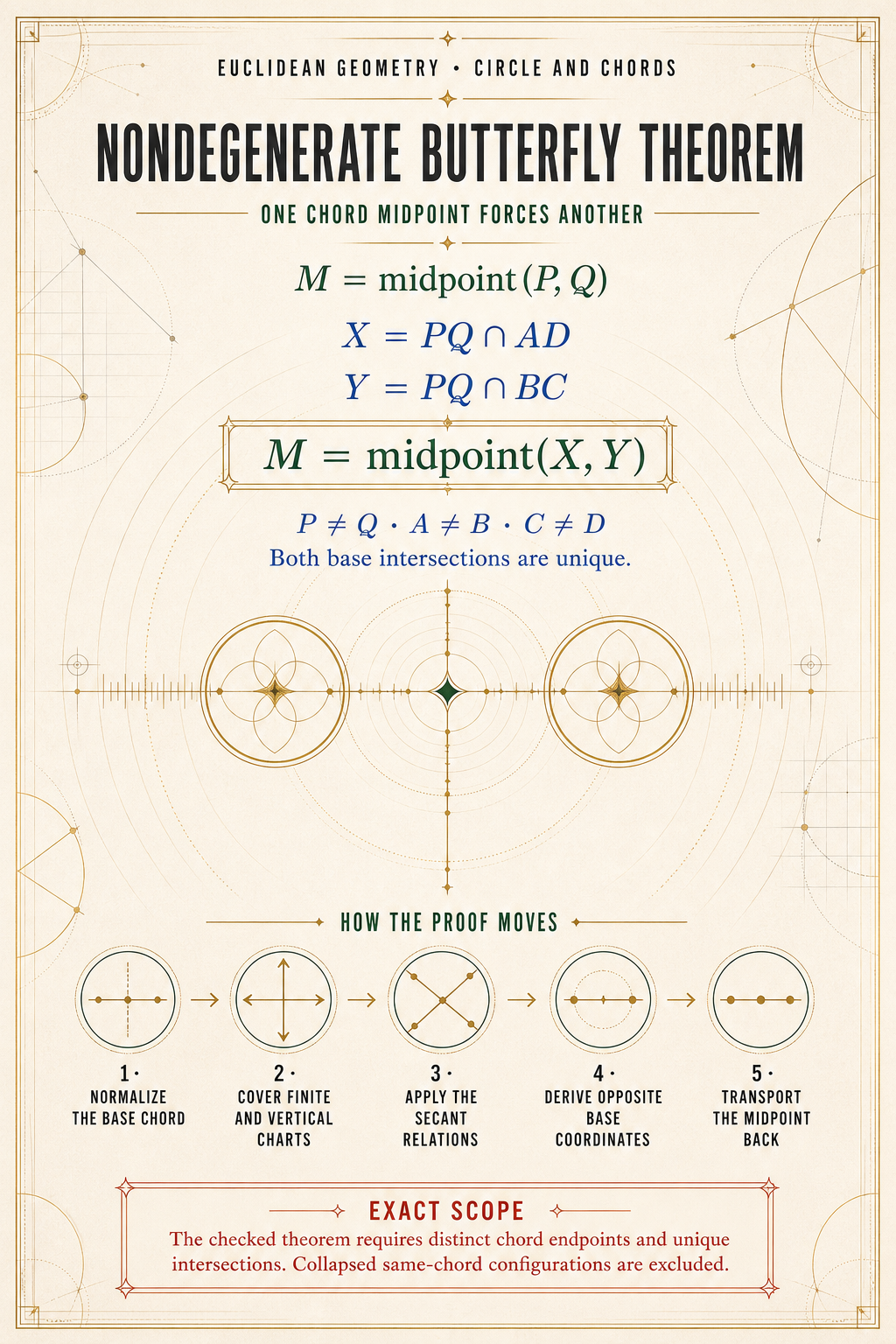
Butterfly Theorem at a glance
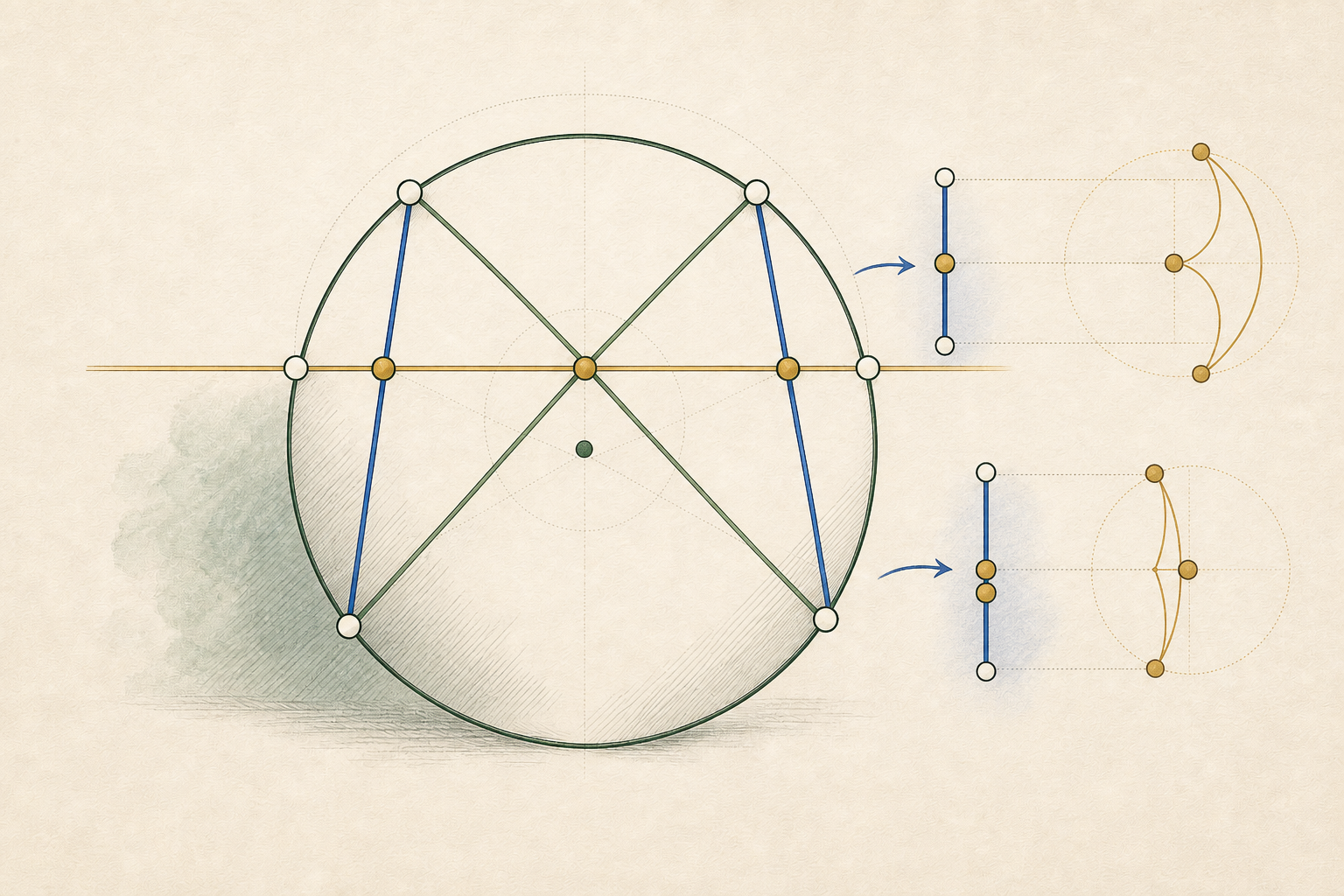
EnlargeA chord midpoint forces the two crossed-line intersections to be symmetric about it.
Accessible transcript
M = midpoint(X,Y)
The exact nondegenerate midpoint statement and coordinate proof route are presented without risking a misleading labeled construction.
Read the complete poster transcript
EUCLIDEAN GEOMETRY · CIRCLE AND CHORDS
NONDEGENERATE BUTTERFLY THEOREM
ONE CHORD MIDPOINT FORCES ANOTHER
M = midpoint(P,Q)
X = PQ ∩ AD
Y = PQ ∩ BC
M = midpoint(X,Y)
P ≠ Q · A ≠ B · C ≠ D
Both base intersections are unique.
HOW THE PROOF MOVES
NORMALIZE THE BASE CHORD · COVER FINITE AND VERTICAL CHARTS · APPLY THE SECANT RELATIONS · DERIVE OPPOSITE BASE COORDINATES · TRANSPORT THE MIDPOINT BACK
EXACT SCOPE
Distinct chord endpoints in the three stated pairs and unique intersections; collapsed same-chord configurations are excluded.
Theorem schematic
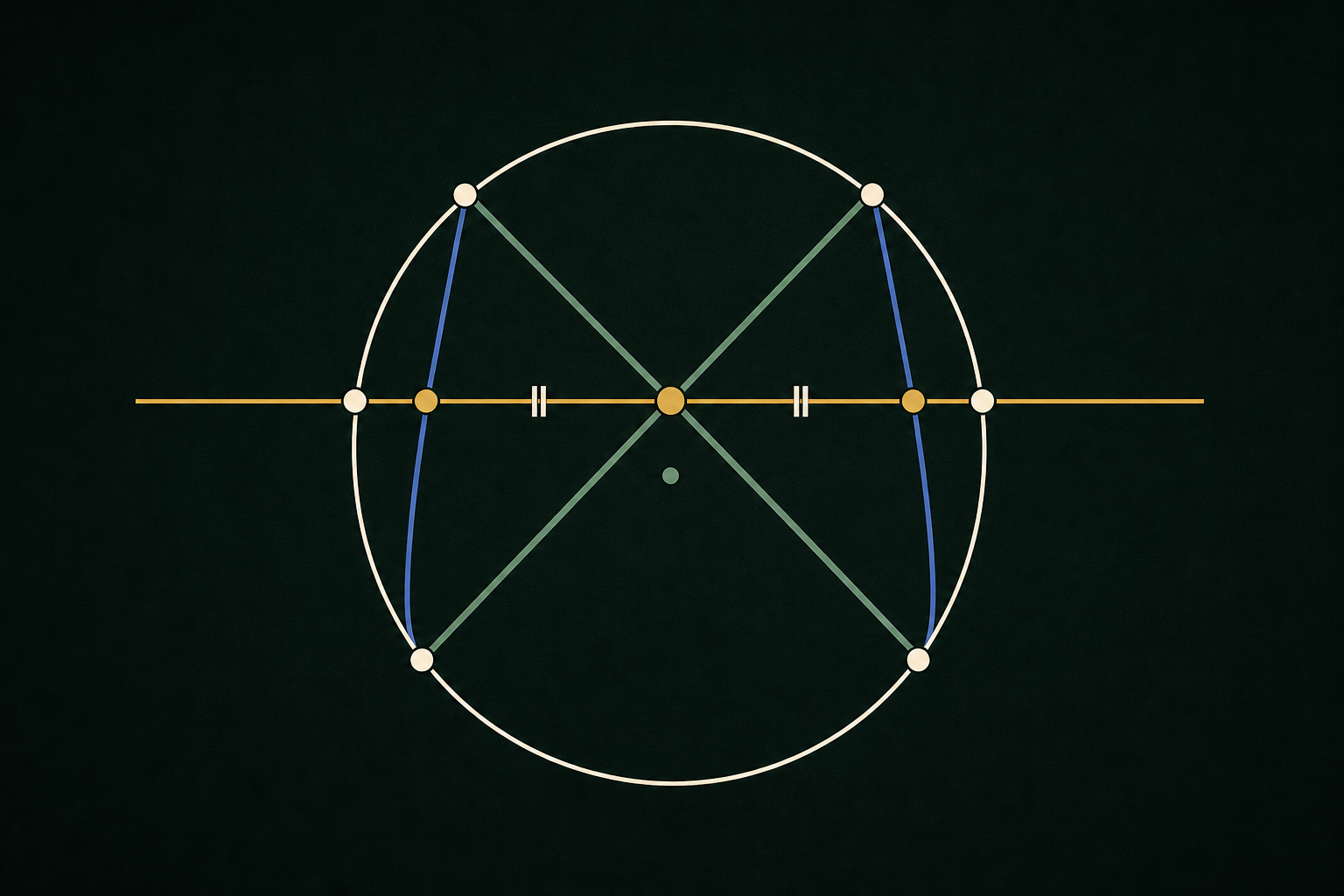
A midpoint symmetry hidden in crossed chords
EnlargeCrossed chords recover the original midpoint on the base line.
M = midpoint(X,Y)
The nondegenerate configuration begins with a midpoint M on chord PQ; two chords through M generate base intersections X and Y whose midpoint returns to M.
Proof architecture
How the nondegenerate Butterfly Theorem is proved
7 curated stages
Follow the coordinate proof from the exact nondegenerate configuration through normalization, complete chart coverage, secant relations, and transport back.
These source-anchored stages explain the retained proof route. They are not an extracted Lean proof-term dependency graph.
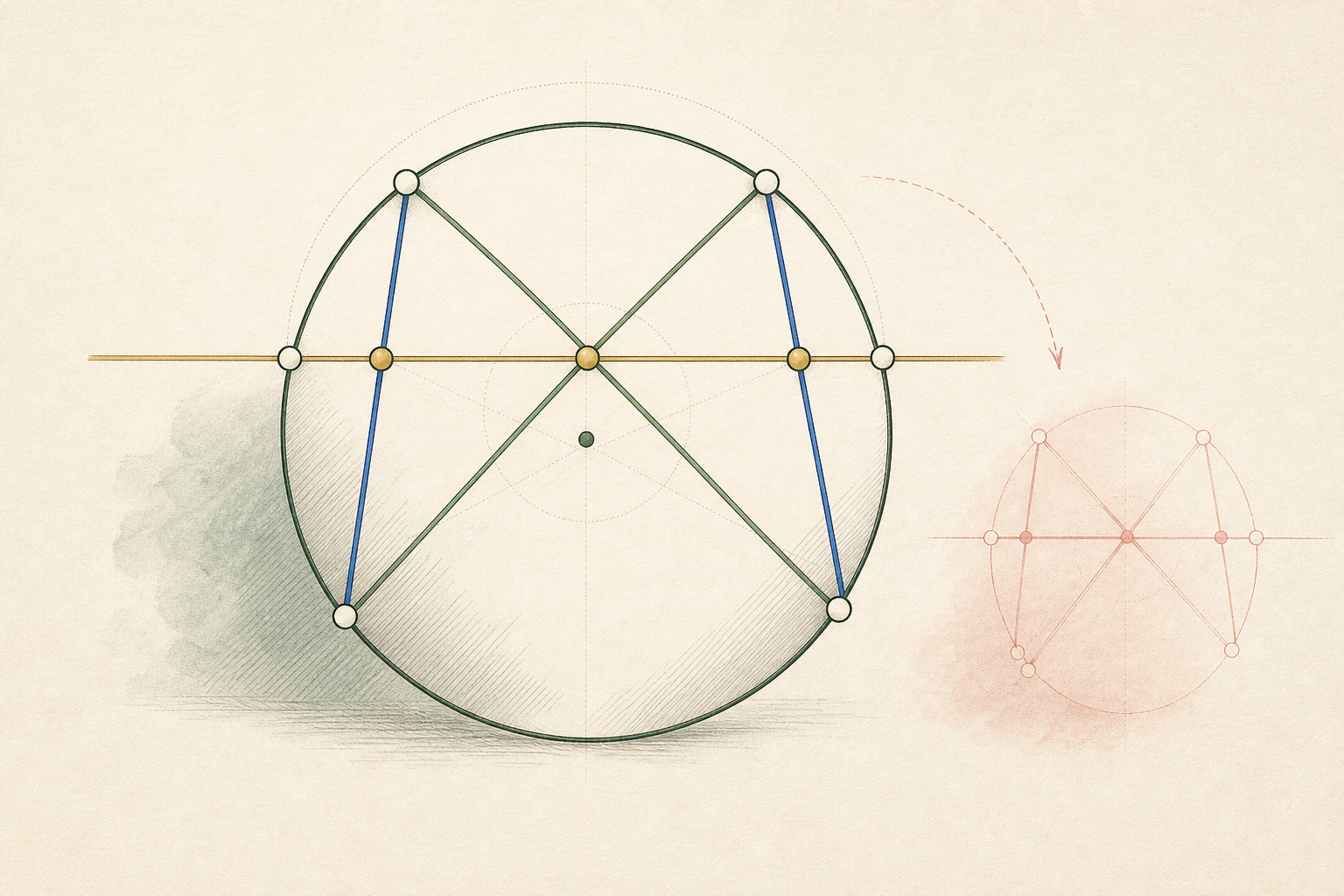
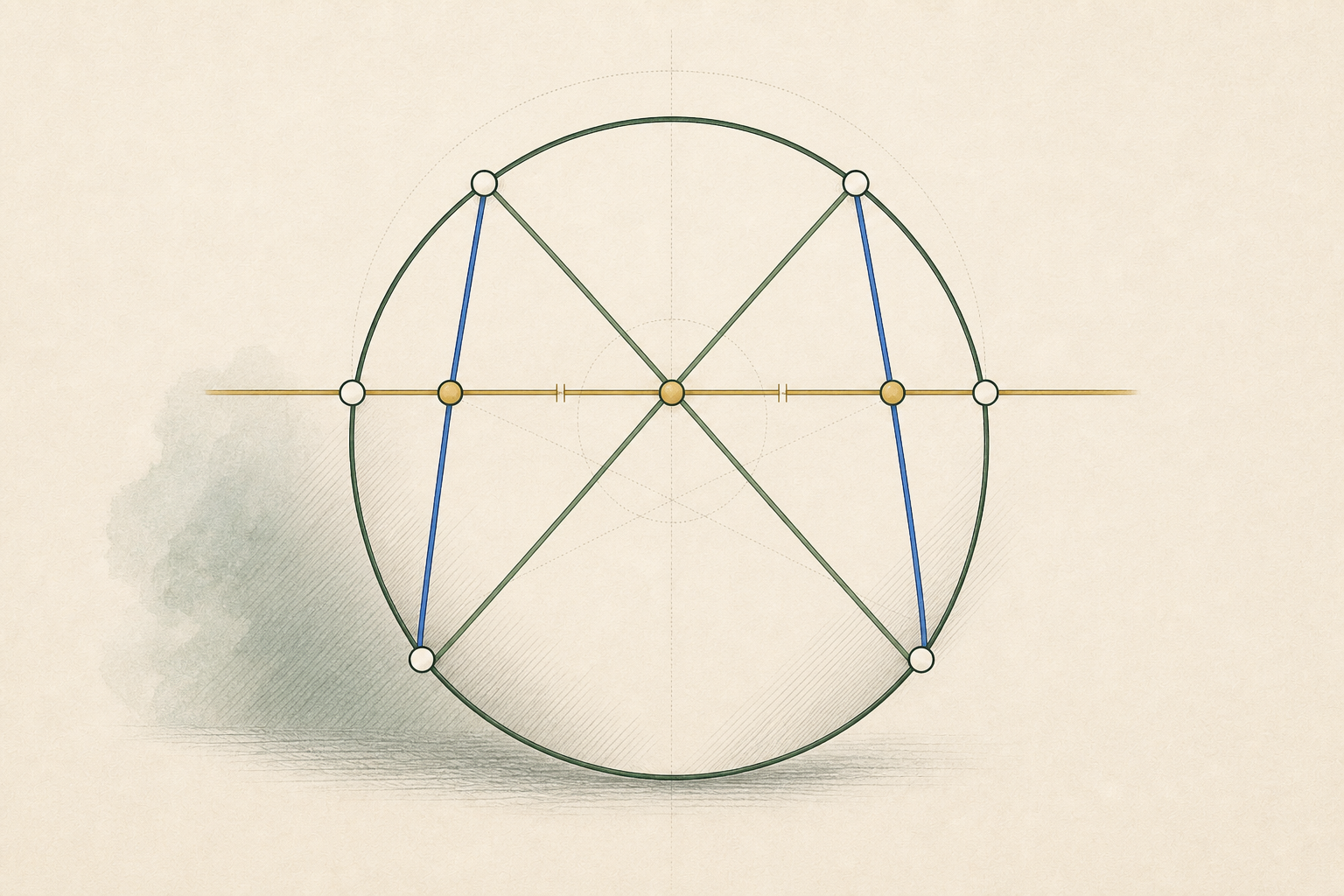
EnlargeThe base chord, two through-M chords, and two unique base intersections set the theorem's scope.
01
Fix the exact nondegenerate configuration
The formal hypotheses require P≠Q, A≠B, C≠D, and unique base-line intersections; they do not require all six circle endpoints to be pairwise distinct.
Lean lemmas for this step
ButterflyConfiguration
ButterflyHyp
DistinctChordEndpoints
UniqueIntersection
baseNormalize
baseNormalizedCheckedChartCoverage
baseNormalizedButterflyTheorem
nondegenerateButterflyTheorem
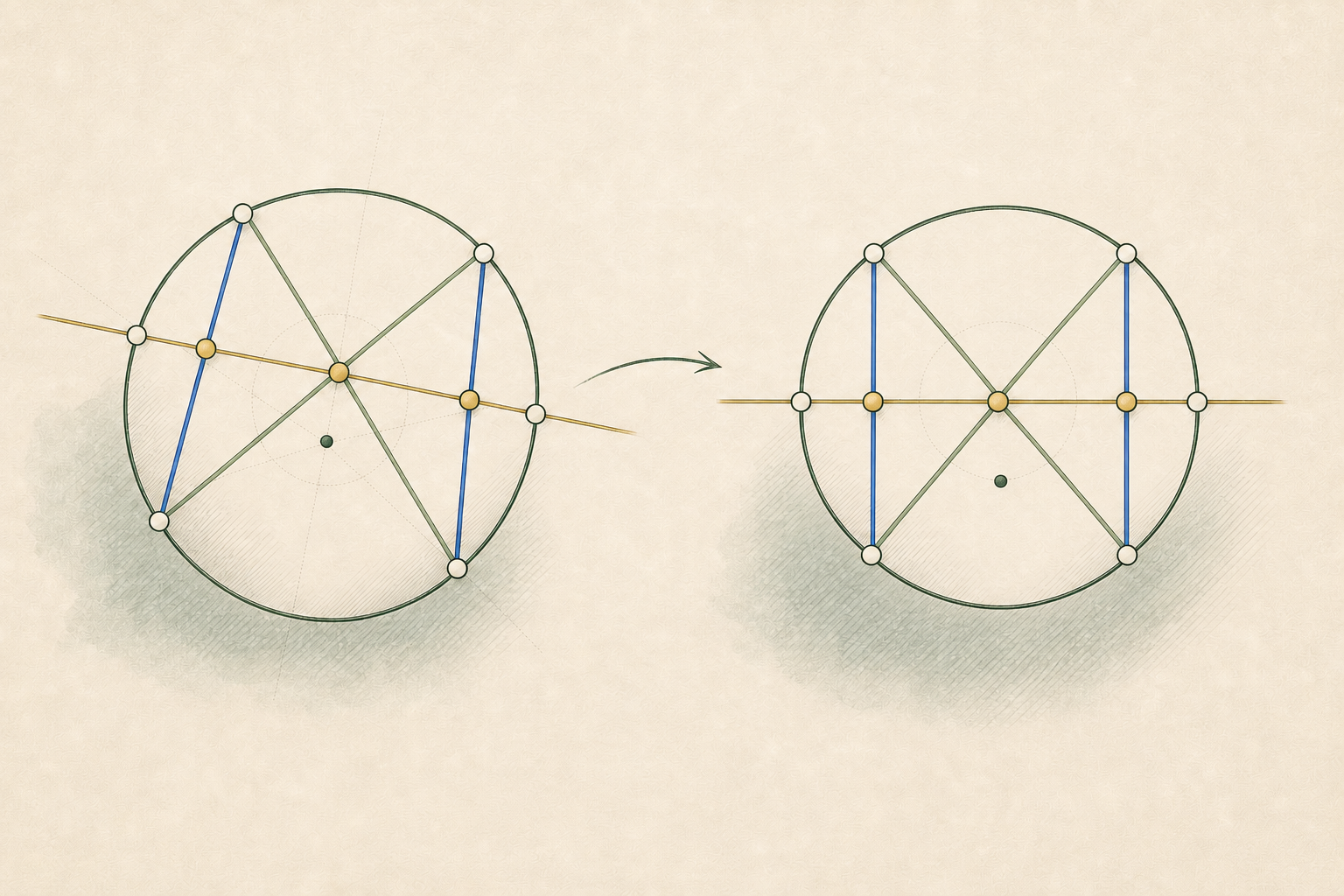
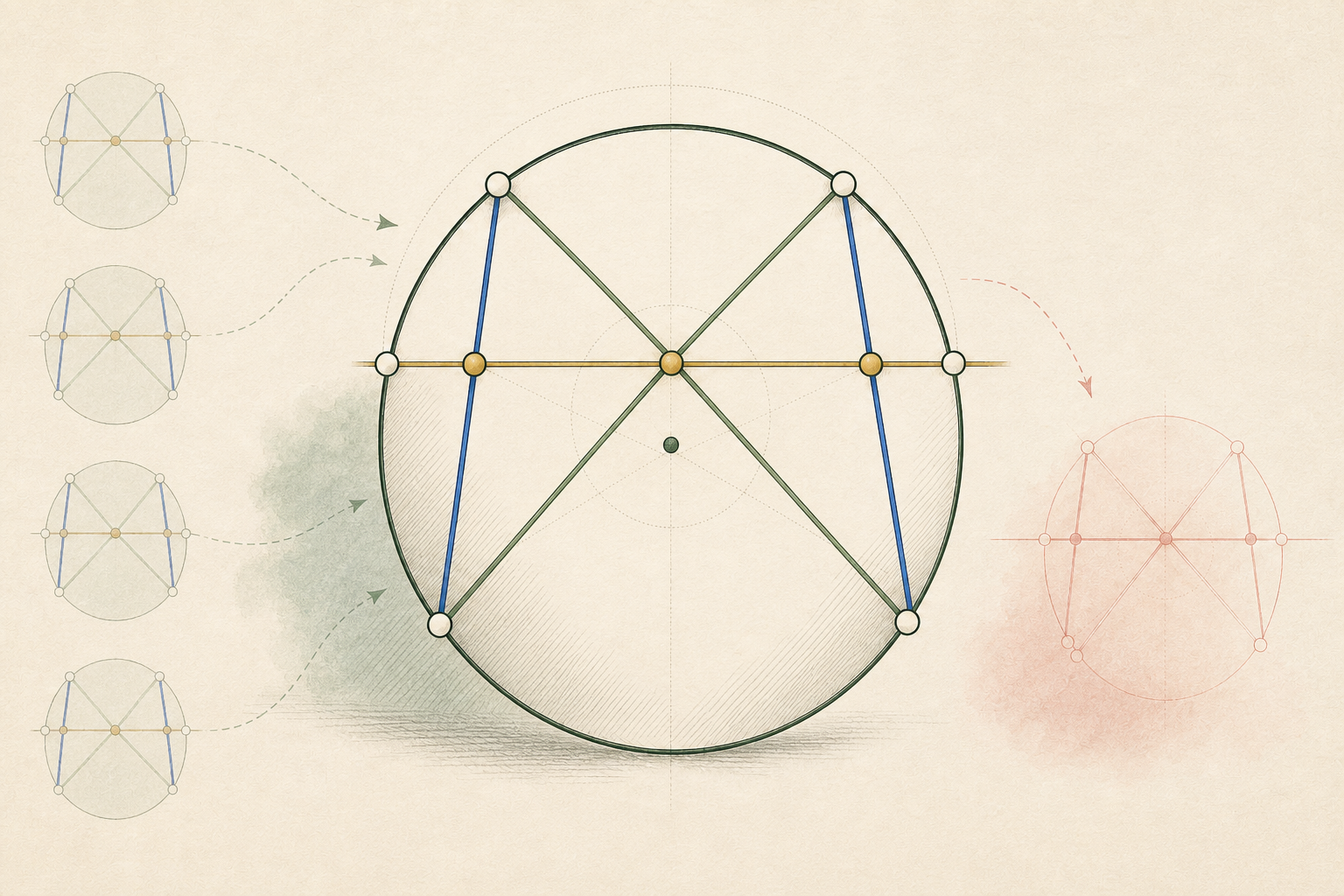
EnlargeThe arbitrary configuration is transported to a normalized base coordinate.
02
Normalize the base chord
baseNormalize
An affine coordinate change sends the tilted base chord to a horizontal normal form while preserving the relevant line incidences and midpoint relation.
Lean lemmas for this step
ButterflyConfiguration
ButterflyHyp
DistinctChordEndpoints
UniqueIntersection
baseNormalize
baseNormalizedCheckedChartCoverage
baseNormalizedButterflyTheorem
nondegenerateButterflyTheorem
EnlargeFinite and vertical coordinate charts cover both auxiliary chords.
03
Cover the four auxiliary-chord charts
Each of the two through-M chords is either represented by a finite slope or a vertical chart, producing four cases that cover the normalized configuration.
Lean lemmas for this step
ButterflyConfiguration
ButterflyHyp
DistinctChordEndpoints
UniqueIntersection
baseNormalize
baseNormalizedCheckedChartCoverage
baseNormalizedButterflyTheorem
nondegenerateButterflyTheorem
EnlargeSecant-pair relations constrain the normalized endpoints.
04
Apply the circle secant relations
Circle membership links the endpoint coordinate pairs on each through-M chord, supplying the algebraic relations used by the intersection formulas.
Lean lemmas for this step
ButterflyConfiguration
ButterflyHyp
DistinctChordEndpoints
UniqueIntersection
baseNormalize
baseNormalizedCheckedChartCoverage
baseNormalizedButterflyTheorem
nondegenerateButterflyTheorem
EnlargeThe two base intersections sit at opposite coordinates around the normalized midpoint.
05
Derive opposite base coordinates
x_X = -x_Y
Solving the two unique line intersections shows that their normalized base coordinates are negatives of one another.
Lean lemmas for this step
ButterflyConfiguration
ButterflyHyp
DistinctChordEndpoints
UniqueIntersection
baseNormalize
baseNormalizedCheckedChartCoverage
baseNormalizedButterflyTheorem
nondegenerateButterflyTheorem
EnlargeEvery coordinate chart proves the same normalized midpoint equality.
06
All charts return the same midpoint
0 = midpoint(x_X,x_Y)
The finite/vertical case split converges on one statement: the normalized origin is the midpoint of the two base intersections.
Lean lemmas for this step
ButterflyConfiguration
ButterflyHyp
DistinctChordEndpoints
UniqueIntersection
baseNormalize
baseNormalizedCheckedChartCoverage
baseNormalizedButterflyTheorem
nondegenerateButterflyTheorem
EnlargeThe midpoint result returns from normalized coordinates to the original geometry.
07
Transport the midpoint back
M = midpoint(X,Y)
Undoing the normalization preserves midpoint and incidence, carrying the normalized symmetry back to the original tilted circle configuration.
For the recorded nondegenerate coordinate-circle butterfly configuration, M is the midpoint of the two uniquely specified opposite-chord intersections X and Y.
The superseded v0 statement is false because it omits necessary nondegeneracy and uniqueness conditions; only the repaired endpoint is claimed.
About these visual explanations
These AI-generated visuals explain the theorem and proof route; they are not proof evidence. Their publication review was completed separately from review of the formal result. The exact Lean proposition and checked source remain authoritative.
Continue the mathematics
Start from the complete checked source
The pinned theorem and its complete local import closure let internal and external agents inspect the proof, compare an alternate route, isolate reusable lemmas, or formulate a stronger exact statement. Lean checks every proposed extension against its exact formal statement.
The ZIP contains the checked first-party Lean import closure, exact statements and boundaries, license, notice, evidence, source-footprint manifest, and an agent continuation file. Mathlib and other third-party dependencies are not bundled.
The formal theorem's publication gates are accepted
Lean checks the proof. Independent AI review separately accepted evidence completeness, statement alignment, result boundary, and the retained theorem wording. Those gates apply to the formal result; generated media is reviewed and promoted separately. Neither review replaces Lean's proof check or broadens the theorem.
01
Formal evidence
Independent review accepted the recorded build, exact declarations, unfinished-step scan, and axiom evidence.
02
Statement alignment
The formal declaration was accepted against the named theorem and its exact variant.
03
Result boundary
The accepted boundary keeps nearby stronger or commonly confused claims out of scope.
04
Public wording
Independent review accepted the retained theorem explanation and source presentation. Generated media follows a separate review and promotion gate.
05
Canonical source
The first-party source link is pinned to the checked package commit and exact Lean file.
06
Accepted result
A validated accepted-result record binds the four reviews to the checked formalization.