Projective geometry · formal theorem

Brianchon’s Theorem

For six recorded nonzero tangent lines to a nonsingular real projective conic, the three joins of opposite consecutive-line intersections are concurrent.

Lean proofpassed
Unfinished proof stepsNone
Formal resultAccepted
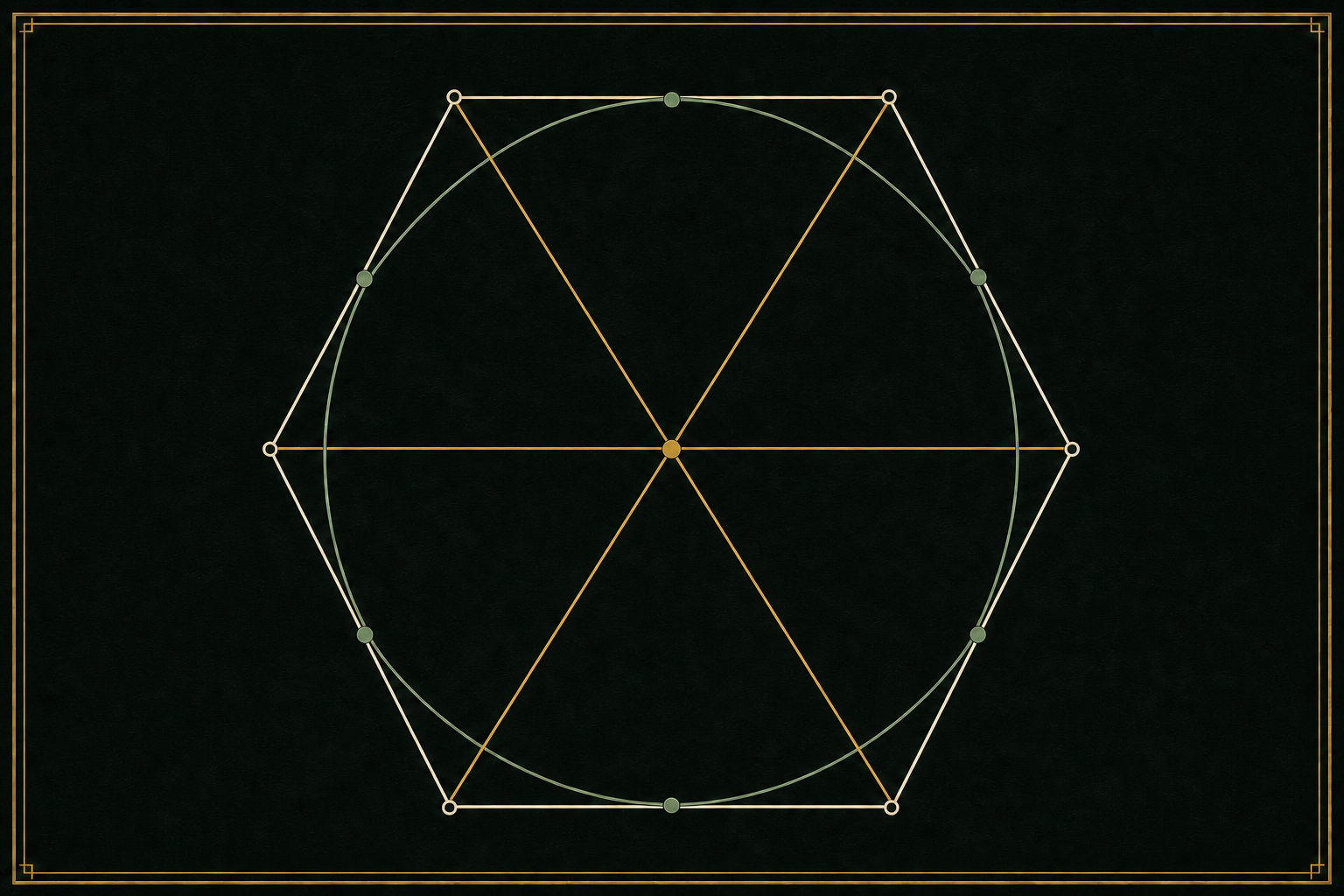
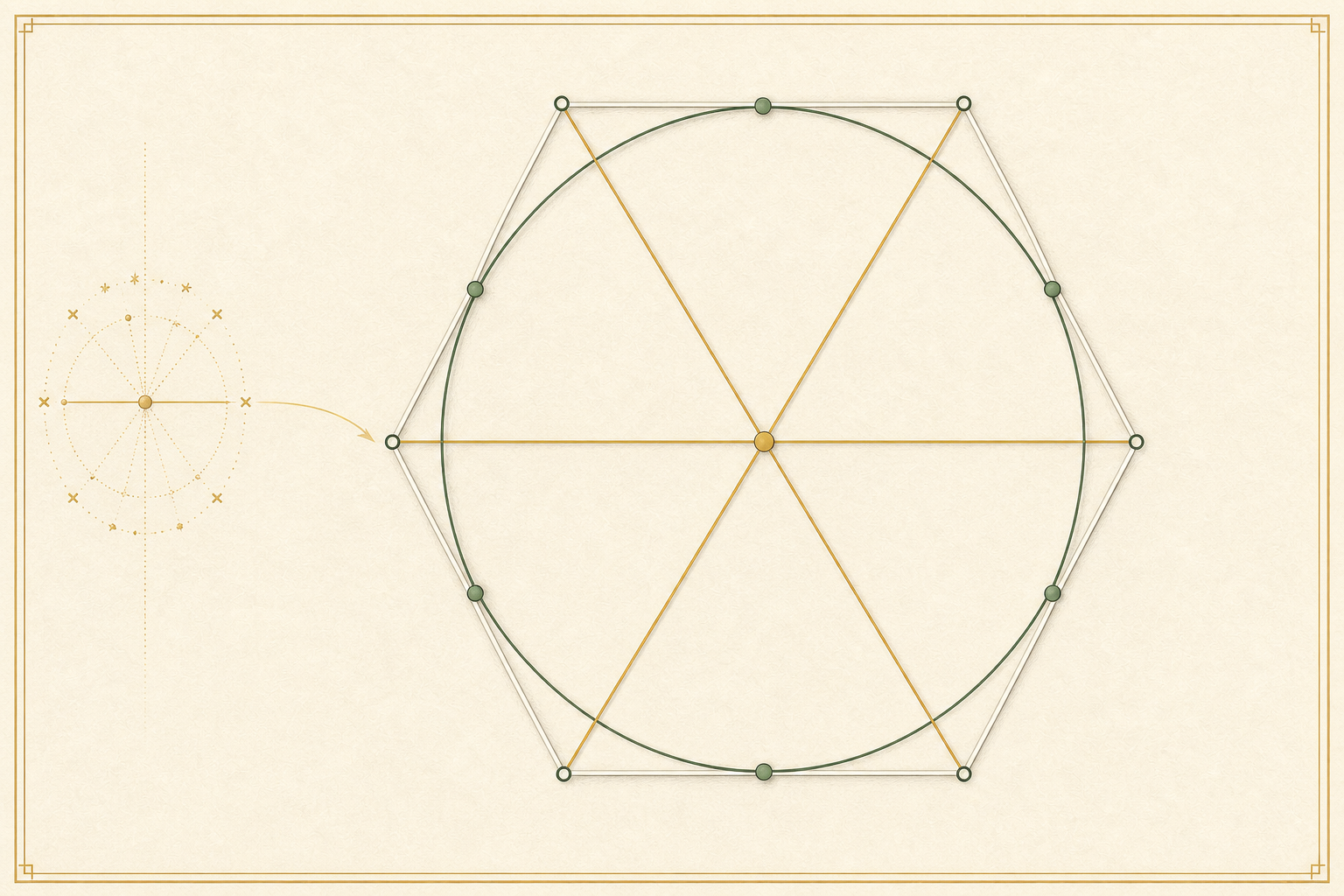
Brianchon theorem statement mapSix recorded nonzero tangent lines to a nonsingular conic determine three opposite-vertex joins, and those joins meet at one point.
Exact scope: For six recorded nonzero lines tangent to a nonsingular real projective conic, the three joins of opposite consecutive-line intersections are concurrent.

Line counts exclude blank lines; comments and documentation count. The total is the commit-pinned first-party Lean import closure; Mathlib and other third-party dependencies are excluded.

The theorem at a glance

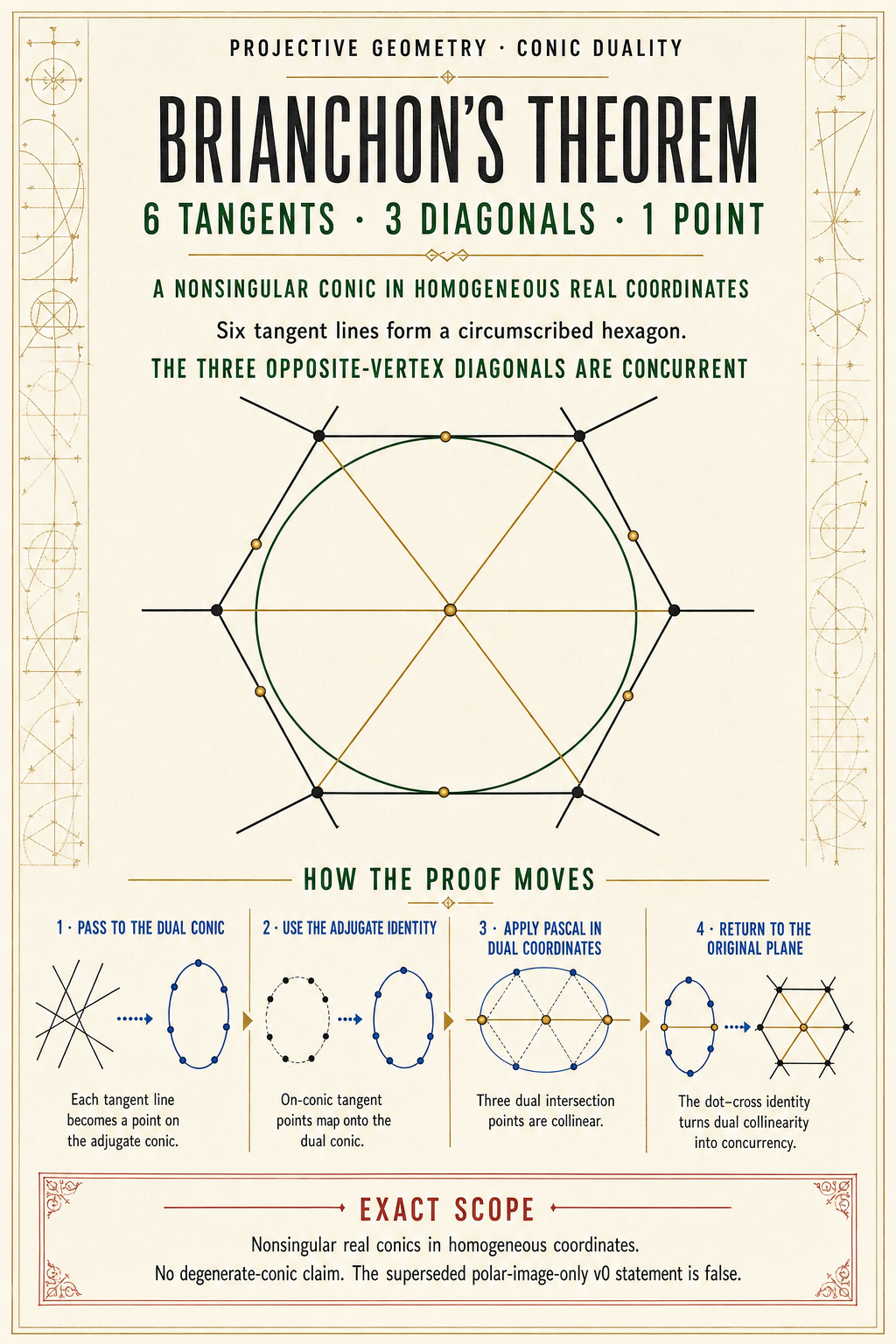
Brianchon’s theorem at a glance

Editorial projective-geometry poster with a conic, six tangents, three concurrent opposite-vertex diagonals, and the adjugate-duality proof route.
The checked nonsingular homogeneous-coordinate theorem turns dual Pascal collinearity into primal Brianchon concurrency.

Accessible transcript

dual Pascal collinearity ⇔ primal Brianchon concurrency

The adjugate matrix defines the dual conic, the tangent identity places the six dual points on it, algebraic Pascal makes three dual intersections collinear, and a dot–cross identity converts that line into the primal concurrency point.

Read the complete poster transcript

PROJECTIVE GEOMETRY · CONIC DUALITY

BRIANCHON’S THEOREM

6 TANGENTS · 3 DIAGONALS · 1 POINT

A NONSINGULAR CONIC IN HOMOGENEOUS REAL COORDINATES

Six tangent lines form a circumscribed hexagon.

THE THREE OPPOSITE-VERTEX DIAGONALS ARE CONCURRENT

HOW THE PROOF MOVES

1 · PASS TO THE DUAL CONIC

Each tangent line becomes a point on the adjugate conic.

2 · USE THE ADJUGATE IDENTITY

On-conic tangent points map onto the dual conic.

3 · APPLY PASCAL IN DUAL COORDINATES

Three dual intersection points are collinear.

4 · RETURN TO THE ORIGINAL PLANE

The dot–cross identity turns dual collinearity into concurrency.

EXACT SCOPE

Nonsingular real conics in homogeneous coordinates.

No degenerate-conic claim. The superseded polar-image-only v0 statement is false.
Theorem schematic

Six tangents, three opposite diagonals, one point

A nonsingular conic with six tangent lines forming a circumscribed hexagon whose three opposite-vertex diagonals meet at one gold point.
For the classical six-tangent configuration represented by the checked homogeneous-coordinate theorem, the three opposite-vertex diagonals are concurrent.

six conic tangents ⇒ three opposite diagonals concurrent

Brianchon’s theorem sends a circumscribed hexagon around a nonsingular conic to one concurrency point formed by its three opposite-vertex diagonals. The formal general-position predicate is weaker than the generic distinct configuration shown.

Proof architecture

From tangent lines to dual Pascal and back

4 curated stages

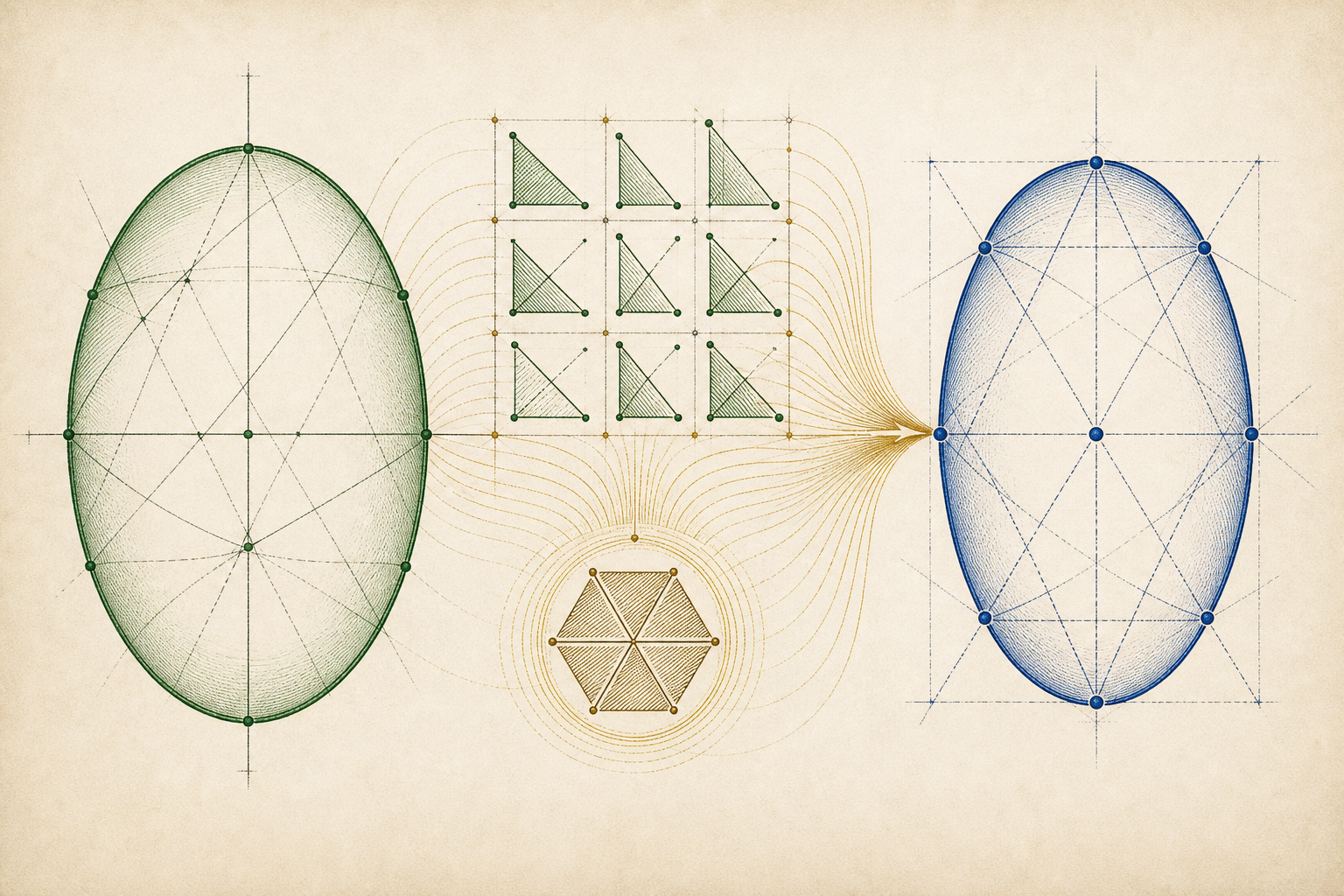
The checked proof maps tangent lines of a nonsingular homogeneous conic to points on the adjugate dual conic, applies an algebraic Pascal collinearity theorem there, and uses dot–cross duality to return to concurrence of the three primal diagonals.

These source-anchored stages explain the retained proof route. They are not an extracted Lean proof-term dependency graph.

  1. A homogeneous real conic is paired with its symmetric matrix and nonzero determinant condition.
    Represent the conic by a symmetric 3×3 matrix Q with det Q ≠ 0.
    01

    Encode the nonsingular conic

    q(x)=xᵀQx; det(Q) ≠ 0

    The proof begins with a symmetric homogeneous quadratic form whose matrix Q is nonsingular. This determinant hypothesis is exactly what makes the adjugate dual conic available.

    Lean lemmas for this step
    • quad
    • NonsingularConic
    • detSym
    • dualConic
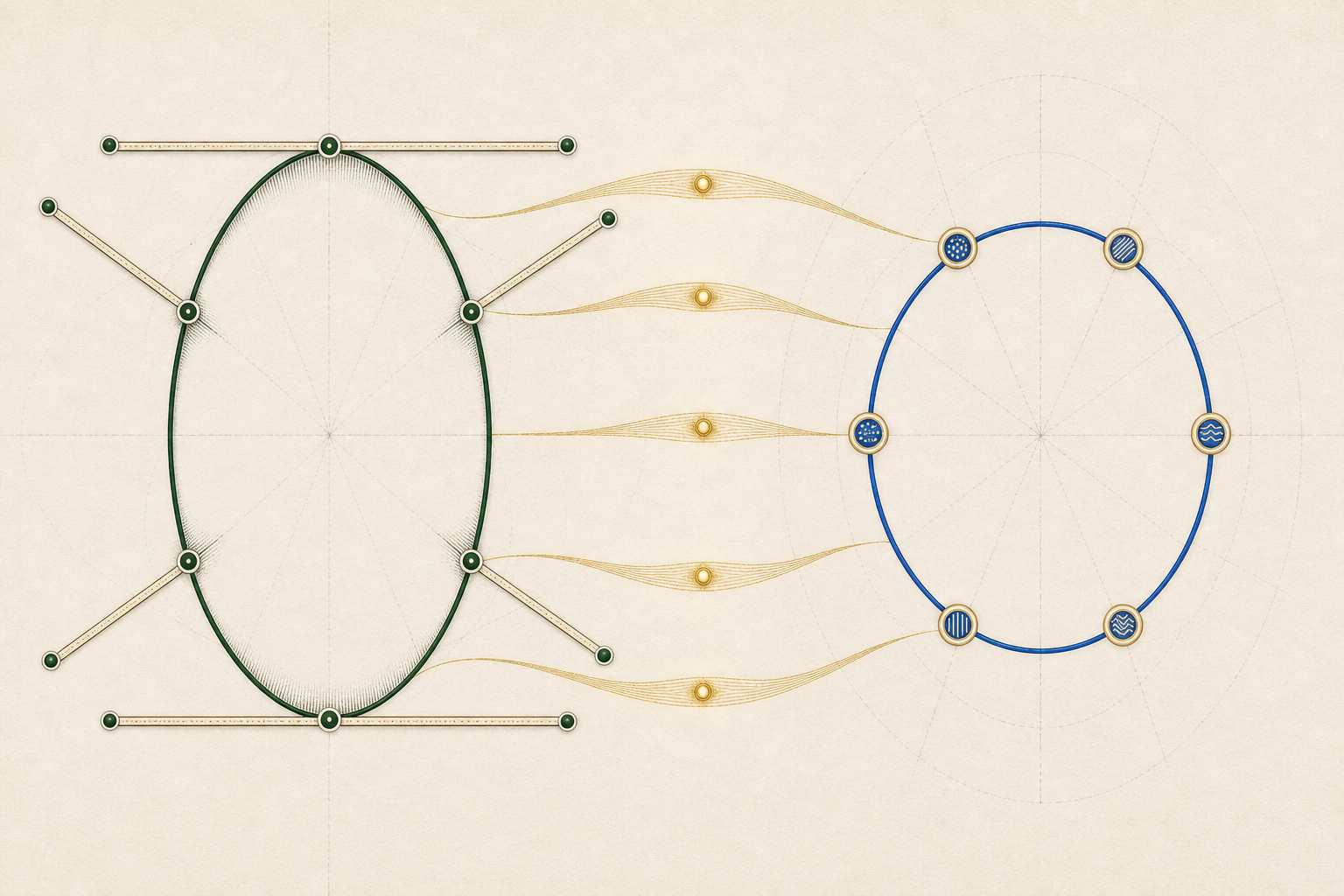
  2. Six tangent lines to a primal conic become six cobalt points on an adjugate dual conic.
    The tangent line at each on-conic point becomes a dual point satisfying the adjugate quadratic equation.
    02

    Send the tangent lines onto the dual conic

    dualQuad(Q t)=2 det(Q)·quad(t)=0

    For each selected point t on the primal conic, Q t gives its tangent-line coordinates. The identity dualQuad(Q t)=2 det(Q) quad(t) puts all six tangent lines on the dual conic.

    Lean lemmas for this step
    • tangentLine
    • dualConic
    • dualConic_tangentLine_quad
    • TangentToConic
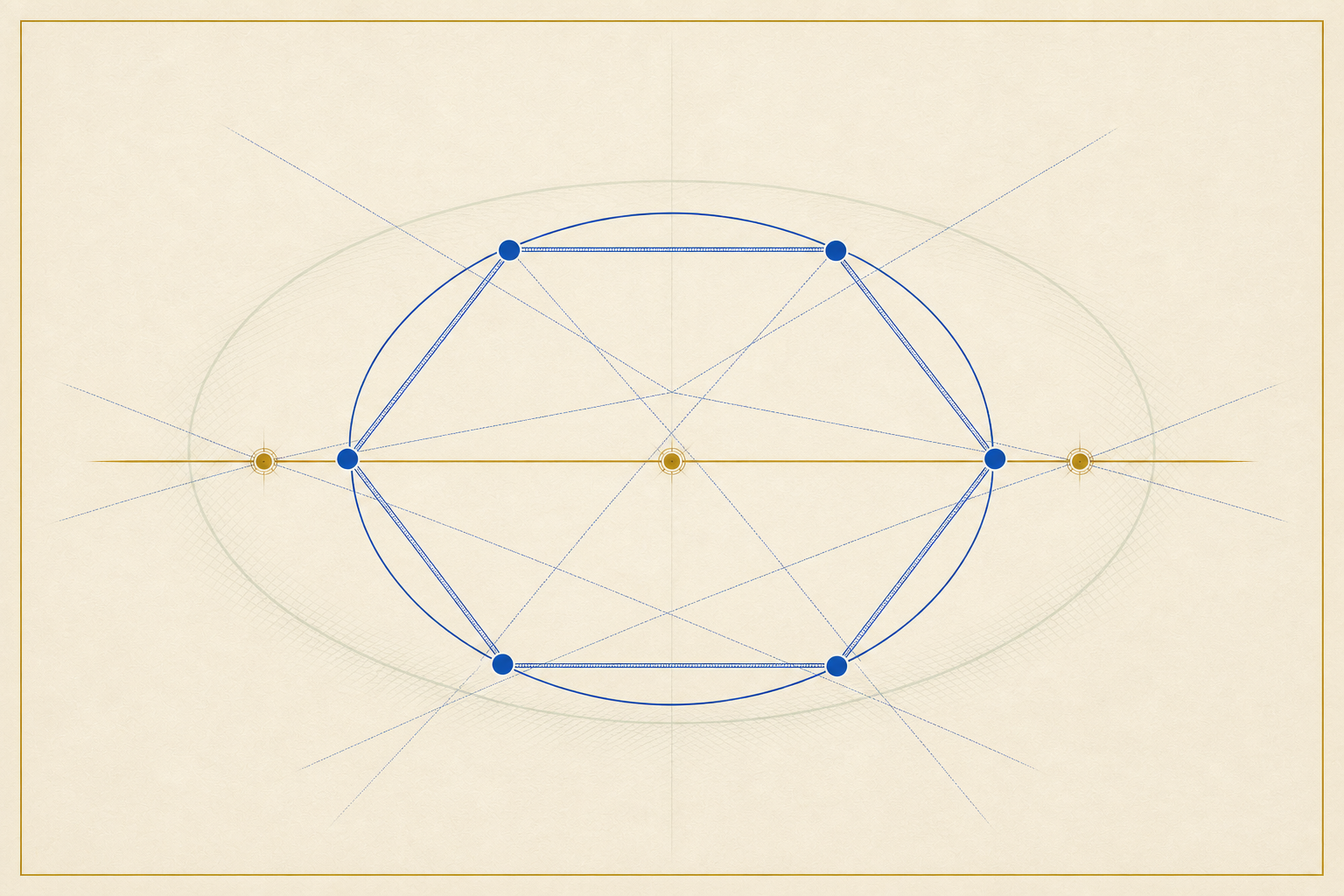
  3. Exactly six cobalt points lie on a dual conic while three gold intersections of opposite-side pairs lie on one line.
    Algebraic Pascal makes the three intersections formed from opposite side pairs of the dual hexagon collinear.
    03

    Apply Pascal to the six dual points

    Pascal dual intersections P₁,P₂,P₃ are collinear

    The six dual tangent points satisfy the algebraic Pascal hypotheses. Intersecting the three prescribed pairs of opposite sides yields three dual points on one common line.

    Lean lemmas for this step
    • pascalTheorem_algebraic
    • pascalPoint₁
    • pascalPoint₂
    • pascalPoint₃
    • Collinear
  4. Three opposite-vertex diagonals of a circumscribed hexagon meet at one gold point, paired with the collinear dual data.
    The dot–cross identity translates the Pascal line in the dual plane into one common point of the three primal diagonals.
    04

    Dual collinearity becomes primal concurrency

    det(P₁,P₂,P₃)=0 ⇒ D₁,D₂,D₃ concurrent

    Cross products encode primal vertices and diagonal lines. The dot–cross identity identifies incidence with the dual collinearity determinant, so the three opposite-vertex diagonals share one point.

    Lean lemmas for this step
    • dot_cross_cyclic
    • concurrent_of_dual_pascal
    • lineThrough
    • brianchonTheorem

Exact formal proposition

Hypotheses and conclusion

theorem brianchonTheorem : BrianchonTheoremStatement

Result boundary

What this page does—and does not—establish

For six recorded nonzero lines tangent to a nonsingular real projective conic, the three joins of opposite consecutive-line intersections are concurrent.

About these visual explanations

These AI-generated visuals explain the theorem and proof route; they are not proof evidence. Their publication review was completed separately from review of the formal result. The exact Lean proposition and checked source remain authoritative.

Continue the mathematics

Start from the complete checked source

The pinned theorem and its complete local import closure let internal and external agents inspect the proof, compare an alternate route, isolate reusable lemmas, or formulate a stronger exact statement. Lean checks every proposed extension against its exact formal statement.

The ZIP contains the checked first-party Lean import closure, exact statements and boundaries, license, notice, evidence, source-footprint manifest, and an agent continuation file. Mathlib and other third-party dependencies are not bundled.

Formal-result publication and review details

Independent publication review

The formal theorem's publication gates are accepted

Lean checks the proof. Independent AI review separately accepted evidence completeness, statement alignment, result boundary, and the retained theorem wording. Those gates apply to the formal result; generated media is reviewed and promoted separately. Neither review replaces Lean's proof check or broadens the theorem.

01

Formal evidence

Independent review accepted the recorded build, exact declarations, unfinished-step scan, and axiom evidence.

02

Statement alignment

The formal declaration was accepted against the named theorem and its exact variant.

03

Result boundary

The accepted boundary keeps nearby stronger or commonly confused claims out of scope.

04

Public wording

Independent review accepted the retained theorem explanation and source presentation. Generated media follows a separate review and promotion gate.

05

Canonical source

The first-party source link is pinned to the checked package commit and exact Lean file.

06

Accepted result

A validated accepted-result record binds the four reviews to the checked formalization.

Expanded visual

Open original image in a new tab